Saturday, February 28, 2015

Mindfulness of the Buddha

(Udumvara flower)

This is a book review of The Life of the Buddha (Penguin Classics). As noted in a previous blog, the book was written by Tenzin Chogyel in Bhuttan about 250 plus years ago. He's in the Kagyu sect of Buddhism, so the Buddha taught the Mahayana ideals and the tantric spells. This new translation is a blessing. I think it's the first one of this text. It makes me wonder how many other great texts are out there untranslated.

The literature of Buddhism is vast and it can take a long time to read it even with what is already translated. There is even the phenomenon of book buddhists, people who read Buddhist books and find them quite enjoyable and in harmony with their aspirations. I have a similarly modern approach to Buddhism that at the beginning involved a lot of books before I took the plunge into sangha and meditation. There are also tattoo Buddhists, people who put a Buddha on their body, but don't really know much about Buddhism. There are Buddhist who think it's presumptuous to read these texts and meditate, because they've been told it's only for the monks. There's all kinds of Buddhism and there is also a unique form blossoming in America and other countries that where not traditionally Buddhist.

My experience is that Karen Armstrong's biography of the Buddha is a fair place to start. Even though she's not a Buddhist, she's a great spiritual writer. The best book is the collection of biographical elements, by Nanamoli. (The Life of the Buddha: According to the Pali Canon). There is a bibliography of recommended books that include Nanamoli and some other books I'm hoping to get to. It's fun to see the differences in this version. Like he had 32 nursemaids as a baby. Vivshpani Blomfeeld's book on the Buddha wasn't on the list, but that's a deep meditation on the Buddha that included stuff I didn't see elsewhere. Unfortunately it's not in print in America, so you can buy a used copy or an electronic version.

I can't remember the scriptures that talk about a fellow who's meditation practice was just to recall his experiences with the buddha, and thinking about the Buddha. Recollecting the Buddha is a positive thing. When I hit on a theme, I chant a mantra that is most appropriate throughout the day. I chant the Buddha mantra. You can also imagine him with you during you day.

There are issues with the miracles. As a modern skeptical person, sometimes it's not clear for me how to translate things from literal to mythical. What does it mean to be born out of the side of someone, instead of coming out the vagina? Do they think women are dirty? Is that misogyny? At the very least it signals him as someone unique who begins talking right after birth. I take it that he has done so much work in his previous lives, that he really hits the ground running.

I don't really have to make sense of it, I can just enjoy it. I've been writing about re-enchanting life, and this account of the Buddha's life certainly does that from a Bhutanese Kagyu perspective 250 plus years ago. There are some interesting little sketches: Mara doodles in the dirt after the Buddha moves past him. There are sections where the devotional writing is inspirational.

If you're looking for your first biography or even second, I might miss this one because you might get some sectarian impressions of the Buddha's life (unless that is your school, of course, or you're considering that school). But if you've read a few biographies and wish to contemplate the Buddha in a new translation, this is a pretty good little book. 

Sunday, February 22, 2015

Tenzin Chogyel

No much can be found about Tenzin Chogyel on line. There's a living musician with a similar name. Tenzin Chogyel lived from 1701-1767, two hundred years before I was born. He wrote a version of the Buddha's life that Penguin thought to publish a new translation. Maybe Kurtis R Schaeffer translated it, and then looked for a publisher. Either way, I'm glad they both extended the effort. This is a beautiful text that I have not read before.

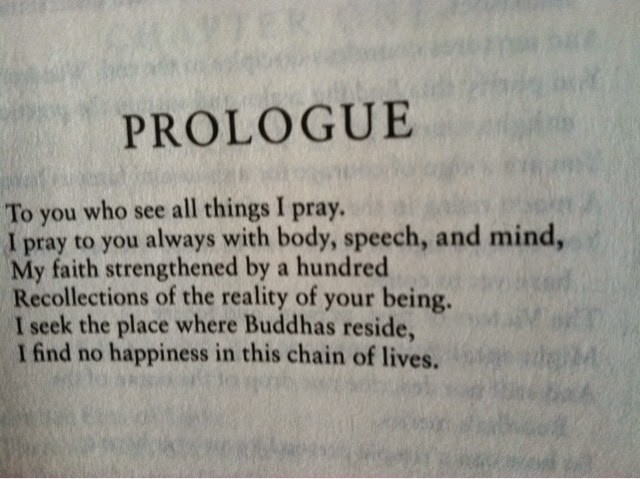
There is a beautiful rupa on the cover. I took a picture of the opening.


I got frustrated with the introduction but I read most of it. The first few chapters are very inspiration, it's inspired writing. I could imagine chanting the whole book over a night, like I have read the Diamond Sutra passing the book around the shrine room.

Tenzin Chogyel was from Bhutan, and was the head man of religious affairs for a while. It's suggested that this work was meant for new students. He's part of the Kagyu sect, which is  a red hat sect, along with Gelug and Sakya. The Kagyu sect has many sub-sects.

I went on line to see if there are any flights to The Eagle's Nest, and I couldn't get a flight to Bhutan after looking at about 20 websites, but then I realized I was only looking at American flight. It looks more complicated to find flights though. Looks like they have similar seasons to the US, July is the hottest month, January is their coldest month. They're supposedly making the biggest statue of the Buddha. Wish I could just fly there now, if it was just to update Wikipedia.

quote

The Life of the Buddha (Penguin Classics) p. 4

"Proud fools rest ever in their errors
Saying senseless things in greed hatred and ignorance."

Saturday, February 21, 2015

Re-enchantment


Walking by a beautiful statue of the Virgin Mary, I didn't have that enchanted feeling. I've been asking myself do I need to re-enchant life? There was a time when I saw a Buddhist rupa, that I wanted to bow down and prostrate to the spiritual ideals. The reverence for the wise ones had an enchanting spell. That was when I was meditating a lot, when I was reading a lot, when I was spending a lot of time with spiritual friends. I've worked myself into very alert states. But inevitably the retreat would end and I would go back to my workaday life. There were times when I would meditate at lunch, so excited from a retreat, that I ended up meditating 2 times a day, sometimes three. I have done pujas, where I felt a kind of bliss and the mantras felt magical. I can begin to approach those things. But my question is whether that is necessary. Do I need that spiritual high to sustain my life, or can I do a kind of "nothing special" approach. One of the aspects of Buddhist modernity is that I'm aware of all the choices. I don't go to the local guy and learn what he learns. In an modern open source Buddhism, I can see all the options, try them on. People will say you lose something by not committing to one tradition, and I'm sure there is more truth there than just the branding and the sectarian thinking. Any good tradition guards the deeper practices to protect the spiritual aspirant from spiritual indigestion, from eating too many rich practices. There is a system of practice. To flit from system to system, you don't get deep into the system. On the other hand some people have said it's easier to get enlightened than to get ordained into some systems, but each sect has a right to control who is teaching that sect. There are slick teachers, who turned out to be sleeping with everyone, and that shows a kind of disconnect from the ideals. Honest and sincere isn't always the slickest. Some movements don't have a charismatic leader. The system is more important than any individual teacher, which reminds me of the San Antonio Spurs in the NBA. The system is the star, not the individual players on the team, the team is the star. It's quite possible the best teacher for you isn't some famous person, or even advanced person, maybe someone closer to your level who has struggled like you, and can say it was worth it, could be a better teacher.

Back to my question, does my spiritual life need to be re-enchanted? What would it give me? Would it add power and focus to my meditation? Would it help me to study more? Would it help me to find sangha? What is it about an enchanted spiritual life would be useful?

The Life of the Buddha (Penguin Classics) came in the mail today. Looking forward to dipping into this, back to basics.


Sunday, February 15, 2015

the positive side of dreams

I found this post amongst my drafts and I thought I would post it....


Felt I should follow up on yesterday's post about escapism with further meditations and thoughts.

Dreaminess isn't all bad, and it's part of the process of developing your vision, reaching for am much as you can. I watched the updated Walter Mitty, based on the Thurber story yesterday with my sons, and in this version Walter Mitty changes his core personality in the end and is a doer and not just a dreamer. I think that evolution is possible for everyone.

I read a book about daydream interpretation, the point being you can interpret those as well, and that thinking about them can be really useful.

The negotiation between dreams, limited resources, planning ahead and accepting opportunity costs is all very important.

I'll end with Langston Hughes' famous poem.

Harlem BY LANGSTON HUGHES

What happens to a dream deferred?

Does it dry up
like a raisin in the sun?
Or fester like a sore—
And then run?
Does it stink like rotten meat?
Or crust and sugar over—
like a syrupy sweet?

Maybe it just sags
like a heavy load.

Or does it explode?

the positive side of dreams


Felt I should follow up on yesterday's post about escapism with further meditations and thoughts.

Dreaminess isn't all bad, and it's part of the process of developing your vision, reaching for am much as you can. I watched the updated Walter Mitty, based on the Thurber story yesterday with my sons, and in this version Walter Mitty changes his core personality in the end and is a doer and not just a dreamer. I think that evolution is possible for everyone.

I read a book about daydream interpretation, the point being you can interpret those as well, and that thinking about them can be really useful.

The negotiation between dreams, limited resources, planning ahead and accepting opportunity costs is all very important.

I'll end with Langston Hughes' famous poem.

Harlem BY LANGSTON HUGHES

What happens to a dream deferred?

Does it dry up
like a raisin in the sun?
Or fester like a sore—
And then run?
Does it stink like rotten meat?
Or crust and sugar over—
like a syrupy sweet?

Maybe it just sags
like a heavy load.

Or does it explode?

Saturday, February 14, 2015

Escapism


One time on retreat, a woman suggested that sport talk radio was escapism. I was surprised at how quick the denial came out of my mouth, and I say today that sports fandom is escapism. As a person working hard to squeeze out the most meaningful life, I ended up in social work, and this has been a challenge because I can be a sensitive person. Even worse, now I'm in child welfare, which is for the thickest of the skins. No Rogerian unconditional positive regard. There are systems of condescension and blame. I thought I heard the worst stories of abuse in the female prison I worked in. Well, child welfare has them too. The secondary trauma of listening to trauma is perhaps what the social worker hopes to master as the wounded healer.

I sat down to read a book about one my new escapist subjects (How Soccer Explains the World: An Unlikely Theory of Globalization ), soccer, and walked into grim descriptions of hooliganism in Serbia and Croatia. At least I had been warned the book started out negative and then got progressively more positive as it went along.

And then there's the entitlement of compensatory indulgences, the feeling that I dislike being put upon so much to work, that I have the right to gork out on light ensemble friendship sitcoms while playing video games.

And then there's the pure laziness, the immaturity of only wanting to do what I want to do. There are times when I subjugate myself so much for others, that I go on strike. I actually love giving to others, but sometimes I feel needy.

My flawed human approach to Buddhism was a reflection of my own personality and sometimes what I presented gave people the impression of escapism. That should have been a sign. Life teaches you the same lessons over and over until you get it. Don't imagine my escapism tinged Buddhism is the real Buddhism, I think it's counter to that actually. Meditation is about facing your experience, instead of running after the various escapist sticks, turning to the stick thrower. Engaged Buddhism is about facing problems in society and yourself. Not escapist at all.

So like this family the father sees his face in everyone, I see myself in my escapism. It is everywhere.


source

Sunday, February 08, 2015

Billy Collins poem

Shoveling Snow with the Buddha (Billy Collins)

In the usual iconography of the temple or the local Wok
you would never see him doing such a thing,
tossing the dry snow over a mountain
of his bare, round shoulder,
his hair tied in a knot,
a model of concentration.

Sitting is more his speed, if that is the word
for what he does, or does not do.

Even the season is wrong for him.
In all his manifestations, is it not warm or slightly humid?
Is this not implied by his serene expression,
that smile so wide it wraps itself around the waist of the universe?

But here we are, working our way down the driveway,
one shovelful at a time.
We toss the light powder into the clear air.
We feel the cold mist on our faces.
And with every heave we disappear
and become lost to each other
in these sudden clouds of our own making,
these fountain-bursts of snow.

This is so much better than a sermon in church,
I say out loud, but Buddha keeps on shoveling.
This is the true religion, the religion of snow,
and sunlight and winter geese barking in the sky,
I say, but he is too busy to hear me.

He has thrown himself into shoveling snow
as if it were the purpose of existence,
as if the sign of a perfect life were a clear driveway
you could back the car down easily
and drive off into the vanities of the world
with a broken heater fan and a song on the radio.

All morning long we work side by side,
me with my commentary
and he inside his generous pocket of silence,
until the hour is nearly noon
and the snow is piled high all around us;
then, I hear him speak.

After this, he asks,
can we go inside and play cards?

Certainly, I reply, and I will heat some milk
and bring cups of hot chocolate to the table
while you shuffle the deck.
and our boots stand dripping by the door.

Aaah, says the Buddha, lifting his eyes
and leaning for a moment on his shovel
before he drives the thin blade again
deep into the glittering white snow.

Tuesday, February 03, 2015

Free Will

"Just as a ball of string that is thrown, will run away always unwinding, even so the fool and the wise running on, circling around, will eventually make an end of suffering." DN i.53-55

Jayarava has a great blog about free will, and he really reads the texts closely. Optimistic determinism of sorts as far as I can tell.

Saturday, January 31, 2015

Free will and addiction


In the disease model of addiction, it is nice in that it counters some of the heaping moral blame. Blame the victim is fairly standard in the good old USA, another self defeating philosophy amongst many. You can find a few articles on line about the disease model of addiction and free will.

The good old USA, we have a kind of wacky political bifurcation, either you follow that party line or this party line, and neither the twain shall meet. Either you believe in personal responsibility and ignore other social factors, or you look at other social factors, and you don't harp on personal choice. I feel like you can do both, and we don't need to entrench into partisan sniping.

The physiological element to addiction makes it very rewarding, and to quit is hard, mere exertion of will doesn't really make it so.

In Buddhism, we work to transcend our conditioning and not be reactive, to be creative. There's probably a percentage of free will, creativity, and we're looking to increase the percentage.

There's a lot emphasis on improving condition, creating the conditions that will lead to enlightenment. Improving conditions is an important way of working towards moving toward enlightenment.

Once someone is addicted, and you have the cycle where more and more is required to get the high as you habituate to the drug. Moral judgements don't stop people from using, it contributes to feeling bad about yourself and that leads to more use. Recovery has to be a choice, moving out of attraction and not just avoidance.

There's also a generic element in our genome. Before for water treatment, putting wine into your water killed bacteria and having the gene helped you to survive.

Addiction is very complicated. Free will and blame are in an interesting dance with the issues of addiction.

My first philosophy class was about free will. The Christians who want it because they need it to solve the problem of evil were heavily invested in it. How can an all knowing and all powerful god make something bad happen. The answer is free will. But if you don't have that commitment, the need to have it is less. On the other side, the materialists, who think only the stuff of physics exists, they have a need to defer to physicist, which is a much more muddy picture at this point, but could be an anti-free will position, determinism.

I like the idea of free will, even if it's not true, at least psychologically. Focusing people on their choices can help one to actually reflect on them, and in error analysis. If determinism is true, then I can't help but like the idea of free will.

The magical thinking involved in substance abuse is amazing. Working with substance abuse is interesting in that often times mental health professionals want to ceed that territory to substance abuse counselors. There are some that cross over, and the MICA tradition addresses both issues.

BTW, my sons interrupted me a million times while I was writing this post, so I apologize for any incoherence. 

Friday, January 30, 2015

Hotai in a frump hat


McMahan on Suzuki

P. 133 of The Making of Buddhist Modernism:

"Suzuki's insistence that the enlightened person transcends social conventions and prescribed morality, realizing intuitive action as the vehicle of nature, reconfigures and radicalizes Rousseau's primitivism."

Tuesday, January 27, 2015

Once In A Lifetime


And you may find yourself living in a shotgun shack
And you may find yourself in another part of the world
And you may find yourself behind the wheel of a large automobile
And you may find yourself in a beautiful house, with a beautiful
wife
And you may ask yourself-Well...How did I get here?


Letting the days go by/let the water hold me down
Letting the days go by/water flowing underground
Into the blue again/after the money's gone
Once in a lifetime/water flowing underground.


And you may ask yourself
How do I work this?
And you may ask yourself
Where is that large automobile?
And you may tell yourself
This is not my beautiful house!
And you may tell yourself
This is not my beautiful wife!
Letting the days go by/let the water hold me down
Letting the days go by/water flowing underground
Into the blue again/after the money's gone
Once in a lifetime/water flowing underground.


Same as it ever was...Same as it ever was...Same as it ever was...
Same as it ever was...Same as it ever was...


Water dissolving...and water removing
There is water at the bottom of the ocean
Carry the water at the bottom of the ocean
Remove the water at the bottom of the ocean!


Letting the days go by/let the water hold me down
Letting the days go by/water flowing underground
Into the blue again/in the silent water
Under the rocks and stones/there is water underground.


Letting the days go by/let the water hold me down
Letting the days go by/water flowing underground
Into the blue again/after the money's gone
Once in a lifetime/water flowing underground.


And you may ask yourself
What is that beautiful house?
And you may ask yourself
Where does that highway go?
And you may ask yourself
Am I right?...Am I wrong?
And you may tell yourself
MY GOD!...WHAT HAVE I DONE?


Letting the days go by/let the water hold me down
Letting the days go by/water flowing underground
Into the blue again/in the silent water
Under the rocks and stones/there is water underground.


Letting the days go by/let the water hold me down
Letting the days go by/water flowing underground
Into the blue again/after the money's gone
Once in a lifetime/water flowing underground.


Same as it ever was...Same as it ever was...Same as it ever was...
Same as it ever was...Same as it ever was...


Sutta Nipata 4.15

Seeing people floundering
     like fish in small puddles,
     competing with one another — 
               as I saw this,
               fear came into me.
     The world was entirely
               without substance.
     All the directions
                                    were knocked out of line.
     Wanting a haven for myself,
     I saw nothing that wasn’t laid claim to.
     Seeing nothing in the end
     but competition,
     I felt discontent.
              —Sutta Nipata 4.15, trans. Thanissaro Bhikkhu

Saturday, January 17, 2015

Meditating with a new cat

Anandi enjoys cats, and she waited an appropriate time after Oscar died, and then she decided she wanted rescue cats from the shelter. She adopted Ella and Lulu (originally Booboo and Cupcake). They were fixed free of charge, and their first vet visit is free if done within a certain time limit. We got the cats the next day, because they don't perform an operation on a cat that they will eventually put down. They used the phrase "no longer available" to describe one cat. There are no snuff shelters but the city one is not one of those. Here's the search site if you're looking for a cat in NYC. The place is pretty disturbing but it feels good to snatch a cat from the jaws of extinction. I wanted to adopt them all. Talking to one of the workers there, we asked her how she does it. She said she'd avoided it for quite a while, but finally she was able to accept the situation. You can volunteer there if you like animals. And I guess that's where you can go if you have to get rid of an animal and you can't find someone to take it. Luckily my aunt took my cats when I moved and couldn't take my cats. And she got someone to take the cats when she moved.

They are obviously traumatized from living in the shelter, and who knows what before that. I call them scairdy cats sometimes. Each day they relax their vigilance brought on by the traumas of their past.

We sat down to meditate for the first time since getting them today, and Ella was clawing at Anandi's foot.


Ella proceeded to snuggle in, head butt her. She brushed by me. We laughed. And that was all after chasing the bird off the air conditioner near our shrine.

As always, you focus on the breath. The cats will learn we don't pet them when we're meditating. But they did like it when we finished.


Perennialism

The Making of Buddhist Modernism is really eye opening in that it discusses how other ideas are used to articulate Buddhism in the modern world, as a reaction to imperialism, as the first wave of western converts articulate what they like about it. What does it mean when traditionalists can see meditating as presumptuous, and the plethora of printed English Buddhism that has created a kind of western bookish Buddhist? I'm going to riff, with my thoughts from reading the book, but in no way are my thoughts either a review of the book or some scholarly paper themselves. This is a personal blog post.

Perennialism is the idea that all religions participate in the ultimate truths. This contrasts with perhaps the Buddhist who feels that it's the Buddha's experience that matters, and that there isn't some universal kind of truth it participates in.

As I delve into the book, I'm don't think I want to be a traditionalist, and I think it's OK to blend modern ideas with Buddhism. I don't necessarily think science has the best truths, or that Buddhism is more scientific than other religions. But I do believe in pluralism and multiculturalism instead of separatism or the importance of erasing differences.

Perennialism really helps in the exclusive truth wars. I've written in the past about friends who think religion necessarily leads to people feeling closer to the truth and that leads people towards conflict. A modern mindset is inclined to think that truth is more of a function of a system, learning the lessons from Godel's Incompleteness theorem. That you can't prove the truth of a system without referring to the system, and that just makes it all a kind of game. There is no super system that explains it all. That points to a kind of pragmatism, just noticing what each system does, and resisting reduction or assimilation into other systems. Perennialism functions to promote harmony, and not discord, and whether it's true or not. Nobody needs to be colonized or converted, we're all on the same journey. The only danger could be to ignore differences and history.

The modern world has allowed for more open source Buddhism, that teachings are available. We don't need a system that concentrates the information into the powerful hands of a central authority. We don't need to have an allegiance to one kind of Buddhism, we can love the variety and appreciate the spirit of certain teachers, even if we don't believe in the system they created. We own our own spirituality and have the responsibility of finding out what works for us. Now you can lose some depth by not committing to one tradition and there will be people that will tell you you should only shop exclusively in their bookshop, but most people see through that. They see it as branding, a sales pitch.

The lack of a cohesive system and community can be an outgrowth of open source Buddhism. The real living traditions that actually exist are more traditional.

I like to be around other people of different traditions, and I get the feeling I sometimes get when I'm with sangha. Even outside of Buddhism.

So it think the trick is to have a community, with a tradition, but that also allows for independent thinking. And being aware what is Buddhism and what is not Buddhism. What does our modern culture add in to adapt Buddhism to our times, and what do we gain and lose by doing that? I don't like sectarianism, but loosey goosey doesn't always work either. Buddhism without beliefs is wonderful, but Stephen Batchelor has not founded a sangha. He visits other sanghas and organizations. People come to hear him teach, but he does not present a system for spiritual development.

I think perennialism, which would be hard to prove, does function in a harmonizing multicultural way.

Sunday, January 04, 2015

what is a Buddhist?


McMahan talked about modern existence, and being disenchanted, and that we are looking for re-enchantment.

I'm not sure which I want. There were times in my life when I saw a rupa and had a visceral desire to prostrate myself to it, even though I was in a museum. I have done the prostration practice to the TBC refuge tree. On the other hand I would also like to just tolerate not knowing and not necessarily multiply entities beyond their necessity. I like the idea of Padmasambhava pinning down demons, but I also interpret that psychologically. I see great psychological benefit in thinking archetypically, but don't think there are unseen spirits beyond my mind.

I am deeply suspicious of "organized religion". I do feel the differences between myself and other Buddhists. One time a waitress had a Buddhist necklace on. I asked her if she was a Buddhist. She said yes. I asked her if she meditated, and she said no. I didn't even know at the time if she could have considered it presumptuous for me to meditate. I did not even know that.

I sat at a Wesak celebration onces, where Sri Lankan children played out various aspects of the Buddha's life in play. It felt weird to see that because the children were kind of being force, and the parents were so proud of their children for doing this thing they seemed to feel put upon. For me Buddhism is a choice that goes counter to the dominant culture I am surrounded by. To be sure in New York City, there is multiculturalism, but outside of NYC, there is a kind of Christian fog hanging over America.

At one point I was exploring various centers. I went to one where I was talking to a monk outside. I thought we were having an interesting conversation until he abruptly stopped the conversation to open the door for a Chinese woman to enter the temple. I got the message. This is for Chinese people. I have no problem with his commitment to cultural Buddhism. I even wish for an American Buddhism, though that's going to take hundreds and hundreds of years. I tried to read a memoir by a guy who grew up in a Zen family. I didn't really detect much that was Buddhist about it, it was more about how his journey was impacted by having Buddhist parents. He seemed to be into Buddhism, but it also seemed to be going with the flow, and not something he committed to. Perhaps he did later in the book, I honest could not finish the book, not much was happening and "hey look I grew up in a Zen family" wasn't enough for me.

McMahan has a term called Buddhist sympathizer, which he got from Thomas Tweed. I had a Buddhist t-shirt that said, "I am a Buddhist" and it was shouting it out loud. I remember once time in a cafe in Santa Fe someone laughed at the idea. I suppose they wondered why would someone have to shout that. I feel the need to distinguish myself from Christians, and to raise the profile of American Buddhists. Coming from NYC I feel as though what ever my religion is, that is fine, and that it won't hinder me to be Buddhist.

When I was a therapist I had a few patients that followed Soka Gakki. I didn't really feel like we had a common ground. My understanding is that they hoped, that by chanting a mantra about their devotion to the Lotus Sutra, to be reborn in a pure land where they could then become enlightened.  I was hoping to move towards enlightenment through my own personal efforts. I do think we need other power to help us, why not, but for me there's more of a personal responsibility.

In discussion with a friend on retreat, he thought it was pretty controversial to feel like you had to do it in one life time. Another friend says that it's hard to imagine the life force energy doesn't go somewhere after they die. Another friend suggested to me that the only important thing about reincarnation was that I kept an open mind to it, and I later read how Sangharakshita asserted that there was no Buddhist movement that didn't include reincarnation. There are various books about reincarnation in the movement that as far as I can tell, debunk the popular notion, and water down into something inoffensive. It's just conditionality. Who knows. I find the work of Stephen Batchelor refreshing.

There is a part of me that makes me think I can't just make it all up for myself. That there should be some bite to the spiritual life, the bending of my will.

On another hand I want to guard myself against the social control aspects of being manipulated by religion, for other people's goals. I'm individualistic in a way that will not jive with the more socially oriented versions of Buddhism.

I have been enchanted at times, loved puja, mantra, ritual, felt strong feelings towards the sangha. I wondered why someone wouldn't get a visualization practice at ordination, that was the final step in Sangharakshita's system of meditation. I like the idea of having a visualization practice about ideals, the embodiment of ideals. I like all that Jungian kind of thinking, but I do not so much think about these things literally, and put a modernist twist on what others take literally.

What Buddhism is, is a question for the scholars. What is my spiritual journey, is another question, and it's good to realize the modern/traditional split in Buddhism. I think of thesis, antithesis and synthesis. I'm ok with importing modern psychology and theoretical understandings into ancient Buddhism, making it my own. And that is a very modern idea, I have come to learn.


Saturday, January 03, 2015

off to the opera

Reading the Visuddhimagga really gets you into the word tangle. Disentangling the entanglements is perhaps one of the missions of Buddhism. One of my teachers was reading that book when he used that word a lot. This is the kind of book where I'm probably going to read a page a day and finish in a few years.

I got The Making of Buddhist Modernism in the mail yesterday. It came out in 2008. It's one of those complex books that has a million references you want to read like The Saturated Self or Courtesans and Fishcakes. A tour de force. I read the introduction and the section on Sangharakshita's The Art of Religion. That's one I haven't read. Guess I need to read that one.

The book basically traces the various ideas and synthesis of modernity and Buddhism. I was writing about that in my review of Daughters of Dolma. It makes me wonder if there is anything wrong with adding in ideas and whatnot to the original tradition? Is there any virtue in not adding in modern ideas? McMahan asks a few times what is it about Buddhism that you can say you're "into Buddhism"? Do people say they are "into Protestantism"? I guess people don't brag about it anyway. Also there is a plethora of published books in English, which makes reading about Buddhism a new phenomenon. Forget about blogs.

Last night after I listened to a talk about the 5th precept, last night, I still hadn't fallen asleep, so I was listening to an audio version of The Varieties of Religious Experience by William James, and I heard the phrase "unbarrowed experience". I'm not sure if I could read that book, but I can certainly fall asleep to it. I got an audio version off one of those free read book websites. But I digress. Unbarrowed experience means something that not someone else's formulation, it's your own formulation. Can you actually do that?

I almost didn't break my position for the 40 minute sit this morning. I've decided to meditate every day again. I've taken some time off. I'm ready to get back. As I'm getting back into meditation I'm aware that I kind of control the breath when paying attention to it. The third stage I focus on my posture, and think about wanting to read Will Johnson's book about posture.

I'm hoping to meditate for 20 minutes every day and longer on work free days when I don't have my children.

Doing a retreat at home was interesting. I'd hoped to be more disciplined, but it's good that I pushed myself to do what I did. Doing a retreat with someone else, gets you more intimate with them. Anandi and I did a lot of talking.

And now it's off to the opera!

Here is a picture of the calzones Cori made last night--squash, onion and mushroom.


Friday, January 02, 2015

'body scan meditation' by vidyamala


free buddhist audio : : 'body scan meditation' by vidyamala

Retreat update: We did a body scan, which is wonderful. Vidyamala really does an excellent one and it takes 40 minutes. There are some phrases I like, like "back breathing" and "soft hands". She really zooms in on some interesting places. We had a lot of thoughts and feelings about our bodies and shared them in our check in.

Before that we read another intense section of The Essential Sangharakshita. That guy gets me every time.

We slept late. I think there are a few things about having a retreat in the home with two people. One is that it's harder to push yourself to conform to a schedule. We created an intense schedule and we've done about half of it. And I've broken all the rules. But I'm proud I meditated twice for 40 minutes yesterday and read a lot of Dharma, and cooked.

We just made a smoothie, that I'm going to write about on my other blog.