I've made mistakes in my life, and when I feel bad about myself, I don't think I have the self esteem to look at my mistakes. But any self esteem ebb is never permanent, and underestimating myself isn't permanent either. When my mind allows me, I can reflect in a kind and useful way.
In what ways have I used the "spiritual practice" to avoid growth? Kevin Griffith (One Breath at a Time: Buddhism and the Twelve Steps ) pointed out one, and that's that I don't always talk about what is going on with me with my close ones. I have to have a sense of what I need to talk about. I can't endless hope for an archaeologist to be digging to find them for me. I am that archaeologist.
Mistakes are fruit that helps you see that you're missing something. Wishing things were otherwise just doesn't work. Not allowing yourself to see your shortcomings is a mistake.
On problem with putting the petal to the metal, "going for it", really trying hard, is if you take your foot off the petal and coast. You can try to hard, get exhausted, and coast. That's the whole lute strings lesson. Pressing as much as you can consistently is a skill, not binging in effort, but being consistent day after day.
Spiritual bypassing implies that you've missed something along the way.
Reflecting today I got an appreciation for vigilance and constancy. I think of Charlotte Joko Beck's idea of "nothing special"(Nothing Special ). Not getting too excited by the peak meditation experiences, the sangha highs, the pleasures of intellectual discourse. Theoretical pyrotechnics can be pleasing, but do they really help you to be more aware and kind to others? It can be an intoxication of sorts for me. Sangharakshita warns about spiritual indigestion from eating such rich teachings. We have an open source Buddhism now, to some extent, but we need a teacher who points us to the teachings we need at that moment, or we need to just be mindful of this phenomenon, be our own best teacher. My spiritual heroes often had to do so much themselves, there were no good teachers. The Buddha spent time with two teachers whom he learned as much as he could from, and they had very high attainments. It's so amazing that he somehow knew there was more.
I can get through a lot of meditation on the high of thoughts. Other ground me, and help me see when I've walked over towards a ledge. The sense pleasure hinderance of thinking is a real hinderance for me. (Wet cat noses are not too much of a hinderance.)
Another thing that excites me is buildings, real estate, space. Every "for rent" sign I see, I wonder if I could set up a Dharma center. I need to be grounded in reality and know when I am ready for that. The desire to share the dharma outstrips my ability to effectively communicate it, and really embody the teachings. It's my narcissistic grandiosity to think I could do so, but it's always a huge leap to think one could lead, and yet we need leaders in the world. Pointing oneself in a direction is what is needed. You launch yourself out there, and it becomes a self fulfilling prophecy.
I've binged on the teachings, and I'm not doing that any more. I'm digesting them and not projectile vomiting them back out. Patience is required, you can only eat some much. Being in tune with your body helps you to not abuse yourself, to not try too hard. So looking at past mistakes can make you get a sense of progress. I'm no longer doing that any more.
The forever dilemma of a latch key child (me) is wanting more support, and then being too isolated and "independent". Working with others the right amount is a challenge. Even the story that I'm a latch key child is something I can loosen my grip on, that was so long ago. Growing up is such a challenge. I don't like it when people shout "grow up!" at others, but others can be frustrating. Even said gently and sweetly it's not easy to grow up.
I am grateful for the people who care enough to point me in the right direction, even if they have given up on me in the present. Actions from the past linger and nourish one. I think of all the lessons I've learned along the way and I am grateful. Thanks to all my teachers and all my mistakes and all the awareness and self esteem in myself that allows me to recognize and plot a course. I am grateful for catching mistakes, and seeing things I've missed in my attempt to bypass. It teaches me what short cuts don't work. Reading one's actions and not just fickle intensions is important. Seeing oneself clearly can be difficult for different people in different ways. I hope to have the grace to embrace my real journey.
In what ways have I used the "spiritual practice" to avoid growth? Kevin Griffith (One Breath at a Time: Buddhism and the Twelve Steps
) pointed out one, and that's that I don't always talk about what is going on with me with my close ones. I have to have a sense of what I need to talk about. I can't endless hope for an archaeologist to be digging to find them for me. I am that archaeologist.Mistakes are fruit that helps you see that you're missing something. Wishing things were otherwise just doesn't work. Not allowing yourself to see your shortcomings is a mistake.
On problem with putting the petal to the metal, "going for it", really trying hard, is if you take your foot off the petal and coast. You can try to hard, get exhausted, and coast. That's the whole lute strings lesson. Pressing as much as you can consistently is a skill, not binging in effort, but being consistent day after day.
Spiritual bypassing implies that you've missed something along the way.
Reflecting today I got an appreciation for vigilance and constancy. I think of Charlotte Joko Beck's idea of "nothing special"(Nothing Special
). Not getting too excited by the peak meditation experiences, the sangha highs, the pleasures of intellectual discourse. Theoretical pyrotechnics can be pleasing, but do they really help you to be more aware and kind to others? It can be an intoxication of sorts for me. Sangharakshita warns about spiritual indigestion from eating such rich teachings. We have an open source Buddhism now, to some extent, but we need a teacher who points us to the teachings we need at that moment, or we need to just be mindful of this phenomenon, be our own best teacher. My spiritual heroes often had to do so much themselves, there were no good teachers. The Buddha spent time with two teachers whom he learned as much as he could from, and they had very high attainments. It's so amazing that he somehow knew there was more.I can get through a lot of meditation on the high of thoughts. Other ground me, and help me see when I've walked over towards a ledge. The sense pleasure hinderance of thinking is a real hinderance for me. (Wet cat noses are not too much of a hinderance.)
Another thing that excites me is buildings, real estate, space. Every "for rent" sign I see, I wonder if I could set up a Dharma center. I need to be grounded in reality and know when I am ready for that. The desire to share the dharma outstrips my ability to effectively communicate it, and really embody the teachings. It's my narcissistic grandiosity to think I could do so, but it's always a huge leap to think one could lead, and yet we need leaders in the world. Pointing oneself in a direction is what is needed. You launch yourself out there, and it becomes a self fulfilling prophecy.
I've binged on the teachings, and I'm not doing that any more. I'm digesting them and not projectile vomiting them back out. Patience is required, you can only eat some much. Being in tune with your body helps you to not abuse yourself, to not try too hard. So looking at past mistakes can make you get a sense of progress. I'm no longer doing that any more.
The forever dilemma of a latch key child (me) is wanting more support, and then being too isolated and "independent". Working with others the right amount is a challenge. Even the story that I'm a latch key child is something I can loosen my grip on, that was so long ago. Growing up is such a challenge. I don't like it when people shout "grow up!" at others, but others can be frustrating. Even said gently and sweetly it's not easy to grow up.
I am grateful for the people who care enough to point me in the right direction, even if they have given up on me in the present. Actions from the past linger and nourish one. I think of all the lessons I've learned along the way and I am grateful. Thanks to all my teachers and all my mistakes and all the awareness and self esteem in myself that allows me to recognize and plot a course. I am grateful for catching mistakes, and seeing things I've missed in my attempt to bypass. It teaches me what short cuts don't work. Reading one's actions and not just fickle intensions is important. Seeing oneself clearly can be difficult for different people in different ways. I hope to have the grace to embrace my real journey.

 is like a sutra to me.
 .
. type stuff. He really influenced a lot of people, lots of artists and psychotherapists, and if you can imagine a time when it was hard to get information about Buddhism, he was an initial popularizer with over one hundred books in English.
 that Suzuki also said things supporting the militarization of Japan. I tend to think that he was probably against the war, but said pro-war things just to get along in that climate, before he felt confident enough express his real opinion. But I could be wrong, and I might be whitewashing it like the film does.
 . I read a lot of his books and got confused while I was in college. But later on when I found a sangha and learned the tradition, Zen makes sense to me. It is a tradition that focuses on the perfection of wisdom aspect of the tradition, and emphasizes meditation. But Suzuki taught at a Shin university for a time, and wrote some books on
  . Halifax combines Buddhism with Shamanism, deep ecology and Jungian dream psychology. I was particularly interested in the concept of world wound.
 . This book is the memoir of the brother of the Dali Lama, and fills in the picture more of what happened over there in Tibet.
 is a book in two parts. The first half is about Mr. Lokos' recovery from severe burns in a plane crash, and the second is about the dharma that helped him recover. There is an interesting post script where a nurse tells him him that he is "so kind", which Buddhists will remember Ananada as saying about the Buddha as he passed. Mr. Lokos has a kind of determination and commitment to the Dharma that helps him to organize his experience and chart his course for recovery. He looks at things in the most positive way and keeps his extra stress to a minimum. The extra stress comes from unhelpful stories we tell ourselves. Like putting a second arrow after a first one goes in. He handles a very challenging recovery very well, and survives despite doctor's predictions that he wouldn't. There is a section where he follows up with his first book,
  . He sees patience as just not over reacting to things, having the insight to not add on. I have read so many dharma books, but this one doesn't overload me with basic instructions, but is also written in a simple practical way that is not overly complex. I read the book while on a camping trip and quite enjoyed it. Now I need to go and visit the


 :
:
 . As noted in a
  ). There is a bibliography of recommended books that include Nanamoli and some other books I'm hoping to get to. It's fun to see the differences in this version. Like he had 32 nursemaids as a baby. Vivshpani Blomfeeld's book on the Buddha wasn't on the list, but that's a deep meditation on the Buddha that included stuff I didn't see elsewhere. Unfortunately it's not in print in America, so you can buy a used copy or an electronic version.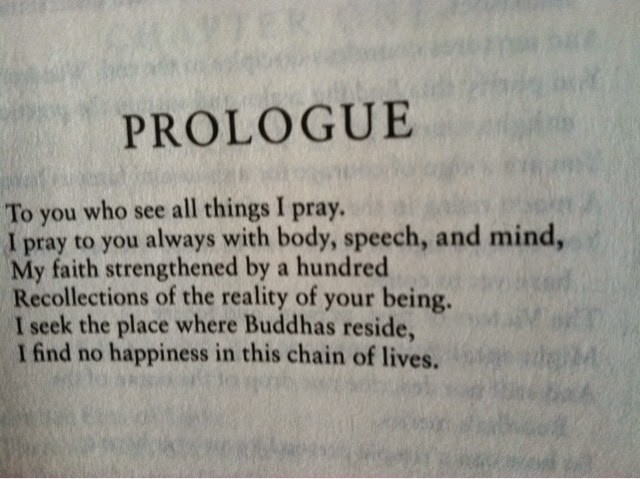


 came in the mail today. Looking forward to dipping into this, back to basics.

 ), soccer, and walked into grim descriptions of hooliganism in Serbia and Croatia. At least I had been warned the book started out negative and then got progressively more positive as it went along.

 Posts
Posts


