Dallas

Singapore

Amitabha


Sweden




Amitabha Pureland


Dallas
Singapore
I've sat on writing this because I was waiting for the article that explains it all in the proper context, and that article came out yesterday, about recent information and a video about the 83 year old Dalai Lama.
When the video came out, I couldn't watch it. "Suck my tongue" doesn't have good optics for people outside Tibet, but it turns out there is a cultural background that makes it part of playful dialogue for the elderly with children:
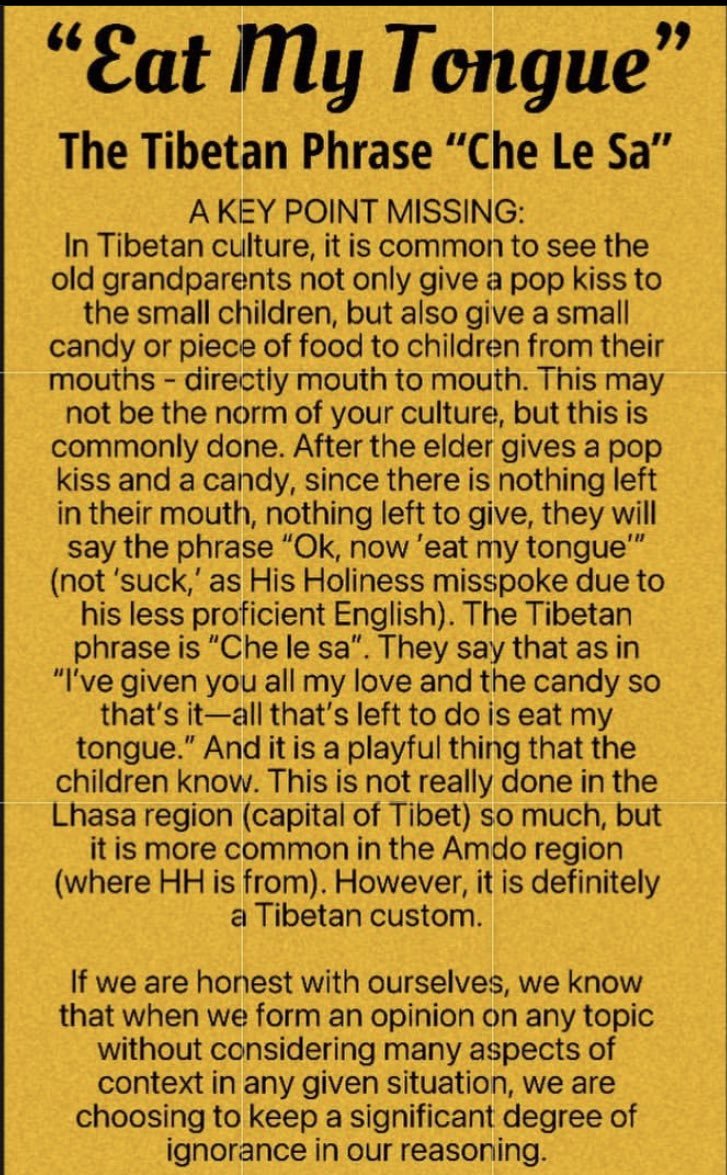
There's an excellent article in Tricycle by Joshua Brallier Shelton, a PhD student at Northwestern in Buddhist studies and masculinity. His studies include "uncovering the ways that male power becomes entangled in practitioners’ sincere religious aspirations, cultivating environments in which men eroticize and abuse that power in perverse and nauseating ways." He speaks Tibetan and is a practitioner himself.
He talks about his own discomfort, but also the importance of hearing Tibetan voices. The family were joyous at meeting the Dalai Lama and the video comes out 2 months later. Whether or not it was brought out by forces sympathetic to China, who are deeply against the Dalai Lama, that would be interesting to find out.
There is a problem with sexual misconduct, and power structures, but Shelton concludes this incident isn't one of them, after elegantly laying out the various aspects of this incident. I'm going to take his word for it, and the words of Tibetans.
You can feel the need of people that this is innocent, and you can feel the tension of people who want to take the Dalai Lama down a peg, expose him, depower him. I've always seen him as a global spokesman but also on the leader of one of five main sects of Buddhism from Tibet. For people who regard him as the manifestation of Avalokita, he's a projection of their own power onto him, and he reflects their power back to them. He has devoted his entire life for working for Buddhism, Tibet, with lots of support to be sure, but also many years of intense practice. I know people who resent his popularity and influence, insist he's not all that. China, a collection of individuals, whose government invaded Tibet in 1959, and wouldn't be unhappy if the Dalai Lama took a hit on this one. Autocratic countries like China use information to undermine many things in open societies, like democracy and spiritual traditions, knowing that there will be some blowback such that the Dalai Lama issues an apology, when most Tibetans don't think he even needs to apologize. There's a freaky frame to this whole situation, and unpacking that is interesting. Hearing Tibetan voices is interesting. My heart goes out to them. There are several Tibetans who live in my neighborhood, and I'm going to have to ask them about this, it's an excuse to strike up another conversation.
Links in Shelton article:
Tibetan women say ‘no’ to violence as part of 16-day activism against gender disparity (Phayul).
Buddhist scholars receive grant to document sexual abuse in American Buddhism (Lion's Roar).
Tiben voice of Tenzin Pema (Facebook).
After 60 years in India, why are Tibetans leaving? (Al Jazeera)
Dr. Lobsang Sangay (Facebook) Video of someone who worked with the Dalai Lama for 10 years.
It's easy to remember because my son was born on the same day! Jai Bhim!
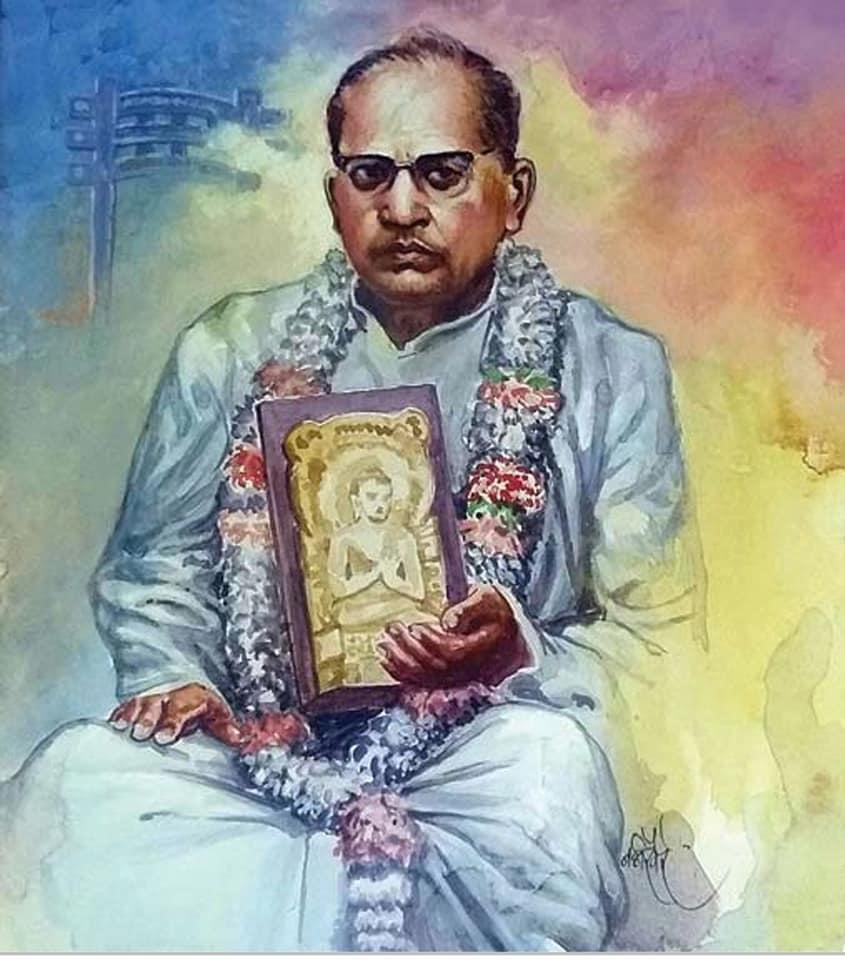
Link: to He Dared To Fight, about Babasaheb Ambedkar, 36 players.
How Dr BR Ambedkar's Words Helped Me Overcome My Fears (book excerpt from Yogesh Maitreya's memoir Water in a Broken Pot)
"I only talk about seeing your nature. I don’t talk about creating karma. Regardless of what we do, our karma has no hold on us. Through endless kalpas without beginning, it’s only because people don’t see their nature that they end up in hell. As long as a person creates karma, he keeps passing through birth and death. But once a person realizes his original nature, he stops creating karma." (Bodhidharma in The Zen Teaching of Bodhidharma)
Another monk, this one from Vietnam:

“When Bodhidharma arrived in China, in the latter part of the fifth century, there were approximately 2,000 Buddhist temples and 36,000 clergy in the South. In the North, a census in 477 counted 6,500 temples and nearly 80,000 clergy. Less than fifty years later, another census conducted in the North raised these figures to 30,000 temples and 2,000,000 clergy, or about 5 percent of the population.” (Introduced and translated by Red Pine: The Zen Teachings of Bodhidharma.)

You can listen to a computer read the book.
“If this is all we know about Bodhidharma, why, then, is he the most famous of all the millions of monks who have studied and taught the Dharma in China? The reason is that he alone is credited with bringing zen to China. Of course, zen, as meditation, had been taught and practiced for several hundred years before Bodhidharma arrived. And much of what he had to say concerning doctrine had been said before—by Tao-sheng, for example, a hundred years earlier. But Bodhidharma’s approach to zen was unique. As he says in these sermons, “Seeing your nature is zen … . Not thinking about anything is zen … . Everything you do is zen.” While others viewed zen as purification of the mind or as a stage on the way to buddhahood, Bodhidharma equated zen with buddhahood—and buddhahood with the mind, the everyday mind. Instead of telling his disciples to purify their minds, he pointed them to rock walls, to the movements of tigers and cranes, to a hollow reed floating across the Yangtze, to a single sandal. Bodhidharma’s zen was Mahayana Zen, not Hinayana Zen—the sword of wisdom, not the meditation cushion. As did other masters, he undoubtedly instructed his disciples in Buddhist discipline, meditation, and doctrine, but he used the sword that Prajnatara had given him to cut their minds free from rules, trances, and scriptures. Such a sword, though, is hard to grasp and hard to use. Small wonder that his sole successor, Hui-k’o, was a one-armed man.“ (op cit)
Bodhidharma: “…when you first embark on the Path, your awareness won’t be focused. You’re likely to see all sorts of strange, dreamlike scenes. But you shouldn’t doubt that all such scenes come from your own mind and nowhere else.”
Recent listening:
It's 30 years since Meeting The Buddhas came out. I listened to the interview of Vessantara on Windhorse. I appreciated that book when I read it long ago, pretty near when it came out, and I'm glad to see it's all back in one book now. It was split up into 3 books for a while.
Fascinating interview of Nagabodhi about his book about Sangharakshita.
Bhikkhu Bodhi from Chuang Yen Monastery.
Ajahn Chah on Right Samadi. Developing Samadi.
Hillside Hermitage seems pretty intense.

Watched documentary: The Sacred Tattoos of Thailand. Seems interesting, but when the guy says he broke the precept of not having a woman on top, I sort of scratched my head. What's the Dharma reasoning behind that idea? A minor point. Very interesting footage of tattoos and a ceremony where people are possessed. They mention it went down in popularity after WW2 but then Angelina Jolie got one and popularity began to raise.


The revolution of being a Buddhist has many aspects. The revolution is beautiful like a sunrise or a forest in a valley or a waterfall. A revolution is not violent, and this one is internal.
Prioritizing spiritual development over anything else, not buying stuff, not being unhappy to need stuff, profoundly puts a crimp in the capitalist plans, cuts consumption, leads to minimalist living.
As you begin to live beyond conditions, you become less easy to manipulate and exploit. Conspicuous consumption isn't the way, competing for status, being so needy and desperate isn't the way.
Not filling your mind up with commercials and jingles, there is so much more space. I resist guarding the gates of your senses sometimes, but not when it comes to this.
By taking ownership of your mind, your journey, your experience, there is nothing and nobody who can take anything away. By undercutting capitalist narratives, you are not exploitable or easily manipulated.
You don’t have to get a new phone every year or a new car every 2 years and you don’t need a big cavernous house to store all your stuff. You rejoice in decluttering and giving things away. Use libraries, you can be minimalist in a tiny house, or a digital nomad, or just a nomad.
Prioritizing spiritual friendship is revolutionary. To make time for others instead of grinding at the job, prioritizing career, is to unplug from the grind. To create the space where friendships flourish is revolutionary. It’s great grounds for working on compassion and generosity.
Compassion is so threatening, for so many reasons. You have to cut off compassion to exploit people in a capitalist system. Compassion is radical.
I feel sorry for the delivery people who feel their only option is to press buttons to enter into the apartment entry where I live. By shifting the frame I don’t dwell on my pet peeves.
People are so afraid to appear weak, afraid that being too empathetic, they will lose the firm stance they imagine is necessary. They fear it’s not standing up for themselves to empathize for others. Maybe, I’m speculating, who knows what blocks and obstructs compassion, except it’s opposite is selfishness, egoism and narrow self interests. Idiot compassion isn’t compassion. It’s a hard skill.
You could use the asceticism thing to work harder, ignore your needs, and give the money away in effective altruism. Make the world a better place. Mindfulness is necessary in the work place because people are forced to focus on things they’re not interested in, and it takes a lot of energy to focus on things you don’t want to focus on. For me, anyway, that’s the hardest thing about work. But it’s also useful to focus on something. There’s a movement called effective altruism to focus the positive effects of donations.
You could fight for social justice, even if people aren't going to be happy in samsara. You have to be for treating people well because they are a part of you, you have to be against all forms of oppression and harming others. The insights of intense meditation has many implications.
You evolve towards a vegan diet, environmentalism, compassionate forms of government, truthful communication, avoidance of manipulation, avoidance of exploitation and abuse. Even a spiritual individualist can't help but think of others. Embracing your own freedom is a very difficult thing.
Maybe government needs to be reduced, you're also going to work to avoid polarizing and dualistic thinking regarding politics. Fighting for your own justice and interests might be something individuals and not the government do--I’m trying to not slant this towards one political personality. The Dharma revolution is not only for one side of the political spectrum, ideally it should be non-dualistic, not partisand, even though I feel one side very strongly.
Thinking about others and how everything is interconnected would prevent CEOs from polluting the environment for short term gain, for limited gains to stockholders. It undercuts the really negative side of Capitalism. People point to failed authoritarian regimes to say socialism won’t work but there are democratic examples of socialist success, collectivism success. There are strange paradoxes of libertarianism, and honestly I can’t fathom it.
The Dharma is free. It's been translated into English and sure, you need a computer or phone to access it on the internet or you pay hefty prices for hardback copies, but it's essentially free. You can go on high priced retreats with star teachers, but you really only make progress because of your own efforts to work the spiritual activities: friendship, study, ethics, meditation and devotion.
The negative forces are reduced voluntarily. Substance abuse will be empathetically worked on, avoiding judgment, and being honest about what works, let the social scientists decide policy.
As civilization and humanity evolves, we're going to be less and less confused, bewildered and alienated. Thorny knots will untangle. Culture advances, and we learn even if it is frustratingly slow to really be implemented in places, and there are times when we take steps back. Citizens will participate in democracy, not easily duped.
Radical respect for others autonomy and journey, and indeed other spiritual traditions will reduce conflict by exemplifying models of maturity and respect. When everyone’s journey is respected, there isn’t any kind of shade given, there’s no saying this or that is wrong, and when you see someone who seems quite mistaken, you can talk about your experience, and discuss so that you can close out the distance you feel between someone.
There are wars and violence done by cultural Buddhists, but the idea of fighting violently to impose Buddhism just doesn’t seem in line with the ideals. Thailand may be a Buddhist country but the persecution of the Rhogayans is antithetical to buddhism. I tend to think a country isn’t Buddhist, it could be influenced by Buddhism, but the complexity and depth of Buddhism doesn’t make it open to a mass movement. I mean it might have swept over northern India 2,500 years ago, and people were pretty upset so many people were converting, families were decimated, but they just also made it a condition that a family approves that someone goes forth, you have to be in harmony with your family to go forth.
I let go of the culture of insisting on my understanding of spirituality for others, and trying to rid others of heresy or apostasy. I celebrate diversity and difference, and am curious about other’s journey.
Going forth is to walk away from the grids of power in the regular world. For me the hardest thing is to put aside my mating mind. To be freed from the mating mind would be amazing.
Everything in life is a self fulfilling prophecy. If you want to overcome trauma, the trauma will still be present in your experience, but you can be creative instead of reactive. If you want to move towards enlightenment, you can move towards enlightenment. You can’t know what it is or whether it’s worth it, but either you’re really disciplined or you get something from the journey even if you don’t completely transcend sense desire, or whatever other promises you wish for.

So there's a post that gets to me, and then I open up to celebrating the devotional. I really think it's a personality difference with these guys.
There's a subreddit called r/goldenswastica. It's for the traditionalists who don't like the secular bent, and don't like dilettantes. Some of the people can be heritage Buddhist who are born in Buddhist countries and grew up in Buddhist families. They like posts like Why Secular Buddhism is Baloney.
They asked: What Buddhist practices, mindsets, disciplines, etc. do you have in your life (and your temple/congregation) that are not found in modernized/westernized Buddhist communities? (post by NyingmaGuy5)
It's actually a good exercise and I love devotional activity and learning about other sects activities.
I'm afraid the post proves the opposite of what they imagine they're proving. I worry that if I'm too afraid to provide this feedback, how are they going to get the feedback about what they are doing? They're trying to prove that they have the right distinct practices while simultaneous saying those are just examples from sects. Just that in general a secular western Buddhist isn't really a Buddhism, and suffer from the lack of their privileged expertise. We should venerate them more. So what are these practices?
Bathing the Buddha. OK, I don't do that. My main statue is a wooden rupa, I don't want to warp it. My metal and stone ones are small. I guess I could bathe them, but they are so small. But that gives me the idea to put a Hotai in the shower and another by the kitchen sink. Not a bad idea. Hotai isn't my favorite Bodhisattva but it is stone.
Nuns give out literature? I've loaned and given people literature. They talk about nun culture, and to be honest there aren't a lot of nuns in the USA, but I have met nuns at a Taiwanese temple. They said Triratna has no lineage, and we have 2 lineages. I wrote a post about that. I wrote that in 2010 and I stand by that essay. I have read books about nuns, and one of my favorite parts of the Pali Canon is the Therigatha. I had a transcendent experience reading that book on retreat at Aryaloka. There are women order members in all the sanghas I participate in. I'm not sure if the traditionalist cultures are the most friendly and respectful to women, I've seen some fishy stuff from those cultures.
Displaying mantras in print form. I do that.
Praying to gods of wealth and health. I have a medicine Buddha icon, but yea, I don't pray for worldly gain to the gods of favor. That is true.
"Washing dishes, seeing how the food scraps drops and flows down the drainage, then thinks and wishes for the benefits of small animal sentient beings that would eat those scraps somewhere." I'm going to pass on by with that one. I do wish all well, at various times a day, but no, I don't imagine the food scraps will nourish other. I could think of that, I do like that. That is kind of sweet. I really wish I could compost, and I love composting on retreat, I always take out the compost when I'm on retreat. I do think along those lines, though.
"Use of effigies at the temple." I mean your temple is my temple, but forget that. I don't use effigies in my house. I have Buddha statues and images all over my house. But my sangha doesn't have a building, or even a dedicated room with effigies. They rotate people's houses and work spaces. The retreat center does have effigies.
"Going to the sea, making offerings to the nagas." I haven't done that. That might be Hinduism, but whatever. I do have awe at the ocean, and I love the mythology of Buddhism. I think a million thoughts at the ocean, Hamlet taking arms against a sea of trouble, Moby Dick, and my fears about not seeing what's under the water, remembering peak experiences snorkeling.
"Doing life release. Buying animals meant for slaughter. Rescuing them or releasing them back to their natural habitat." Got 2 rescue cats, which saved their lives. But not as a ceremony.
"Collecting, using, or having some material, artifacts, ritual objects that are believed to be sacred and beneficial both for practice and mundane needs." Not true.
These were all examples and not specific things to be scrutinized, but I'm sorry I look at them all.
Someone post "prostration". I've done a lot of prostrations in the style of Triratna and as explained in the book Teachers of Enlightenment by Kulananda, and as taught to me by order members.
I don't collect amulets, but I do have one.
I don't take merit literally but I do strive in my own way.
It also seems like my not coming from Thailand, I don't have all the holidays they celebrate, and yet I yearn for them. That's actually something I really struggle with. I wish I was embedded in a tradition. I am trying to build that in America.
I make offerings. I have done confession. I do believe in devotional activity. I celebrate their activity.
I don't have various sect practices like the Feeding of the Hungry Ghosts ceremony. I'm so curious about them, but I'm not sure if I should be a tourist in a sect to learn things. I do sometimes think about visiting pure land temples near my house, though I don't think they speak in English. "Feeding of pretas" Yea, I don't do that. I do give money to homeless people. I worked in a prison and worked to be compassionate.
Maybe we'll never agree about the ontological status of miracle stories. Magic is used as a metaphor, and if you think it's more than that I celebrate your credulity and wish you well with that.
They say, "Dharma talks can sometimes touch on concepts in Eastern medicine and geomancy, like yin and yang energy channels, the three dantians, the meridians, etc." I've actually heard those things, but I don't experience non-Dharma as Dharma. I experience culture as culture and hopefully and celebrate it. I really do like Taoism and other ideas from all over the world.
They say, "even though Yantra tattoos are not a traditional Buddhist practice per se, there is a lot of intersection between them (and the work of the Ajarns) and the Buddhist Theravada religion." OK, okay, I don't have a Buddhist tattoo but you also seem to be saying it's not traditional.
Being against superficiality is one thing, but to relish in name calling. NyingmaGuy5 likes "Pumpkin Spice Prajna". He's also someone who probably rails against Karens, woke culture and virtue signaling. What is the right way to make fun of superficiality? I think there is no right way. Don't do it. Point it out gently if you have a relationship with that person.
Kathas are Thai sacred prayers. I have sacred prayers. I'm not Thai.
"I approach: Phra Phrom (Lord Brahma), Phra In (Lord Indra) and Phra Pikanet (Lord Ganyapati)." I hope that practice is good for you. Buddhism does spring from a pre-Hindu culture.
Being vegetarian means Buddhism is controversial, but I'm 99% vegan, so again not really talking about me. I guess this whole post, if it don't apply, let it fly.
General statements feel untrue: "Convert communities don't have kitchens....?" (source) "That's Buddhist AF. Mad respect for nuns-dominated communities." is NyingmaGuy5's response. Later he says, "I got to get a Buddha's tooth for my altar". I wish him well.
I think the worst practice he engages in is ill conceived posts like this one, setting up strawman, not being accurate. Why not just celebrate devotion, culture and mythology?
Pointing out others hubris maybe isn't polite or Buddhist or humble myself. But come on, someone says dana is something they don't practice and the bogey man superficial secular buddhist doesn't practice generosity?! Lots of othering going on.
My pointing out how superficial calling out superficiality might be superficiality. Bottom line, I don't think this post helps my practice, so I'll look in other directions. But as a part of Buddhist culture I want highlight it as something that exists, and give my own personality take on it. I'm not sure how much I want to police other Buddhists, but then again I do have these types judgements, and I give them in this post so I don't really rise above it. Not sure mine are any better. I don't think I contain all the truths. I don't think any sangha contains all the truths. I don't think any religion contains all the truths. I have loyalty to my teachers, and gratitude.
Another thought is that if I do most of the devotional activity, and I feel a secular bent. I don't have to literally believe mythology. What do they do with that? Why am I so afraid to post this to the subreddit? My experience with Christianity in America makes me not want to be confrontational in the spiritual world with virtual strangers. Maybe if I met him face to face.
I don't want to stir up dischord in the sangha. I don't feel like they are my sangha. They don't want to be part of my sangha. I don't want to be a part of their sangha. And yet I celebrate their devotion to the Buddha, so we are part of that sangha. And I take away reflection on devotional activity.

“There is that dimension, monks, where there is neither earth, nor water, nor fire, nor wind; neither dimension of the infinitude of space, nor dimension of the infinitude of consciousness, nor dimension of nothingness, nor dimension of neither perception nor non-perception; neither this world, nor the next world, nor sun, nor moon. And there, I say, there is neither coming, nor going, nor staying; neither passing away nor arising: unestablished, unevolving, without support [mental object]. This, just this, is the end of stress.” — Ud 8:1

“There is, monks, an unborn—unbecome—unmade—unfabricated. If there were not that unborn—unbecome—unmade—unfabricated, there would not be the case that escape from the born—become—made—fabricated would be discerned. But precisely because there is an unborn—unbecome—unmade—unfabricated, escape from the born—become—made—fabricated is discerned.” — Ud 8:3
You can have a boob flash movie in which ultimate lesson is that Babylon wasn't really all it was cracked up to be. I just watched Babylon, all 3 hours of it, including the Tree of Life hallucinatory ending.
Babylon in the Bible: "Noah’s great-grandson, Nimrod, was the first mighty man of the Bible (Genesis 10:10), and the Bible says Babel was one of the towns that encompassed the beginning of Nimrod’s kingdom in the land of Shinar." (source)
Tangent, have you ever seen that documentary about a high school basketball team called Nimrod Nation?
"The people who erected the Tower of Babel decided to make a name for themselves in opposition to God, and they proceeded with outright disdain for God’s rule. That in and of itself was enough to make them evil because they clearly defied the Lord. Babylon’s god was Marduk, one they considered the supreme deity over all others."
In Buddhism Mara is the great distractor from the goal of the path. You could say just about everyone but a few monks are on the path, some pay respects, and it's fashionable to be mindful at work now, and everyone else ignores. You don't need to make a lot of bogeymen, cities and nations against enlightenment, because they're literally everywhere, including forces and instincts inside you. The inner Babylon of the heart.

Random Buddhist Link:
Great article by BBC on Nalanda University: "In the more-than seven centuries that Nalanda flourished, there was nothing else like it in the world. The monastic university predates the University of Oxford and Europe's oldest university, Bologna, by more than 500 years. What's more, Nalanda's enlightened approach to philosophy and religion would help shape the culture of Asia long after the university ceased to exist."

Random poem:
By Peter Gizzi
I guess these trailers lined up in the lot off the highway will do.
I guess that crooked eucalyptus tree also.
I guess this highway will have to do and the cars
and the people in them on their way.
The present is always coming up to us, surrounding us.
It’s hard to imagine atoms, hard to imagine
hydrogen & oxygen binding, it’ll have to do.
This sky with its macular clouds also
and that electric tower to the left, one line broken free.

Came across photos of Hercules protecting the Buddha. This is syncretism, the combining of traditions as the Silk Road connects early Buddhist culture with Greece. When you open up to the mythology of the whole world it's quite an exciting world.
The opposite of syncretism is fundamentalism. In fundamentalism you ward off combing ideas. Buddhism shouldn't combine with modern psychology. Buddhism shouldn't combine with secular ideas. We shouldn't care about the parallels with modern physics and Buddhism. Even Buddhism and Taoism or Confucianism shouldn't combine in early china. New age hippy ideas shouldn't be combined with Buddhism.
Closer to home, I think reliance on the guru in Vajrayana is Hinduism influence, perhaps. Buddha nature is Hinduism inspired, we are all god in some sects of Hinduism, OK we're all really Buddhas. Shake out what kind of interesting insights that might shake out. Pudgalavadins believe in a soul. Buddhism tries out other ideas in the history of Buddhism. Pure Land is an exploration of a kind of thinking, more reliance on other power.
We need self power, community power, and other power in the spiritual life because it is so demanding. There are some who believe the burning of oneself in protest isn't part of Buddhism. In a way the battle about what is and what isn't Buddhism is a constant battle. In Cambodia monks are brought up on heresy charges. In Europe there are blasphemy laws designed to protect Christianity being utilized for Buddhism.
I mean you can try to keep things pure and uninfluenced, and it's good to be clear what is what. To pretend like we're not influenced by everyone around us is silly. Materialism brought about by more fair economics is also a change in culture. The world is changing rapidly and yet humans need things to be the same, we are all profoundly psychologically conservative. Boredom is the emotion that drives us to challenge ourselves and try new things.
I can't help but think the spiritual life isn't where wars should be fought. The spiritual life can be focused on comfort, but it must also include an element of confrontation and discomfort. Not knowing and the negative capability can be used in the spiritual life.
People from traditional Theravadan countries sometimes see American adaptations of Buddhism as something they don't recognise, and can be offended by how it's being adapted. Some people want to have conflict over sects. There is a kind of branding war that smacks of materialism to me.
If there's no permanent self, can there be a permanent Buddhism? I think you can make mistakes, claim something is Buddhism and it's not, so I think there is a temporary essence, even if that is philosophically is problematic, it works psychologically. I keep coming back to the practices of community, devotion, study, ethics and meditation. Maybe it's my overly secularized influence, but I think Buddhism is more about what you do than what you claim to believe. Humans are complex and don't always act on their belief, we are hypocritical and unintegrated, confused, bewildered. Enacting ideals isn't easy. I also believe in authenticity over pretending you're more advanced than you really are.
Even if I am not a heritage Buddhist from a Buddhist country, and find secularizing interesting, doesn't mean that I can't be offended by McMindfulness and capitalism coopting the language of mindfulness to exploit workers better. I can even see traditionalist behavior as against Buddhist's quest for harmony. An over reliance on "right view" can seem like Christians hunting for blasphemy and dogma. Right view is the first step on the path, but like the first step in AA, is has to be constantly refreshed.
On page 80 of the Long Discourses the Buddha says to beware of eel wrigglers, people who can't be pinned down and won't express an honest commitment. Vagueness and superficiality are a problem.
My life experience matters, and the forced Christianity in America means I have little tolerance for what is Christian evangelical moves. Buddhism is supposed to change as it moves through new languages, new cultures, and new geography. But it still needs to be identifiable as Buddhism.
There is a point where Buddhism isn't just an individual sacred cherished aspect to a person and must enter out into the larger world. How involved in politics will it get? America is going through hype partisan times, as people don't understand that psychology pushes one to see the world in different ways, to see others hypocrisy, and not your own as much. It's the same old struggle in battling with yourself versus battling with the world. At the end of a soccer game, they play the song about how "everyone wants to rule the world."
Yes, maybe my white middle class male Buddhism is tinged with all those descriptors, but I still hope it reaches for something more universal, transcendent, and rooted. I like to think Buddhism isn't obsessed with gonads, flesh color and class, without deny those things are in play in the world, and not trying to silence anyone is expressing their experience about those things. I want to throw open my arms to everyone, metaphorically, but realize you can only see the people you see, in front of you, face to face. There are book Buddhists who just write on social media, but don't connect with sangha face to face. Everyone engages with Buddhism with their personality, history and culture.
Syncretism is unavoidable and therefore not unwelcome because resisting reality is a recipe for exhaustion, and errors. We both want to shoot for what we are not already and we must start where you are. It's about becoming, the glorious process of seeking.

On page 75 of the Long Discourses (DN), my version translated by Maurice Walshe, there's a casual references to when the world contracts, everyone goes to Abhassara Brahma.
When I read about the cosmology of early Buddhism, I could find this article, which has a whole elaborate cosmology Dr. Ari Ubeysekara, and mentions it in context, complicated, rich setting. I feel overwhelmed and skeptical, like nobody thinks any of this stuff any more. It's just a thought experiment from spiritually evolved beings. For some reason in my mind I keep coming back to Amos Bronson Alcott's weird prophetic writings Tablets, which I haven't actually read, but I wonder about, and get flummoxed quite quickly reading a few pages. And I think about Sangharakshita in the Hindu ashram with the guy who took down dictation from God. Sangharakshita spent a lot of time with him, I was really surprised. I think I'd like to come up with my own cosmological imaginings. But mostly I just want to get on with the practice: Study, community, devotion, ethics and meditation. Included in this is the study of mind stretching books.
I think the mating brain is a supercomputer that is overclocked, and wants to do something, even if you're not into attracting a mate. I also enjoy a Jungian exploration of mythology. What is important? What are the foundation myths in the machine language of your brain?
Dwelling in Abhassara Brahma, "...there they dwell, mind-made, feeding on delight, self luminous, moving through the air, glorious--and they stay like that for a very long time."
Sounds like a pure land, not like the pure lands where your tongue covers everything, and there are all these jewels, and or the fantastical magic of The Life and Liberation of Padmasambhava, or the Lotus Sutra. I don't always speak California slang, but these books are far out, man.
We can choose what sacred writings to perfume our minds with. Is it true crime? Is it romance? Is it operation manuals? Is it investment strategies to grow wealth? Is it nutrition? I think a Buddhist will spend time with the word of the Buddha, the Buddhavacana, that miraculously is handed down to us through centuries. Every day I'm amazed that I get to read this stuff, and come across new concepts that launch my mind that is ready to be launched and reigned in.
The internet is devoted to manic pixie girls latest outfits, but there's not a lot on this: link: Abhassara. Wisdom Library.
Mind stretching is what spirituality is all about, the freedom of pushing boundaries. I don't like the language of transcendence because I look up instead of to my body. The body will lead you to enlightenment with all it's ramshackled questions. What do you keep coming back to?

I'm reading the Long Discourses, and I wanted to see a map of the Buddha's times, where Rajagaha and Nalanda were:


 Posts
All Comments


