Showing posts with label Tara. Show all posts

Thursday, May 02, 2024

Lama Govinda on Tara


Among the female embodiments of Wisdom (Prajña) Tara occupies a special position because she is not only of importance as the female aspect of a Dhyani-Buddha, but plays an outstanding role in the religious life of Tibet, on account of her special qualities. She represents the very essence of loving devotion, which is the foundation of all religious practice, from the simplest act of veneration (puja) to the most developed training of meditation. She is therefore one of the most popular, approachable, and attractive figures of the Tibetan pantheon. She unites in herself all human and divine traits of a Madonna, whose motherly love embraces all living beings, irrespective of their merits. She extends her loving care to the good and the bad, the wise and the foolish, like the sun that shines for sinners as well as for saints.

Tibetans, therefore, call her 'dam-ishig-sgrol-ma', the Faithful Dölma, She is the embodiment of that faithful devotion, which is born of love and strengthened by the Bodhisattva vow to liberate all living beings. 'Dam-tshig' means literally 'a sacred or solemn vow', but in the mystic language of the Tantras it is the force generated by such a vow through faith and complete self-surrender. It is 'the faith that moves mountains, the wisdom of the heart. It corresponds in a certain way to the Sanskrit term 'bhakti', which in the theistic religions of India signites the loving devotion to and the ultimate self-identification with God. It is therefore more than sraddha, more than simple faith, because it is inspired by love. A 'bhakta' is a devotee as well as a lover.

'Dam-tshig' is the devotion for the Buddha in one's own heart. The syllable "dam' means "bound', 'fixed'; as, for instance, 'bound by oath, promise, agreement or convention (Skt. samaya)'. But in this connexion it is a bond of inner relationship through the power of loving devotion, by which the devotee dedicates himself to the Dharma and identifies himself with the Buddha who forms the centre of his mandala of meditation or the object of his devotional practice (sadhanã).


Foundations of Tibetan Mysticism pp.111-2


Sunday, October 02, 2022

Tara

I've been saying the Tara mantra while walking home from dropping my daughter off from school. Then when I get home, I finish off the 108 mantras looking at the image of Tara on my wall. 

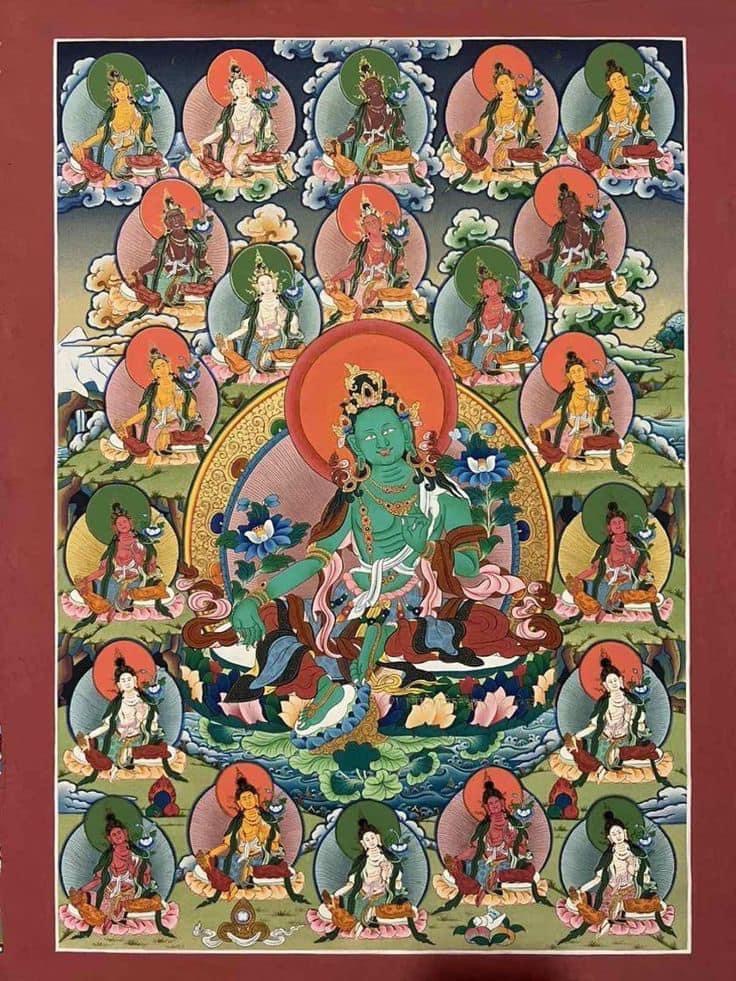
I've seen a tanka with like a zillion Taras on it. I'd like an old woman Tara image, but I can't find one. I've found some images of women who could serve as model for a more mature woman. I'm not sure if I'm on board with impossibly round breasts, though I know she is 16. It's kind of fun to look at all the various versions you can see on the internet. I'm afraid it also attracts some people who kind of skirt around going deeper into Buddhism, but I'm disinclined to put down people's journeys. There's a kind of person who's into female goddesses, good for them.

My daughter loves rainbows, and I like it that her skirt is rainbow colored. In Vessantara's descriptions rainbows are whispering Tara's mantra. The mantra actually feels kind of long and wasn't my favorite. I like Avalokiteshvara, Amitabha, Shakyamuni, Amoghasiddhi, and Padmasambhava mantras. Not sure why I like those mantras, and this one less. 

I really enjoy the 21 Tara praise. I will admit that I sat for the first time for 40 minutes in a while. I have begun piecing together my own practice sheet cobbled together from everything I've learned.


Wooten discusses anger in the best way I’ve ever read. She doesn’t say it’s always bad and notices how we’re conditioned to not express or admit it. She discussed it from a woman’s perspective.


links:


Red Tara: Om Tare Tam Soha.


Mantra from Dharma Refuge, Rochester NY.


Vessantara visualization excerpt: 

Out of the lake of tears rises a pastel blue lotus flower, of an extraordinary delicacy. A stream of tears falls into the soft heart of the lotus and transforms it into a white full-moon disc slowly, just above the surface of the moon disc, jade green light appears. Its outlines become more definite, without gaining any solidity. We are watching the birth of a princess, a goddess, a Bodhisattva. She is jade green in color, clad in a rainbow skirt, with a meditation sash tied around her body. She is decked in precious jewels: bracelets, armlets, anklets, necklaces, ear-rings, and a tiara of gems. She is seated, her left foot resting on her right thigh in meditation posture. Her right foot steps down gracefully and as it does so a small pastel blue lotus and moon mat rise out of the lake to make a footrest. Her right arm reaches down, the back of her hand resting on her right knee. Her palm is open in a mudra of supreme giving. Her left hand is held in front of her heart, palm outwards, the thumb and ring finger together, so that the other three fingers point upwards. This mudra bestows protection and fearlessness through invoking the Three Jewels. Her thumb and ring finger delicately grasp the stem of a lotus flower, which curves upwards to open into a spray of blossoms by her left shoulder. There is a bud, a half opened flower and a fully opened blossom of pale blue. She is sixteen years old, full-breasted with flowing black hair. She is supremely beautiful. Her apparitional birth complete, her jade eyelids open for the first time to reveal two perfect blue eyes, identical to those from which she was born. She looks out over the world and the lake of tears, and upward to the while cloud of compassion far above her, and her face breaks into a smile of such beauty and tenderness that the whole world trembles with joy.

Wikipedia:

As Green Tārā she offers succor and protection from all the unfortunate circumstances one can encounter within the samsaric world. As White Tārā she expresses maternal compassion and offers healing to beings who are hurt or wounded, either mentally or psychically. As Red Tārā she teaches discriminating awareness about created phenomena, and how to turn raw desire into compassion and love. As Blue Tārā (Ekajati) she expresses a ferocious, wrathful, female energy whose invocation destroys all Dharmic obstacles that engender good luck and swift spiritual awakening.


November 1st Rachael Stevens comes out with Red Tara. If you'd rather read her Ph.D dissertation you can read that.


Tara has a tiara on her head that has the colors of the Buddha families, and the various colors of the Buddhas determine the flavor Tara gives. 


Wednesday, September 28, 2022

Adventures in Tara


So walking home after I dropped my daughter off, I did 108 mantras of Tara. I've been reading Wooten's book. I took Vessantra's Meeting The Buddhas off my shelf to reread the Tara section. I read out the 21 Praises of Tara today. I've been looking at my poster (above is a close up). I'm guessing that is Amitabha on Tara's head, the red Buddha, the focus of the most popular form of Buddhism, the Pure Land tradition, reaching out for other power. 

Love, compassion, and compassion in action. I love the mythology of Tibetan Buddhism, the messiness and yet the rightness, colors, directions. I love the gestalt of it all, and the specifics. 

Avalokita shattered when he took his foot off the pedal of saving all beings, and despaired. I've been shattered quite a few times in my life. His tears form the pond, lake, ocean in which Tara is born.

In the visualization, you picture those requiring assistance of compassion in front of Tara. I'm thinking about my parents as hurricane Ian, a category 4 hurricane, bears down on them. I think about my growing daughter's fears and joys. I think about my stepfather's bad back, my mother. I think about my sons, my exes, all the loves I've had, all my friends, active and lost. I think of all my neutrals and enemy. I love the connection to my favorite practice the brahma viharas: Metta, compassion, sympathetic joy, equanimity. Equanimity comes out of insight, hard practice.


Links:

8400 Another translation of 21 praises

Sky Dancer Press another translation of 21 praises

Drukmo Gyal - Green Tara (Music video of mantra on YouTube)

Green Tara Empowerment Bestowed by H.E. Garchen Rinpoche// April 26 2020 YouTube


Wednesday, September 21, 2022

Tara

When I was in the ordination process for Triratna I thought maybe I'd do a Avalokiteshvara sadhana. Then I destroyed things, sabotaged, lost contact with my preceptor. It's like calculus, I feel like I've taken so many algebra classes, in preparation to get to calculus, but I never got over that hump. I read Cultivating a Compassionate Heart by Thubten Chodron, but I didn't really feel like I knew enough to practice it, but I found an interesting book by Rachael Wooten, so I'm reading about Green Tara. My library has a copy and I've read some of it already and it seems like a good book.

I got a Green Tara poster once for Anandi, and she left it on my wall when she left. Left hand in the refuge mudra, ring finger to thumb. 

I want to try it out. Anything that gives me energy to practice is a good thing. I know it's good not to flit from practice to practice without really devoting yourself, but I think it's OK to follow your interests also. Wooten was taught by Lodrö Tulku Lobsang Champa Khedup Namgyal Rinpoche, who seems to have been taught by many in the Gelugpa tradition.

I'm hesitant because usually it's part of a connection to a teacher that you do such things. And I wish I had somehow the ability to do the right dance to get one. I'm sure I will learn to when the time is right. I went along to a few zoom sessions with Sayka, and even witnessed an empowerment but they wanted me to come a bit more before they explained it. That kind of quid pro quo rubbed me the wrong way and I couldn't come all the time. I accept it that teachers can have a protocol for teaching, and I might not fulfill the requirements. In a way I want to be my own guru, not in narcissistic or solipsistic way, but self reliance in this period of my practice is somehow important. Anyway, I'm a dilettante, and it doesn't hurt to try something out and give up easily. Maybe it's a preliminary step to when I do get a teacher, and get sorted out. Who knows. I does become clear that doing this without a teacher is a mistake, a person to guide you seems essential. This is perhaps the weird truth of our age, you can get lots of teachings but without a teacher, it doesn't get the support it needs to really blossom. 

I'm listening to the Black Tara mantra, because it dispels negativity. My daughter liked this one.


Link: 

Green Tara mantra (Wildmind)

How to Do Green Tara Practice (Tricycle)

Take Refuge in Green Tara Tricycle

DECHEN / Black Tara Mantra (YouTube)

Black Tara Mantra (YouTube)

Black Tara Mantra (YouTube) 

Intro to Green Tara Practice (Dawn Mountain YouTube. I think it's Anne C. Klein in Nyingma lineage)

Introduction to Green Tara and the 21 Taras (YouTube, White Conch)