Thursday, November 02, 2023

El Dia de los Muertos


The day of the dead is a Mexican holiday, maybe even from the Aztecs, where you joyfully celebrate the people you have lost. 

We're lucky to have so many cultures in NYC to learn from, so many celebrations. 

I miss my grandparents, other relatives and friends, a high school friend who had a heart attack and died. I have so many great memories. What a joy to remember them. 

Marigolds are the flowers for the day. I've seen parades in Corona Queens. I've stopped short of having a dead people altar (ofrendas) for myself but many photos I have are of deceased people. I have a coffee mug with the skeleton (calaveras). There are special foods. Traditional celebrations are wonderful. I like the aesthetic, the iconography. 

Diego Rivera has a mural that is quite cool. There is an opera where Frida comes back to Diego on El Dia de los Muertos.

Coco (2017) is the Disney/Pixar movie version exploring this tradition. In the movie, there's a family that has banished music because a musician husband left the family. So there's a story around the dead that controls the living. The specifics are perhaps specific, but the dead's influence on the present is universal. And then Miguel goes into the dead realm, and that's the odd part that is imaginative, and a mystery and so much more. Great songs.

Six Feet Under is also a show with an extended meditation on death. 

Everything seems to unfold into anicca, there is impermanence of memories of ancestors. How can I convey my dim memories of my great grandparents to my 7 year old daughter?


The Denial of Death is a pivotal book in my mind, and a day where you confront it a little is quite cool.


The refuge tree of inspiration is a kind of ofrenda.


Kondo Hall of Horyuji Temple

Link: The link goes around and has photos of the art inside the temple. They're so old, they're pretty faded, but there are some things you can see.

"The Kondo, or Main Hall, at Horyuji Temple is the world’s oldest extant wooden structure and enshrines the temple’s most important treasures. It and the Five-storied Pagoda form the centerpiece of the temple’s Western Precinct. " (source with photos)

Wikipedia: "...world's oldest wooden building..."


I find it so amazing that there are buildings that Kukai could have gone into in Nara, Kyoto, Xi'an, that still exist. Halfway to the life of the Buddha from our vantage point in time.

Kukai went to college in Nara, went there at age 16 in 790 to study with an uncle before college, and then at 22 writes his "Indications of the goals of the three teachings" which I'm trying to read right now. And then he wanders around as an unaffiliated mendicant Buddhist monk until he goes to China at age 31. I'm fascinated with this time between ending college, and going to Xi'an China, the start of the silk road, to get the teachings, so that he can go home to found the Shigon school in Japan. This Horyuji temple would have been there, they think it was rebuilt in 711.

I was looking around for Kukai representations in art and found this one. It's kind of dark, and I think it's really old. Found it at the Nara National Museum:


Facts and details about Kukai


Seattle sangha led meditation .

Wednesday, November 01, 2023

Yashodhara

Fabulous storytelling about Yashodhara by Professor Vanessa Sasson on YouTube. I don't even want to summarize it, because she tells it well. Cut past the introductions and it's only about 30 minutes, and then they take questions and discussion, which I didn't watch all of it. I will just say it's dramatic and human, full bodied.

I went to my shelf to find Janet Surrey's book on Yashodhara. 

Monday, October 30, 2023

I have a tiny Buddha statue somewhere in my kitchen. I have many Buddhas throughout my house. My daughter tells me she believes in god and she's not a Buddhist, which is fine, it's her journey, but I'm also going to teacher her hopefully, through my exemplification, about Buddhism. She was excited to find this tiny Buddha. She wondered if she should put it on my shrine. Even if she doesn't embrace the outward showings of devotion of mine, she knows what my shrine is. I've offered to help her create a sacred space with anything she wants, it doesn't have to have some guy, it could have a woman idol. She declined so far but I'm hoping someday she creates a sacred space of things that are meaningful for her, where she can go to center herself or reflect. I think she doesn't really understand the order of the home and the places things go in, but then she finds things and asks if they go somewhere else, and I usually tell her to just put it back where it was, but she's got a sense that things have a place and it's not just chaos, in the home. There was a leaf she picked because it was beautiful. It's been a while and it's not quite a beautiful. I want to throw it away, but give her the choice, shrine or garbage? She picks shrine. I feel silly for imagining she would make the choice I wanted. 

I'm making retreat oatmeal. For some reason my whole life I had boring oatmeal, and then on retreat, I learned you could put all kinds of nuts and fruits into it, and yogurt (vegan) and it was really yummy.


Saturday, October 21, 2023

P.27 Self Compassion by Neff

“It is not only Westerners who are harshly judgmental toward them-selves, of course. We recently conducted a study in the United States, Thailand, and Taiwan and found that in Taiwan-_where there is a strong Confucian ethic there is also strong belief in self-criticism as a motivating force. The Confucian ideal is that you should criticize yourself in order to keep yourself in line focusing on meeting the needs of others instead of yourself. In countries where Buddhism plays a stronger role in daily life, such as Thailand, people are much more self-compassionate. In fact, in our cross-cultural study we found that people had the highest levels of self-compassion in Thailand and the lowest in Taiwan, with the United States falling in between. In all three countries, however, we found that self-criticism was strongly related to depression and dissatisfaction with life. It appears that the negative impact of self-criticism may be universal, even though different cultures encourage it to a greater or lesser degree.”


She cites her scales, which she validated and published an article about her self-compassion scales.

Wednesday, October 18, 2023

Anapanasati

When I first got into Buddhism 20 or so years ago, I read there was an abbot in Flushing who's thing was to read the Diamond Sutra over and over, once every day. A reading practice.

This morning I decided to read the Anapanasati sutta every day for a while.


Visakha: "Visakha later convinced Migara to see the Buddha, which led to him reaching sotapanna (stream entry), a stage of enlightenment. Migara was so grateful for Visakha helping him reach a stage of enlightenment he declared her his spiritual mother, earning her the nickname Migāramāta, or "Migara's mother".

So Visakha convinced another benefactor to pursue the path and he got his mind blown, and had an amazing spiritual career, and he traced it back to her hipping him to the path, and connecting him with the right people. I can't imagine he didn't give it all away and join the wandering monks. Or else maybe he joined the 3 month rain retreat every year, and then the other 9 months he was a regular bloke. It doesn't say. And the other monks nicknamed Visakha as Migara's mother, because her referral caused all that. She was given some glory of his attainments, an appreciation of what he did, was also reflected back on her. You can see how the system of patronizing was fostered through showing the benefactor how great it was that they supported the monks, what they made possible with their generosity.  

The Buddha has done the 3 months rains retreats at the Eastern Monastery, which was sponsored by Visakha. It has gone so well, he decides to stay another month and gives the teaching for July, after being there May, August and June. They followed a lunar calendar in those days, and the phases of the moon, marked the week. The elder monks gave instructions. There were a lot of monks, but calculating the numbers seems difficult. 10+20+30+40 equals 100 monks being instructed, and we don't know how big the team of instructors is, though there are 9 leading disciples listed and the Buddha, so at least 110 monks at the Eastern Monastery or Pūrvārāma Monastery in Shravasti, more than 2,500 years ago. It says there were mother monks, so more than 131 monks. 150 is a nice round number, so probably not exactly that many. But the sutra says "some" which could be multiples. There could be 2, 3, 4, 5 of each group. It was like you start out with 10, then move to 20. There was a real ranking system, and you could imagine there were explicit criteria for moving from teaching one group to another. It could have been 750 people in the monastery. Seems unlikely to feed all those people even if they're partially enlighten, peaceful and didn't eat a whole lot. They'd done 3 months and were kicking it out for a 4th. Seems really intense.

(It's a 4 hour car drive from Lucknow. It's over $500 for one way flights to Lucknow, and under $900 round trip from NYC. There's a stupa to Angulimala, and Jetavana grove is there too. I see no remains of Pūrvārāma Monastery, but Jetavana monastery archaeological site can be seen in photos online. This was also where the Buddha had 3 residences when he was growing up. Anathapindika is the patron of Jetavana monastery, so maybe there were two big monasteries close to each other? "Visakha founded the temple Migāramātupāsāda" and Pūrvārāma Monastery. With two big monasteries, I would say Shravasti was a real center of early Buddhism, and set the precedent of benefactors, merit and generosity. Visakha and Anathapindika are held in reverence as the original benefactors. The Anandabodhi tree is in Jetavana grove to this day.)

They were content. But not just content, they were content in their hearts. You could probably infinitely expand it, they were content in their heart of hearts. It wasn't just contentment, it was beyond contentment. They were worthy of being supported by the community. To give a gift to this community was a special kind of amazingly great generosity. To host and support such a retreat was to give the best thing ever. I'm going to say it, it was a pure land.

There was no idle chatter. They were no psychoanalysing each other with free association, they were all quiet. They went about the day on retreat, eating so they could meditate and study, stay focused on this one particular meditate practice that flows from 16 stages of contemplation from focusing on the breath, through body awareness and calming, through rapture and joy, through underingstanding the conditionality of mental processes, though calming and gladdening, getting deeper in concentration and steadying the mind. There was liberation and insight, disentanglement and detachment, cessation and relinquishing. It wasn't just counting the breath, there was some intense application of ideas into meditative experience, listening and cultivating. 

I'm not going to go into the chief disciples: Ven. Sariputta, Ven. Maha Moggallana, Ven. Maha Kassapa, Ven. Maha Kaccana, Ven. Maha Kotthita, Ven. Maha Kappina, Ven. Maha Cunda, Ven. Revata, Ven. Ananda.

The Buddha ranks and describes attainments of those present. Arhats, anagami, sakadagami and sotapathana. There are levels of enlightenment that has to do with how many fetters have been broken and weakened. They're also called stream entrant, once returner, non-returner and arhant. Once you enter the stream, you will eventually get enlightened.

The lists below are a clear reference to the Satipatthana sutta, which will be my next obsession, after this one, and all the teachings, which like Indra's net, the goddess of creation, reflects and intensifies each jem, each jem reflects light back onto every other jem in potentially an infinite runaway:

Four foundations of mindfulness: Body, feeling, mind and Dharma

Four right exertions: stop unskillful mental states, snuff out unskillful arisen mental states, cause skillful mental states, maintain and strengthen skillful mental states.

Four bases of success: Keen interest, persistence, wholeheartedness, and careful to make adjustment and corrections in the path, they saw how to detect the need for adjustments and found the ways to do these adjustments.

Five faculties: Faith, persistence, mindfulness, concentration and wisdom.

Five strengths are the lack of the opposites of the five faculties.

Seven factors of awakening: Rosenberg suggests going through these while contemplating the body.

8 fold path: Right understanding, righ aspiration, right speech, right action, right livelihood, right effort, right mindfulness, right concentration.

Brahma Viharas: Universal loving kindness, compassion, sympathetic joy and equanimity.

Mindfulness of breathing develops the four foundations of mindfulness and leads to the seven factors of awakening, and they lead to perfect insight and awakening. The various lists guide the realization when understood correctly, practiced with zeal and supported by others. Then after 3 months, they really focused on anapanasati for a month.

The meditation setup: go to the wilderness, to the shade of a tree, or to an empty building, sits down folding his legs crosswise, holding his body erect, and setting mindfulness to the fore. Always mindful, he breathes in; mindful he breathes out.

Dropping my daughter off at school, I do a walking meditation home, to set mindfulness to the fore so that when I get home, I can meditate.

16 stages:

1&2. Know the quality of the breath: long or short

3. Sensitive to the body while breathing.

4. Calming body while breathing.

5. Sensitive to rapture.

6. Sensitive to pleasure.

7. Sensitive to mental processes.

8. Calming mental processes.

9. Sensitive to mind.

10. Gladdening the mind.

11. Steadying the mind.

12. Liberating the mind.

13. Focus on impermanence.

14. Focusing on fading away.

15. Focusing on cessation. 

16. Focusing on relinquishment.


There's something about the way Kamalashila describes it that makes it come alive for me. You can read Breath by Breath by Rosenberg. And Buddhadasa's Mindfulness of Breathing is also a book about anapanasati, he taught Larry Rosenberg. I'm currently reading Analayo's book Mindfulness of Breathing. This is a the kind of Buddhist books I really dig. The more takes I have on all this the better. This is one of the things I can go over and over and over. 


The sutra goes through the 16 stages 2 more times. My hope in reading it over and over is that I'll figure out what that is all about, or whether it's just the oral tradition liked to repeat things. You're more likely to remember a sutta if you way it over 3 times instead of just one.

They add in "subduing greed and distress" that gets more and more intense. To me, I feel like that's cutting out all sort of neurotic wanting, and overcoming the trauma that makes one want more and more, the extra from they're actually getting. 

"...with reference to the world," to me seems to be saying, you're able to apprehend what the world is actually giving you, so that you don't really have room for greed, and you're not out of distress, wanting more to make yourself feel better.


Links to translations:

Wikipedia

p. 198 in Breath by Breath by Larry Rosenberg doesn't attribute the translation, so it must be his. I have a hard copy of this book that came out in 1998.

Access To Insight

BuddhaNet (pdf)

BCBS cheat sheet

Gil Fronsdal translation (pdf)

Sujato translation

Bhikkhu Bodhi translation

Plum Village


Student notes from Vaddhaka (Triratna)


Audio Readings:

YouTube Bhante Vimalaramsi, don't really know much about him, but he has a particular take on anapanasati, not endorsing it, just like all information and perspectives. 

Vimalaramsi makes an interesting point that thinking is a sense pleasure.


Ajahn Brahmavamso's 2 hour talk.


Last edited 11/7/2023.


Monday, October 16, 2023

Metta

I can't remember when that retreat was.

I went on a Brahma Vihara retreat in 2002, and I fell in love with metta meditation. Lately I've really been liking anapanasati, so now I can empathize with people who feel like metta meditation is a chore. I don't get that feeling in my head like I'm coming out of warp speed. That feeling might be an illusion, a pleasurable experience I grasp at. 

Metta Monday is the way to go. At least once a week. Better yet, today I'll also do compassion, sympathetic joy and equanimity. That's a lot of meditation. Sometimes I do an hour meditation where I do them all laying down. What a wonderful thing, 20 stages, 3 minutes each. I'm not really into complicated meditation apps that lose my data and are really designed as money makers, but you might have to resort to one of those for that meditation.

I'm working on self compassion with the Kristin Neff book. She's the expert. I like the way she put it, self compassion has all the good elements of working on self esteem, without the bad elements. Working on self esteem can easily go wrong, but compassion can't. Compassion is an aspect of metta. It's just a joyous feeling at others well being too. I think of myself sledding as a kid, I used to really enjoy that. Simple joy and well being. Wishing that on others and myself. 

A near and dear friend in this day and age can be hard. Society has gotten a little more reserved since Covid. That might be a good thing, in some ways. It can just be someone you'd like to get to know better too. There's plenty of those people around if you hang out with sangha. There's a natural tendency to focus on sangha folk. 

The neutral I call Rando. Someone at the grocery store, just to get an image, but then I start thinking about the grocery store, and that stirs up a lot of feelings. My grocery store doesn't stock the things I like, they run out of them. Things come in groups, and I just like the one thing, but they don't stock up the other parts. I like one kind of samosa, because it's vegan, but there are all these chicken ones. I like a vegan mac and cheese, but they don't stock it any more. And on and on. I think about how Thoreau's mother survived the summer without summer when she was pregnant, because she didn't drink coffee or tea. 

I call the sort of delinquent kid near me Malfoy. There are difficult adults, but I don't hold out much hope for their change, but I'm hoping my metta can get into Malfoy. 

Spreading metta around the world, and out into the universe. I try not to get all caught up in all the amazing photography. I think the reason we haven't been visited by aliens is the distance. Those scifi shots of space ships with stars whizzing by, well I don't believe them. They make the stars too close together. 

Tuesday, October 10, 2023

Paramartha


From Sallie King's Buddha Nature.

This got me reading about Paramartha. He was quite a force of spreading the Dharma, with some real struggles to overcome, and interestingly is paired with Xuanzang, who was similarly impressive in his travels and translatoins, and I guess criticized Paramartha some, and got me thinking of another pair in Buddhist history like Kukai and Saicho in Japan, later.

I've been wanting to read Awakening of Faith, even if Paramartha might not have written it. 

She mentions Zhiyi and Fazang too, interesting historical Buddhists down the road in China. It's interesting to see how spellings have changed since 1991 when Buddha Nature came out. 

Paramartha added in Buddha nature onto translations, something that wouldn't be done today:


Thursday, October 05, 2023

Museum photos 2

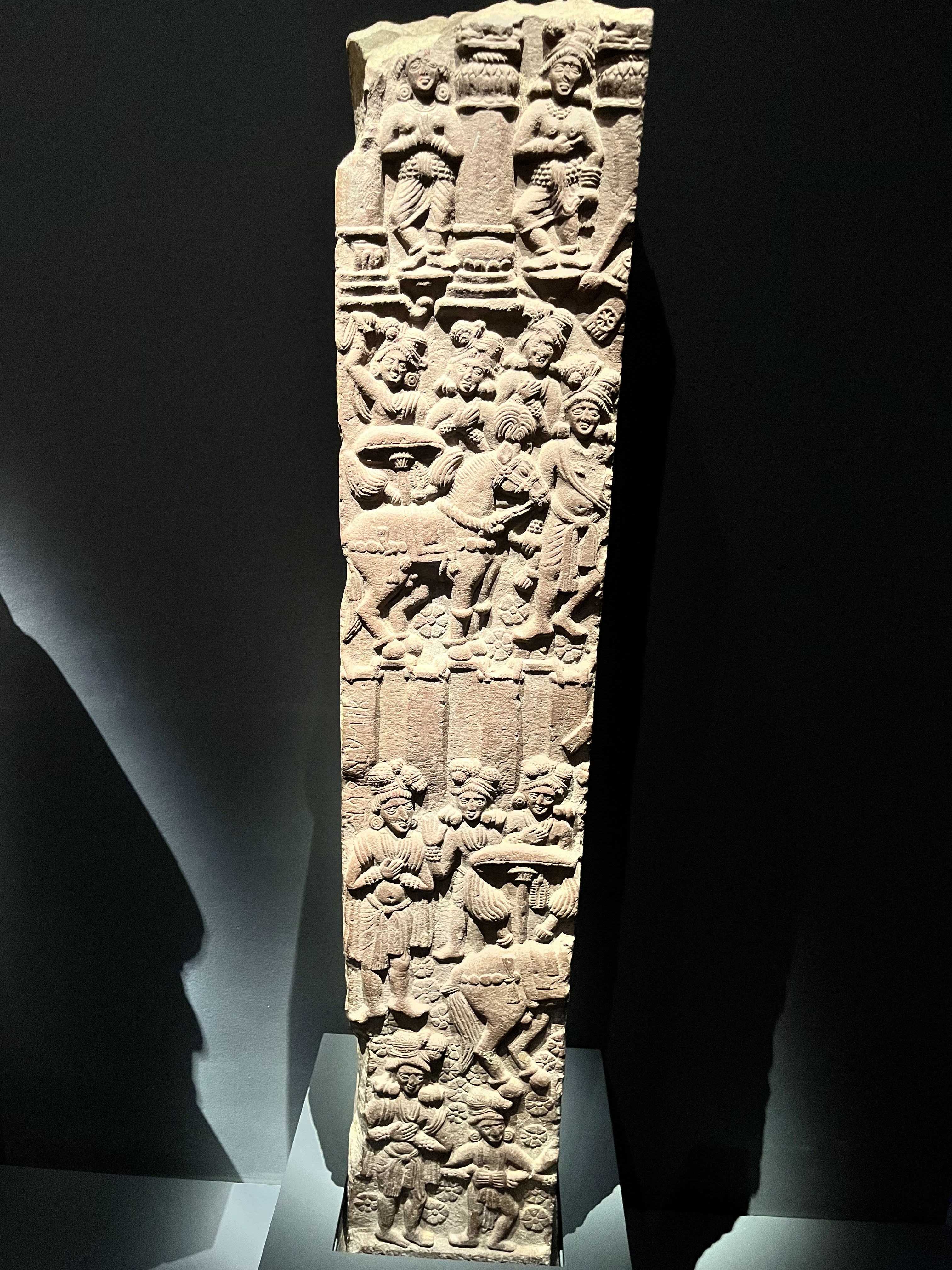
These are panels from a stupa from dating from 200 BCE to 400 CE From Bharhut Great Stupa and Piprahwa stupa. This art is later than the Ashoka pillars (260 BCE), and later than the Sanchi Stupa No. 2 (2nd century BCE). 

The exhibit has borrowed from many museums to bring this exhibit together. You can check out the large print explanations. If you can go see the exhibition in person, it's fantastic. 


Macalania: The audio section starts here. The protective naga. A tree, perhaps were the buddha was enlightened?


Mountain Climbers!


Yaksha


The yaksha is giving life to plant life. This mythology is pre-Buddha. Sources of luck and prosperity. The area of India is reliant the monsoons. Rain clouds are life giving. The monks appropriate the role of rainmakers to boost their power and role in society. 


The goddess of abundance...


All these relief rocks come from stupas:


Museum photos

 Maitreya


Mahavairocana.


Partying with the Buddha?


There are stone faces of an ancient ornate stupa. This one has Maculinda, a theme of quite a few relics on this exhibit, Tree & Serpent, at the Met. Awesome show.


This one is a presentation of the Buddha's crown. 


The wheel of the Dharma was turned when:

The Blessed One then asked again, “Kaundinya, did you understand? did you understand?”

Kaundinya replied, “Blessed One, I understood.  I understood.”

“Since venerable Kaundinya has understood the Dharma, he shall now be known as Ajnatakaundinya - the Kaundinya who understood.” (source)


Saturday, September 30, 2023

Akshobhya and blue

"a monk wished to practice the Dharma in the eastern world of delight and made a vow not to harbor anger or malice towards any being until he achieved enlightenment. He duly proved "immovable" and when he succeeded, he became the buddha Akshobhya." 

He represents mirror like wisdom, which perhaps means equanimity, a fairly advanced Buddhist virtue and skill, maybe not even attained until enlightenment. Unflappable. Steadfast. Non-reactive. Profound endurance and patience.

He resides in Abhirati, the eastern world and pure land connected by a staircase (source). The a paper from 2000:  "... in Aksobhya's  world  birth  does  not  result  from  ordinary  sexual  intercourse.  On the  contrary,  whenever  a man  looks  at  a  woman  with  desire  (for  in  this  world  desire  has  not  been  completely  eliminated)  his  lust  is  immediately  cooled,  and  he  enters  into  a  state of samddhi;  as for  the  woman,  she  immediately conceives  a child." (op cit). 

A desired food just appears. No need to do dishes. There are no precepts because nobody does anything wrong. 

"Though Mara is  present  in  Aksobhya's world  -   or  rather,  though  Abhirati  has  its  own  Mara  figure  -  he  will  not  attempt  to  obstruct  the  bodhisattvas'  progress,  and  without  such interference  they  will  all be  able to  attain  the  state of non-retrogression from Buddhahood." (op cit) You can also transport to another Buddha land if you think of it, so there's instant mental teleportation. You never forget a teaching or sutra, everyone has an eidetic memory. 

"No longer  do these paradise-like realms  appear  as  a concession to  the  needs  of  an under-achieving laity, much less  as  evidence for  the incorporation of  foreign  (e.g.,  Iranian)  or  non-Buddhist  (e.g.,  Hindu) ideas.  On  the  contrary,  the  existence  of other  Buddha-fields now  appears  as  a  logical  necessity,  elicited  by  the  mainstream  understanding  of the  requirements  of  the  bodhisattva  path  itself." (op cit)


I read the following:

Strauch, Ingo. “More Missing Pieces of Early Pure Land Buddhism: New Evidence for Akṣobhya and Abhirati in an Early Mahayana Sutra from Gandhāra.” The Eastern Buddhist, vol. 41, no. 1, 2010, pp. 23–66. JSTOR, http://www.jstor.org/stable/26289588. Accessed 30 Sept. 2023.

With all the sectarian bluster about short cuts, or most direct path, the Akshobhya sutra supposedly doesn't downplay the difficult of the path. I can't force myself to more than skim the article. I like the idea of Gandhara texts, but the reality has yet to catalyse anything. I can't say the Gandhara texts have really set the world on fire, but anything Buddhisty is what this blog is about, and it's not setting the world on fire either.


I dipped into Meeting The Buddhas by Vessantara. Sometimes he is shown an an elephant throne. In the image below he's holding a vajra. He is associated with sunyata. He can be shown touching the earth. The Mara asked the Buddha why he thought he could become enlightened. And his answer was to say he'd been working on it for a long time, the earth goddess was his witness. Perhaps it's addressing the audacity to imagine you could move towards enlightenment. 


I picked this jina to study today because I'm reading Bluets by Maggie Nelson. She writes about her obsession with the color blue. My first question was what Buddha is blue, and it's Akshobya. Her preoccupations are not Buddhist, but I read everything through the lense of Buddhism. Suggesting you rouge your nipples in blue isn't a Buddhist move really, but I also like reading wide and potentially off topic:


"Over the past decade I have been given blue inks, paintings, postcards, dyes, bracelets, rocks, precious stones, watercolors, pigments, paperweights, goblets, and candies. I have been introduced to a man who had one of his front teeth replaced with lapis lazuli, solely because he loved the stone, and to another who worships blue so devoutly that he refuses to eat blue food and grows only blue and white flowers in his garden, which surrounds the blue ex-cathedral in which he lives. I have met a man who is the primary grower of organic indigo in the world, and another who sings Joni Mitchell's Blue in heartbreaking drag, and another with the face of a derelict whose eyes literally leaked blue, and I called this one the prince of blue, which was, in fact, his name." (p. 6)

Nelson talks about Christian saints who avoid skeezy men by taking their blue eyes out, and I can think of instances of that in the Theragatha. It's really quite a classic, read it over two weekend retreats, and wow. Really vivid memory of being impressed, really want a hard copy of it to read from my bedside.

“...when the mines of Sar-e-Sang run dry (locals say the repressive rule of the Taliban, who, in 2000, blew up the two giant statues of Buddha at the mines entrance Buddhas whose blue auras were the oldest-known application of lapis on earth--caused a particularly long dry spell; God only knows what the American bombing has done since), the miners use dynamite to bleed a vein, in hopes of starting a "blue rush."" (p. 31)

Learned about Dionysius the Areopagite is a Christian saint, who's day is October 3rd. He was a convert of Paul the Apostle. There's also a Pseudo Dionysius the Areopagite. 

Maggie Nelson on freedom (YouTube).


Reading about Nelson's associations with blue, I come up with my own. My soccer team is blue. It contrasts with the red of it's rival. "New York is blue" is what you say when NYCFC beat the Red Bulls in the Hudson Derby. Hasn't happened this year, the team has struggled.
    The local vegan and vegetarian restaurants are from the Sri Chinmoy community. The memoir I read about growing up in the community, she calls it a cult. They wear blue and they paint their houses and business a baby blue.
    I saw Blue Men Group perform in the 90's. 
    Nelson quotes Neidecker, the poet of Wisconsin, who I long to read but haven't read.
    I love reading about new tribes, the Tuareg are a tribe in Africa wear blue. They call themselves Imohag, free. They are nomads that refuse to convert to Islam.
    The Prince estate just released Get Blue in 2023. Even from his grave.


Links:

Akshobhya Sutra

Blue Wikipedia: I need to figure out how to edit Wikipedia, because they ignore Buddhism.

Cyanometer can measure the blue.

The Marginalia on Bluets

Wednesday, September 27, 2023

micro and macro cosmos harmony

"The problem on the part of the microcosmos is how to become aware of that eternal harmony and to attune itself to it. To practice samadhi is to imitate the macrocosmic samadhi. The principle of Kükai's Esoteric Buddhist meditation comes ultimately from this basic intuition that the universe is in a state of eternal harmony."

From p. 90, Kukai: Major Works by Yoshito Hakeda (1971) Columbia University Press


Kukai thinks you should sit in meditation 3 times a day (p.96 Hakeda). (Combine that with Sangharakshita's 2 hours a day, you get 40 minute sits.) He thinks you should go for enlightenment. For the sake of enlightenment. 

I know people who are high achievers, do well in life, this is another problem they set themselves to, and it doesn't happen right away. If you knew it would happen after 5 or 10 years, you could know there was an end to it, but there is no end to it. Interminable. The revolution might be in your personal life, but if everyone went for enlightenment, I think we would have a very different society. I like to fantasize what that society would look like.

I learned Sangharakshita first, but I can see now why he's on the refuge tree of inspiration. There are many ideas from him included in the Triratna program.

I really like his take on Tibetan mythology, it's a unique take. I knew a guy who chose Vairocana 

Tuesday, September 26, 2023

Kukai

Stanford Encyclopedia of Philosophy introduction:

"Kūkai (774–835CE) is one of the intellectual giants of Japan, who ought not to be ignored in any account of the history of Japanese thought. Among the traditional Buddhist thinkers of Japan, and perhaps even of the whole of East Asia, he is one of the most systematic and philosophical. He is most famous for being the founder of Shingon esoteric Buddhism in Japan. But he is also remembered not only for his contributions as a teacher and scholar of religion, but for his accomplishments and innovations in social welfare, public education, lexicography, language, literature and poetry, literary theory, calligraphy, art, painting, wood-carving, sculpture, music, civil engineering, architecture, etc. during a period when Japan was undergoing rapid change." 

There's a lot there. Then there are specific things. Nakazawa Shin’ichi, "reads Kūkai’s works on Shingon as involving a hydrodynamic mode of thinking that in its flexibility deals with the non-Euclidean currents of nature with its forces of reality, undulating in ripples and forming vortexes." (op cit)

Imagine a time when you could make amazing contributions is such a wide variety of areas.

I'm fixated on the fact that he's almost at the midpoint halfway historically between the death of the Buddha and this current year. If the Buddha died 483 BCE and it's 2023, it's been 2,506 years since he left this mortal coil. Half of that is 1,253. 1,253-483=770. Kukai was born in 774. OK, so he has to get to 15 before he starts to study systems of thought, but maybe he's chanting a mantra before that, maybe later. Anyway, that's the closest to the midpoint in time, along with Saicho, of major Buddhists, that's the closest that I know to the midpoint between now and the parinirvana of the Buddha. 

Anyway, the end could be wrong. Maybe there are other prominent Buddhists in other places, I need to find other timelines and find out more about other countries at that time. Kukia's teacher Hui-kuo (Wikipedia, seen below), in modern day Xi'an passed his lineage down to another guy but I can't find information on him. That I can't find information on him on the internet in 2023 isn't that big of a deal. There's plenty of information not on the internet in English, that isn't exactly exhaustive. Maybe his teacher was at the midpoint. 


Hui-kuo was the first Chinese lineage holder of a vajrayana tradition. It took half the history of Buddhism for Vajrayana to spread to China.

There's nothing special about a midpoint, to be sure, it changes every second like everything else, except the mathematical novelty of it. There is a kind of mythology of numbers and mathematical ideas in various sects of Buddhism. I'm not sure if these ideas have any actual power beyond what you give them, but it's OK to give ideas power and kind of scaffold your way along. I see Buddhism more of a psychology in support of the path, than an actually theory you work to verify or disprove. Grinding on the path in meditation, fellowship, devotion, ethics and study is the thing. I can't look online for long at all the logic puzzles people think they have discovered, I wonder if they're meditating, or if they're just playing logic games, and it's quite superficial. With deep friendship in the spiritual life a logic puzzle could occupy a minute or two at most. People go online and foil Buddhism by pointing out that desiring to be enlightened is a desire. I don't agree with their assumptions, and the answer as to why that's not a problem involves terms I can't memorize. Letting the things that stick in my mind or not is perhaps not the best measure of general usefulness in Buddhism, but it's become my guide. 


Kukai had a motto about attaining enlightenment in this very body (p.78 Hakeda). Someone on retreat once told me he though my skepticism about rebirth, my consciousness moving after death, meant that I had to do it in this lifetime. Like rebirth takes some of the pressure of the difficulty of the path. Is that one of it's functions, a pressure valve?

Kukai's favorite deity was Vairocana, the primordial Buiddha, who embodies sunyata. It's a fun journey to travel around thinking about the various Buddha's and seeing which one supports your practice the most. When you do a sadhana you are attempting to merge with it, become it. Kukai is a manifestation of Vairocana.


Poem (p. 80):

All beings as individuals are appearances only, like illusions:

They are composites of forever changing constituents.

Our blind desires, which are neither within nor without, 

With their ensuing actions, delude us more and more.


The world is at once the creating and the created;

It is the Lotus Realm, the infinite continuum of Reality.

Neither empty nor non-empty, nor the oneness of the two, 

It is void, temporal, and yet real, beyond name and form.


Flowers in spring, though transient, are bright to our eyes;

The autumnal moon reflected in serene water delights us.

Swift summer clouds appear and disappear in deep dales.

Heavy snow in wind-dancing maidens seems light to the streams.


Inflamed is the world when we are greedy and deranged;

The sublime Universe emerges if we with insight are egoless.

Alas! Wretched are those who in delusion refuse to meditate.

Let us transcend and reintegrate ourselves in the Realm Eternal--A.


Kukai's version of the Vairocana mantra was different than the standard version (source):

vaṃ - oṃ amogha vairocana mahāputra maṇipadma jvāla pravarttaya hūṃ

Standard version: oṃ amogha vairocana mahāmudra maṇipadma jvāla pravarttaya hūṃ

Here's a version of the standard one on YouTube.


Found this daily practice example of Shingon practice on YouTube.