Sunday, March 06, 2022

A line of thinking

So there's the case where the monk's family doesn't have an heir, and the family wants a grandson. The fellow has already robed, and taken vows. But he goes off into the woods and fucks his ex-wife three times, and she has a baby. 

The coda to the story is that his wife and child later become monks, so in a way the family didn't get a heir even though they got another child. (source)

The Buddha is upset. He's more worried about the reputation of the sangha it seems. Now the sangha is seen as something more flexible than he intended. 

He says it would be better to put your dick into a snake, a fiery pit.

Now maybe that only applies to a monk, sure. But doesn't he recommend becoming a monk if you're really serious? Lay Buddhists are nice and all, but the whole program is set up for a kind of goal and the goal kind of invites one, like a slippery slope, to go for it. 

Later on in Mahayana it might be a bodhisattva act to fuck an ugly old woman. Sangharakshita thought a monk who had a family secretly on the side was a better monk than the other monks who didn't have a family on the side. Who knows if these thoughts violate the Buddha's intentions. He could not have anticipated the developments and worldviews of the future. Was the Buddha's attitude only of that culture, of those times? How much does it enter into our own times.

That gets me to the question: Is anything but a monk's life for a Buddhist? I mean I know there are millions of people who think they're Buddhists, but their adherence to the teachings are minimal at best. A culture developed around lay practice, ethics, and such. 

I reject the duality of monastic versus lay. But would you ever really progress with anything unlike a monk's life. I mean I'm sure you can have deep meditative experiences, a level of insight that is useful and pragmatic to a worldly life.

There's the image of a rubber band snapping back to its original shape. Is that what the lay Buddhist does when they go on a retreat, and re-enter their lives? 

Cold Mountain has a poem that disabuses us of the idea of a kind of spiritual bypass of practice. To imagine some amazingly wild mental state for a devoted monk is a bit hopeful. 

Ths shame the Buddha puts on the monk is quite extraordinary, if that's what he really said. It makes you think of the sex scandals in sanghas in America. They really put the sangha in danger. Richard Baker's expose in the book Shoes At The Door for the San Francisco Zen Center. Yashamitra's letter to the order about Sangharakshita in Triratna. A Shambhala temple in Boulder just filed for bankruptcy. It's hard not to imagine Chogyam Trungpa's parties where 7 year olds snorted coke aren't part of that. 

The story of Buddhism in America is almost a story of sexual misconduct and failure. The internet has been scrubbed of many of these stories by well meaning people who hope to grow the sangha. Cutting Through Spiritual Materialism is still recommended in book recommendations of r/Buddhism on Reddit. All that makes me think it's easier to say things, harder to actually do them. It turns out that Trungpa was perhaps the most spiritually materialist person out there. The legacy he left to his son is that his son copied his behavior and leads a faltering sangha. 

Now I think when people do worldly things, that doesn't take away from spiritual ideals, it only tells us to be wary of others manipulation, and how hard it is. Never discount your feelings of what is right and wrong, don't do something that feels wrong. Especially young women. But there are other abuses. I read about a woman who sold her house and gave the money to the sangha and then they charged her rent to live in the temple. That's assuming something without getting it in writing, but still I wouldn't put the fault on her.

How did I spin off onto things that take you away from the ideals. The Dhutanga monks.

The middle way can justify anything, but there's difference between almost starving to death and having some rice milk, and having another bowl of ice cream after a hard day. Not to diminish psychic suffering. I think the suffering in middle class America is quite intense. The pressure to live up to a certain standard of living is immense. 

This tension plays out in the Theravadin prohibition on music, versus the love of music as pointing to the beauty of the spiritual life. Banning of music seems extreme. Monks doing heavy metal seems kind of silly but harmless.

So as always, with something deep, the question is do you just leave it alone or do you go deeper and deeper? Is there something wrong with the dilettante path? Some Zen people would have you believe the life of a flaneur is also part of a Buddhist path. You can't just snap it together and be good for a week or a lent's worth of abstinence. Every second of every day has to be a pitched battle of vigilance and confrontation?

Isn't a worldly life also enhanced by some lent like abstinences, temporary forays into controlling our wants. We do the best we can and are the judges of what is useful to us. There are no shortcuts and easy workarounds. Spiritual bypassing is a mistake. Most of the professional Buddhists in America are lay and they lead fairly conventional lives with meditation retreats mixed in. Maybe mappo is among us and nobody can get enlightened. 

People try to find out who's enlightened on the internet. Is it an urban legend? Who's really enlightened right now? Cause maybe I'd go learn from them. The hope that someone else can give you something you don't have. And yet the Buddha shared what he'd learned and others got it. 

I don't know if I'd notice if someone is enlightened. I've had a really good meditation next to someone with a deep practice, and I think I distracted someone with my distracted practice once. How much is projection and how much is whatever, I don't know. I'm disinclined to go for the magical elements and shamanism of Buddhism. 

People fear, what if everyone joined the path and we didn't have any children any more, wouldn't humans die out? I think the path is so subtle and hard, it seems unlikely, more likely is that enlightenment will leave this earth and the prophecy of mappo will come true.

Some people say I don't know what enlightenment is, I just want to be a little kinder. That's a good goal and if more people were like that, that would be great, but enlightenment is kind of a lynch pin of Buddhism, even if you can't describe it with words, only define it negatively.

Which is to say I want to try harder in the spiritual life by my worldly life distracts me, and I lose focus. 


Thursday, March 03, 2022

Cold Mountain


Zen Buddhism for anybody Vol. 1:

Halos by day; horns by night

There’s a long boring argument among scholars, over the enlightenment or non-enlightenment of some legendary Zen poets.

Their arguments cover a large, varied and curious field of nonsense, but most agree on accusing the work of poets like Cold Mountain, Ikkyu and Ryokan of quite regularly expressing feelings of sadness and desire, which, according to these funny scholars, are not compatible with the Buddhist ideal of detachment.

That is: “They wrote poetry about feeling sad, or hungry, or lonely... Enlightenment is supposed to transcend these feelings; thus, they were not enlightened!”

One might immediately notice here how these poor dummies are beating their heads against the very same barrier that blocked our friend Ming in the previous koan. They are wrongly interpreting Buddhism as an escapist idealization of some “fantastical rainbow world” with no blockages, no sadness, no desires... This is the kind of mistake which could get a fool reborn as a fox five hundred times...

Attached to the fantasy that “it would be far better never to get yourself dragged by the net to begin with”, we block ourselves from understanding the freedom of the golden scaled koi fish as it jumps out of the net.

Of course that Ryokan and Cold Mountain and Shakyamuni and Bodhidharma and me and you – each and every person was and is exposed to the countless nets in the sea. We’re all affected by pain and hunger; by frustration and misfortune...

You can’t “meditate yourself” to some inhuman world that is absolutely free from difficulties and from suffering.

It should be stressed that Zen’s ideal (or, at least, Zen’s ideal as described by some of its most renowned masters) rejects none of our natural human conditions. It actually employs, in this non-rejection, the same stubbornness that it dedicates towards its non-attachment to them.

In a good mood,
The enlightened person becomes a Buddha;
In a bad mood;
Fur and horns grow on the body.

“Detachment” does not mean “rejection”.

Should we really reject part of what we are, so that we maybe correspond to some imaginary ideal; or should we just be exactly who we are?

To hope for a river where no nets are falling from the sky, or to develop the art of jumping out of the net? One of them is the essence of Zen; the other one is a prejudice from people who know nothing about the essence of Zen.

In a nutshell, the idea of Buddhist detachment and enlightenment as “beds of roses”, different from our daily experience – different from the natural world, and independent from it – corresponds to the “kitsch” interpretation of Zen Buddhism.

The kitsch is like covering the ears and screaming LA LA LA at the same time, trying to block the problems of the world by isolating oneself in a cozy and frail fantasy-bubble where feces don’t exist.

Zen Buddhism, in the opposite direction, is a school notoriously known for its contempt towards fussiness and sanctimony; a school from which some of the most prominent masters were making poetry about feces.

An old Chinese saying preached:

"Never fix your sandals when crossing a field of melons, and never straighten your hat when you’re under a peach tree. People will think that you are stealing fruit."

Well, it was precisely a Zen Buddhist monk who replied to this saying with a poem, like this:

Brothels and bars!
No tree and no fruit
Should ever prevent a Buddhist
From straightening their hat!

Savannah Brown


Lora Mathis


Wednesday, March 02, 2022

Parasite (2019)

I really liked the 2019 Foreign Film Oscar winning movie, despite it's gruesomeness. 

There's one scene that reminded me of Zen Flesh, Zen Bones. There's a story in there. A person is chased by a lion, falls off a cliff. Catches a vine. Elephants down below roaring at the person. Ants crawling, gnawing away at the vine. A bee hive is jostled, and a bit of honey drips into the mouth. 

That is what life is like. Soon to be dead, in great danger, and we focus on a bit of honey. Pleasure is very important to humans and perhaps our downfall. And yet asceticism works, never mind few Americans try it. I mean Americans as north Americans, Mexico and Canada joined in with the USA.

There's this one scene in Parasite. The toilet is squirty shit water as the sewers are backed up, and the sister just climbs a little higher, shuts the toilet seat, and enjoys her cigarette as the shit water squirts out.

Cigarettes aren't pleasurable, but the release from the nicotine withdrawal, is close to pleasure. The release from pain is very close to pleasure and good enough for most humans. It must be wonderful to have that as an option of release of pain. And to join the cool people who smoke. I used to go out on smoking breaks but not smoke. It's a glorious social time. But I hate smoke, I was a runner, and love my lungs too much.


The new moon of February is the New Year day for Tibet. Happy Tibetan New Year!

My take on whether secular Buddhism is real Buddhism.

I think this is a battle of worldviews, culture and the battles inside us.

In modernism, a modern view of the world takes up Buddhism, westerners are skeptical, scientific, often refuges from a Christianity that insists of belief. Seems like Buddhism doesn't have orthodoxy, but orthopraxy, where it's what you do that counts: Meditate, study, reflect, commune, be kind. With the perfection of wisdom tradition there's even a sophisticated almost postmodern viewpoint. A leading spokesman is Stephen Batchelor who broke with Tibetans and went to Korean Soen. He articulated it beautifully, but when he got more into the Pali Canon faltered a bit.

Then you have credulous traditional eastern Buddhist who are rightly twitchy about colonialism and people thinking they know better. They run into the western modernist and don't recognize the Buddhism that is deeply embedded in the culture they hope to preserve. They might insist on a more literal polytheistic worldview, maybe haven't read the perfection of wisdom tradition, and they can behave like an orthodox Christian who focuses on believing questionable metaphysical things literally, in this day and age. They go hard on right view and say modernism just isn't even Buddhism, too much syncretism. Are they protecting the tradition or gatekeeping and confused?

You're allowed to make sense of the tradition and think for yourself. I interpret the story where the Buddha whisks a monk off to the realm of 33 gods as a lovely mythological story that isn't literally true. When I called them the 33 Hindu gods, I was corrected, Hinduism didn't really exist then and they wouldn't have gone away in Buddhism, if you believe in them. I think the mythology of Avalokita and archetypal Bodhisattvas is beautiful and a Jungian could go nuts. So it's not like we're really stripping away that kind of thinking, it's just we don't think you need to pay some kind of belief price to enter. This makes a traditionalist uncomfortable, and the different ways of using language clash in a kind of misunderstanding that seems like there are two different ways of being, and the traditionalist can be persuasive to the insecure who distrust their thinking and want to be obedient. To the modernist it looks a lot by all the harping on obedience in Christianity, regardless of your own thinking.

Buddhism is rooted more in your experience because meditation is about your experience. Christians who went on long meditation retreats have said this is what spirituality is really about. We can't talk about the transcendental because it's beyond words, but I see all the God talk as trying to connect to the transcendental and the mysterious.

On top of that the Pure Land tradition smacks of a trying to get to heaven thing. I don't believe mappo, that the world has degenerated so that nobody can get enlightened any more. That seems like a statement that you can't prove, and a self fulfilling prophecy. I get it that it takes the foot off the pedal and you can just try for enlightenment in the next life, and it brings in more Buddhists. Pure Land is the most popular form of Buddhism. I love the Pure Land sutras, but I take them as inspiration to get on the cushion. And since USA is a Christian nation, Thich Nhat Hanh used to use Christian language to communicate the Dharma in English. To the anti-Christian that's hard to swallow.

Then to accuse the person who rejects the Christian power games, to be called a colonialist is quite challenging. I'm not trying to influence anyone's practice and I'm not a teacher, I'm just discussing how it all makes sense to me. I'm not going to get upset if you call me not a Buddhist. But I also don't think it's a philosophy, I do think it's a religion. And most secular Buddhists are folded into a traditional sangha, and just don't talk about that stuff.

Buddhism has interacted with Confucianism and Taoism in China, and it must interact with the modern world. It must stand the buffeting of ideas the Buddha never commented on, forms of government, scientific advances like DNA, and the rapid change due to technology, and social media. We can see through the patriarchal systems of power. A Buddhist informed westerner with a highly educated and sophisticated worldview is welcome in Buddhism I hope.

Some of the newer forms of Buddhism are marginalized because they try harder to modernize, and they have good teachings, but NKT and Triratna have been marginalized on this subreddit because there have been very human growing pains and abuses of power. There are other traditions that maybe should die because of the level of abuse. The very public scandals that are well documented show the abuse of power and exploitation, and traditional forms seem to do better in fighting an anything goes abuse of power, so there might be some wisdom in being a traditionalist.

Even if Chinese immigrants brought Buddhism to North America 500 years ago, Buddhism is very new in North America, and there are many things to figure out. Add to that in the USA we are battling a political worldview that spits personalities in half, those who want a minimalist government and those who want to try to ameliorate some of the systems that hurt people, modify capitalism into a kinder form. There is a lot of confusing manipulation to try to get their way, information wars. And the leave-me-alone ideology has won a lot lately, it's almost an anti-awakening movement. There is great turmoil in the USA at the moment, growing pains for a young nation. And traditionalism versus progress is part of that. Traditionalism isn't bad, my relatives who stayed in the church don't have drug problems, they build stronger families. And yet I've lost 40% of my friends lately because of politics and culture wars. America is deeply troubled and I almost could see mappo. The pandemic has been very stressful. Then look at what is going on in Ukraine.

There are still monasteries and great teachers who haven't been disgraced or abused power, and many foreign teachers who are willing to try and seed Buddhism in North America. America has an intellectual meditation focused Buddhism, but is weak on community because our society is so fractured at the moment, our rugged individualism, and traditional sanghas are foreign, cling to foreign culture. There is no true American sangha, except maybe new movements in a lay Theravadan tradition in IMS, where you're also allowed to have a secular bent. I have no wonder that traditionalist eastern Buddhist are shaking their heads at the wooly headed Americans. Meanwhile after years of horrible Civil War, Sri Lanka is on the brink of financial collapse. If only the chaos in my head and the chaos in the world would go away. And yet, that is the very mud for the lotus.

Monday, February 21, 2022

Buddha images


Dudjom Lingpa He stands out from the norm of Tibetan Buddhist teachers in the sense that he had no formal education, nor did he take ordination as a monk or belong to any established Buddhist school or tradition of his time.

Thursday, February 17, 2022

Wednesday, February 16, 2022

Happy Sangha Day!


The community of people who bring the teachings forward is the 3rd jewel in the three jewels. The Buddha is the example of enlightenment. The Dharma are the teachings of enlightenment.

I'm so grateful for the people who have preserved the teachings, it's truly amazing I can read them in translation. I'm grateful for the various sanghas throughout the world, and especially the ones that have come to my city and supported my journey. I hope to give back. 

Happy Sangha Day.

TTH article on Sangha

Monday, February 14, 2022

Sakya

I'm just a practitioner who is trying out a new sect, I don't represent the tradition in anyway, only my experiences in trying to hang out online. I aspire to the utmost respect for this sacred lineage. I also aspire to be authentic and real. 

"she who has no self" 
She is an embodiment of the Buddhist philosophical concept of anātman 
(anatta in Pāli).


I'm going to do a deep dive into Sakya tradition. I spent time online listening to a teacher, doing a puja, and in meditation, with a really wonderful meditation teacher who was leaving for some time. Some of it was familiar. Some of it seemed unfamiliar. My daughter was with me so there were some interruptions and I meditated while watching her at the park in the snow.


Researching online:

General: Sakya means pale earth: Wikipedia, Rigpa Shedra

Founder: Virūpa (See below)


Founder: Sachen Kunga Nyingpo

Five Sakya Patriarchs

Founding monastery founded by Khön Könchok Gyalpo

Leader

Current Leader

The Path and Fruit


I am currently reading: Trichen, Chogyay. History of the Sakya Tradition, Ganesha Press, (1993). And Lamdre Dawn of Enlightenment by Lama Choedak Yuthok (1997).

If I had money and time I would go to Tibet for Saga Dawa Festival in June. Looks amazing. (Saga Dawa Festival) I'll settle for a push to prepare myself for this.

I forgot what having something to look forward to can do for my motivation and excitement. I forgot the bump you can get from being with sangha.

Here are videos I found

Devotion vs Cultishness in Buddhism, HH Sakya Trizin (YouTube) 2 minutes.

What is the Sakya Tradition? Sakya Trichen - Buddhism Explained (2018) (94 minutes) Tibet House NYC. It's interesting in the question and answer, he's very much in favor of equality of opportunity for women. He recognizes women's contributions. He thinks study and meditation are equally important. You study to meditate. Regarding consciousness surviving death, he points out you can't sense consciousness. He thinks those who practice will grasp the clear light, remain in meditation when consciousness leaves the body, and I guess he said goes out into the universe. 

Living a Virtuous Worldly Life According to the Dharma by H.H. Sakya Trichen (50 minutes). He talks about the Jewel Garland.


Other Links:

The real reason the Sakya Trizin resigned: It's not clear why the order went from lifetime leadership to 3 year terms.

Learn Tibetan language.

Short Sadhana of Dorje Shugden (More associated with Gelugpa tradition) 

About Dorje Shugden


Further Resources 

Compendium of Sadhanas by Jamyang Khyentse Wangpo (1820–1892) and later supplemented by Jamyang Loter Wangpo (1847–1914).

Saturday, February 12, 2022

Jayarava on rebirth on twitter

Jayarava on twitter:


The thing about karma from a Buddhist pov is that *it's all bad*... because, good or evil, karma *leads to rebirth*. 

Ending rebirth (as a sentient being) is the main goal of traditional Buddhism.


This is why I readily admit that my denial of the "truth" of karma and rebirth is nontrivial. It *is* heresy but not quite apostasy.


In 2022 traditional, Iron Age, views have to be seen in a broader context. 450 years of science make a difference. Don't be fooled by the uncertainty at the extremes, we know to nano precision how the local universe works - and the internet itself is a monument to this.


I don't advocate Scientism. But I take science seriously, unlike most Buddhists who are science-illiterate and -innumerate. I also take history seriously. And I read scripture seriously, in canonical languages.


Buddhist don't possess a *Buddhist* description of the universe that is worth a damn. Our "cosmology" literally emerged from a satire of Brahmanism. Our eschatology is fully supernatural.


What we have (left) to offer is a set of techniques for exploring the nature of sensory experience, most notably forms of auto-hypnotic sensory deprivation that result in the cessation of experience without loss of consciousness.


But our techniques are mostly embedded in regressive sectarian religious dogma. And this is counterproductive, because most people immediately see through the ruse when we talk about "Ultimate Reality". (I was embarrassingly slow at this).


When you are cut off from reality, due to extended periods of sensory deprivation, then what reality is like becomes irrelevant. Unless we mistake absence of sensory experience for reality (which many do). 

Tuesday, February 08, 2022

Hanshan, Fenggan and Shide

Another Red Pine documentary, this one about Cold Mountain, also known as Hanshan. With Burton Watson, Gary Snyder, who's poetic name is Listen To The Wind. Watson says the Japanese took up Hanshan more than the Chinese did. This 29 minute short is fun.

Cold Mountain had 2 friends, sidekicks, his entourage, one called Big Stick (Fenggan) or and the other called Pickup (Shide) or Foundling. The friends were both monks, but Cold Mountain wasn't. He was an eccentric poet. Pickup has a story about how he got his name: "Fenggan was travelling between Guoqing Temple and the village of Tiantai, when at the redstone rock ridge called 'Red Wall' (赤城) he heard some crying. He investigated, and found a ten-year-old boy who had been abandoned by his parents; and picked him up and took him back to the temple, where the monks subsequently raised him." The boy was Pickup, and he was found by Big Stick, who was tall.


Hanshan and Shide (Foundling)

They lived in the Tang dynasty, which is 7th and 8th century. They don't know where he came from, but there's a Hanshan temple in China today. They were also around Guoqing Temple in legend. In the film they eat a meal at the cave where Hanshan lived, called Cold Cliff, a days travel from Guoqing Temple (Source). Tiantai mountain is there.

Guoqing Temple is spelled Kuoching by Red Pine, and it's supposedly where the Tientai sect of Buddhism was founded by Chih-yi in the 6th century, spelled Zhiyi on Wikipedia or maybe that's a different person because they said he was the 4th patriarch, and a great systematizer, founded an indigenous version of Buddhism. He wrote a commentary on the Lotus Sutra. Another book to read. "According to David W. Chappell, Zhiyi "has been ranked with Thomas Aquinas and al-Ghazali as one of the great systematizers of religious thought and practice in world history.""

I really like these Chinese hermit poets. I'm reading the Red Pine 2000 translation of his poems that includes Big Stick and Foundling's poems too.

Stonehouse


Roque Dalton poem


Pure Land

The pure land is a psychological construct that sets up a positive hope and focus, for the service of equanimity, in an aide on the path of friendship, study, ethics and meditation.


Friday, February 04, 2022

Kawanabe Kyōsai - Jigoku dayu (Hell Courtesan) (1874)


Thoughts on a Nichiren video

I'm a Buddhist modernist, secular Buddhist in bent. My skepticism isn't meant for trying to convert people to my way of thinking, just an expression of my thoughts. I'm not a Buddhist teacher. I grew up in the Triratna order and have been sanghaless for the past 10 years, sampling but never committing to a new practice. Recently I have become enamored of the Chinese hermetic tradition, the way I was of the Thai Forest Tradition, the Sri Lanka Forest Tradition.

I read on Reddit people who claim that Triratna isn't even a Buddhist sect. That seems pretty extreme and disrespectful to people's spiritual effort, and I don't fall for that kind of gatekeeping. One fellow seems sincere in directing people to traditional sects, because he thinks that's the right thing to do. I'm not sure if I could discuss things with him. I'm pretty sure every sect has had fishy stuff going on, and that doesn't invalidate the sincere adherents. There are sects I would avoid, but I think everyone has to make that decision for themselves. Just like priests molesting altar boys doesn't take away from the spirituality because worldly acts don't take away from attempts to connect to the transcendental. 

I believe that syncretism with modern ideas doesn't invalidate a movement. The Buddha doesn't have anything to say about social media, various political developments, or any of the many many developments in society over the past 2,500 years since his death. We can apply the principles, but there's a wide range of ways of applying them and no key. The Buddha didn't even give an example of what minor rules to get rid of in the vinaya, so what you see as a minor rule will depend on a limited human judgement. Never mind the other developments. 

I agree with sangharakshita by rejecting the lay/monk split. I agree that chanting the refuges and precepts is the act of a Buddhist, not a sect's belief in reincarnation, though I keep a humble open mind about the tradition and admit I don't know everything, in fact it's my skeptical nature that leads me to say we don't know much. I think lineage is a fairy tale, another glorious mythology, but alas one I don't share as a hermit. Therefore I'm not super traditional and will let Buddhist ideas swim amongst a rich soup of ideas. I still think it is Buddhism, and I'm more of a big tent Buddhist than a retrenching traditionalist who dislikes westerners colonist appropriations. I'm colonizing nobody except through the memosphere with text and images, and that's only by accident in expressing myself. I think this intersection with the western modernism and Buddhism is fascinating and will take hundreds and hundreds of years to process.


I watched this video on Nichiren Buddhism. Beautiful reverence and worship of the Lotus Sutra, which is an amazing magical book. I hope to reread it soon. What a glorious and amazing story this animated cartoon video presents. 

It's not true that The Lotus Sutra was the last teaching of the historical Buddha, but you could say it emanated from the Buddha nature, the Buddha head, and part of the tradition is to claim any teaching the Buddha's teaching if it's inspired by him. Instead of an outlandish claim that my skeptical mind rejects, I prefer that it's just reverence for a wonderful sutra. 

The Pali Canon has more claims to be the teachings of the Buddha. They're what's written down hundreds of years later after the Buddha died, when writing became more of a thing. It's almost a miracle that we can read it today, it was preserved in various places, but one was in Sri Lanka. Between the Pali Canon and the Lotus Sutra is a lot of Buddhism. 

Simplifying is an important act, people who ask what to read in Buddhism will not find a straightforward answer. I saw follow your interests and develop an understanding. Quitting reading will be the only thing that limits your understanding. Reading the wrong book won't kill you as you gain a context to put it into, and use your critical thinking skills.

The Nichiren sect focuses on this one sutra, and with all the flurry of information, and in any person's practice however ecumenical, they only draw inspiration from a subset of the total literature of Buddhism. I'm always finding something new to read. The problem for me, is to begin to understand the sutra you really have to begin to know the whole history of Buddhism to realize it's importance. 

Nichiren adds more onto reverence for a sutra. A reverence for a mantra. There are times when nationalistic ideas and reverence for one's ancestors is drawn upon. Zen priests collaborated with the war efforts from World War 2 in Japan (and elsewhere). Most sincere practitioners would have stayed out of it. It's utterly human to get swept up in the times, and to ignore the times. I ask myself if I'm doing enough to counteract the wrongs of my times. Anyway, nationalistic ideas don't feel like Buddhism to me. I wonder if an American Buddhism would help it's development. I don't think so though.

We do not know that mappo is true. Mappo is the idea that the world has degenerated too much for enlightenment to be present. Part of that is the idea that the teachings are not present in the mappo era. I find the teachings are present. While I am attracted to collapse ideas about our society, it's mostly because of environmental and human growing pains accepting responsibility for freedom. I'm afraid that mappo could be a self fulfilling prophecy and I want to turn that the other way. We're heading to a pure land. 

I'm attracted to pure land mythology, and have read and listened to the pure land sutras. The sects built off those are questionable to me, smack of Christianity influence, but as a big tend Buddhist, they are still Buddhism and I am interested in them. For me the pure land ideas are more inspiration to really meditate, conduct oneself with ethics, devotional activity, friendship and to study the Dharma and history of Buddhism. You don't have to be a Pure Land Buddhist to draw inspiration from the sutras. 

The Lotus Sutra is a glorious document, without all the rhetoric about its importance, it doesn't need that. Perhaps it's devotional expression, and I'm misreading them. There are so many different ways of talking and making sense of it all. We agree more than we usually think, and where we do disagree, that's OK too. People are responsible for their own spiritual journey and there are so many people who are willing to guide you. One thing that has happened in our capitalist society is that all the meaning has been drained out in the name of profit, and so people seek meaningful careers, and there are lots of career Buddhists in the USA. I've been going the other way on that, embracing self reliance. 

Nichiren is a glorious beautiful Buddhist tradition that rubs me the wrong way at different levels that I've expressed above, but that's OK. I'm just one voice.


Friday, January 28, 2022

Pure Land? lyrics in the garden susan tedeschi

When I wake up in the garden

Peaceful slumber wakes my eyes

The sun and moon are always present

There are no more crying people around

Love fills all up inside me

Filling my heart with wishful dreams

No more sorrow fills my canvas

Along this lonely sea

Ships fall off of the horizon

Bringing love, peace, and joy

No fire can ever harm us

Only music fills the air

Silver turquoise teardrops drip down

Into a window of your soul

Touching your emotions with sorrow

Of a thousand years of wisdom sold

Love fills all up inside me

Filling my heart with wishful dreams

No more sorrow fills my canvas

Along this lonely sea

Silver turquoise teardrops drip down

Into a window of your soul

Touching your emotions with sorrow

Of a thousand years of wisdom sold

Of a thousand years of wisdom sold

When I wake up in the garden

Peaceful slumber wakes my eyes

[end]

I know the garden is traditionally seen as Christian and Tedeschi sang in Christian gospel choirs, but imagining a perfect world, a pure land, is so fascinating to me.

Joan Halifax Standing on the Edge quotes

"I grew up in southern Florida. Every year of my childhood, hurricanes turned our neighborhood upside down. Electric lines crackled in the wet streets, old banyan trees were uprooted from firm earth, and terracotta tile roofs were blown completely off the Spanish-style stucco houses in our neighborhood. Sometimes my parents would take my sister and me to the beach to watch the hurricanes come in. We would stand at the water’s edge, feeling the force of the wind, the slap of the rain. And then we would quickly return home, open all the windows and doors, and let the storm blow through." 

Joan Halifax Standing on the Edge.

"The Buddhist concept of interdependent co-arising also gave me a new way of viewing the world: seeing the intricate connections between seemingly separate things. As the Buddha explained this concept, “This is, because that is. This is not, because that is not. This comes to be, because that comes to be. This ceases to be, because that ceases to be.” Looking into a bowl of rice, I can see sunshine and rain and farmers and trucks driving on roads."

"I have a friend who was a dedicated and skillful psychologist, but after years of practicing, he had caved in to futility. In a conversation with me, he confessed, “I just can’t bear to listen to my patients anymore.” He explained that at a certain point in his career, he had begun to feel every emotion his patients were going through, and he was totally overwhelmed by their experiences of suffering. The constant exposure had eventually dried him up. At one point, he couldn’t sleep, and he was overeating to relieve stress. Gradually, he had moved into a space of helplessness and emotional shutdown. “I just don’t care,” he said. “I feel flat and gray inside.” Worst of all, he had begun to resent his clients, and he knew this meant he needed to get out of his profession. 

His story exemplifies the negative outcomes of a combination of all the Edge States: what happens when altruism goes toxic, empathy leads to empathic distress, respect collapses under the weight of sensitivity and futility and turns to disrespect with a loss of integrity, and when engagement leads to burnout. Suffering had crept up on the psychologist, and he began to die inside. He could no longer absorb and transform pain to find meaning in his work and his world. My friend is far from alone in his suffering. Many caregivers, parents, and teachers have confided similar feelings to me. Part of my work has been to address the devastating epidemic of futility, which leads to a deficit of compassion in people who are expected to care."

Wednesday, January 26, 2022

Shiwu

Shiwu (1272–1352) was a Chinese Chan poet and hermit who lived during the Yuan Dynasty. He got the nickname Stonehouse because of where he lived as a hermit in Yushan, in the north of China. He studied under master Yung-Wei and three years later was ordained and received the dharma name Ch'ing-hung. Kao-feng took him as his pupil and gave him the koan "All things return to one" for study. He had more adventures with another teacher, and then in 1312 at the age of forty he moved to Xiamu Mountain near Huzhou. He composed his "Mountain Poems" (Shan-shih), one-hundred and eighty-four verses mostly dealing with life in the mountains. He had stints as abbots at various temples, seems like 3 times. 

I'm reading The Mountain Poems of Stonehouse translated and commentary by Red Pine. I really like it. This book, like the one before, could bear rereading.

Red Pine went to the monastery where Shiwu studied for 3 years with Kao-feng. The abbot had never heard of Shiwu or Stonehouse or Ch'ing-hung, his nickname and ordination name.


His last poem before his death: 

corpses don't stink in the mountains

there's no need to bury them deep

I might not have the fire of samadhi

but enough wood to end this family line

Ching An

Ching An is the last poet in this anthology The Clouds Should Know Me By Now.  He chopped off 2 fingers in his early zeal and later wrote a poem about how foolish he was. He was called the 8 finger monk. 


Tuesday, January 25, 2022

Chinese Buddhist Poetry


I'm reading The Clouds Should Know Me By Now (1998) first which is a collection from 6 poets. Edited by Red Pine and Mike O'Connor

Chia Tao is Jia Dao (779–843) on Wikipedia. His ordination name was Wupen, and later Wandering Immortal (Lang-hsien). Han Yu (768 – 824) was his poetry mentor. Su Shi didn't think much of his poems. An interesting story is the one where Chia Tao met Han Yu. He was riding a donkey into the market and kept trying out "push" and "knock at" a gate, and bumped into him. The story coined the phrase of poets trying to pick words as "push-knock". At 31 he abandoned Ch'an monasticism in Chang'an for the lay life of poetry and working in civil service. Meng Chiao (751–814), Chang Chi (712 - 779) and Han Yu and Chia Tao formed a group of poets. (I'm taking Red Pine's spelling over Wikipedia.) In China Buddhism, Taoism and Confucianism are intermixed. He quested for poetic mastery and people who appreciated his poetry (chih-yin). He is compared to Wang Wei (701-761). He often wrote in the form of Tu Fu (712–770). I have now referenced 6 other poets in describing him. He wrote 404 poems. Pine translates 20 poems, neither of the short ones below.

The Swordsman
A decade long I honed a single sword,
Its steel-cold blade still yet to test its song.
Today I hold it out to you, my lord,
and ask: "Who seeks deliverance from a wrong?"

Gone is the guest from the Chamber of Rank,
And petals, confused in my little garden,
Zigzagging down my crooked path,
Escort like dancers the setting sun.
Oh, how can I bear to sweep them away?
To a sad-eyed watcher they never return.
Heart's fragrance is spent with the ending of spring
And nothing left but a tear-stained robe.


I say 6 poets but one chapter says 9 monks and a guy, so it's not 6 different poets, there are 15 in total.

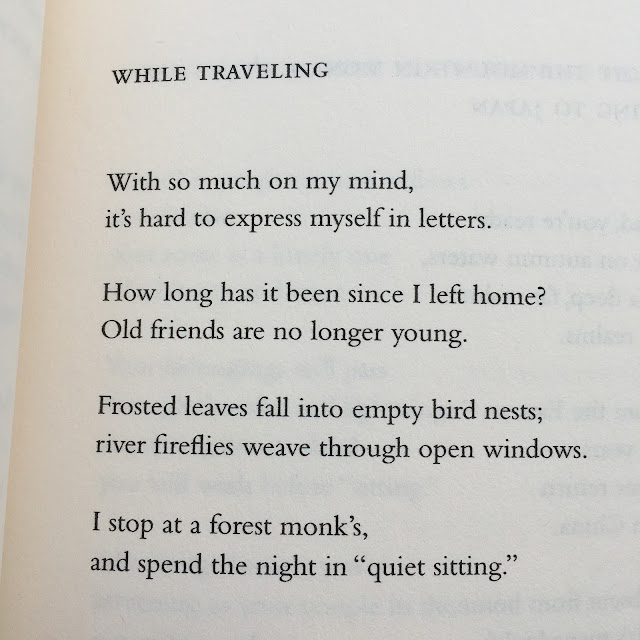
The next poet Ch'i Chi is similar, and it as the end of the T'ang period. He sees a leaf fall into a bird's nest too, like Chia Tao. I guess that's death entering the house, maybe not. Sometimes a leaf is just a leaf. 

Anyway, I really like this book. I'm putting it on my reread list after I read it, because I don't think I've gotten everything from it.


Saturday, January 22, 2022

Thich Nhat Hanh dead at 95


Twitter

Guardian “You learn how to suffer. If you know how to suffer, you suffer much, much less. And then you know how to make good use of suffering to create joy and happiness,”

NY Times "He suffered a severe brain hemorrhage in 2014 that left him unable to speak, though he could communicate through gestures."

Tricycle "Known to his thousands of followers worldwide as Thây—Vietnamese for teacher—Nhat Hanh was widely considered among Buddhists as second only to His Holiness the 14th Dalai Lama in the scope of his global influence."


“People have a hard time letting go of their suffering. Out of fear of the unknown, they prefer suffering that is familiar.” ~ Thich Nhat Hanh

1985 Interview


How Buddhism has changed the west for the better by Rebecca Solnit.

Monday, January 17, 2022

Reddit

Reddit is a big noisy room where everyone is shouting. You read people asking the same question over and over. Herds of people can downvote a perfectly good post, because. Karma can't be cashed in and it isn't literal. Nevertheless it's the town square. Sometimes you can ask questions and discuss things. Some provide wisdom and information. There are lots of good pictures of nature. And art. And photography. It's hard to wade through the dreck for all the diamonds. Lots of judgements, sarcasm, trolling. Maybe it isn't worth it.

Here is a list of all the reddit posts asking how there can be rebirth if there is no permanent self. It's quite a list. From 2 months ago.

Sukhasiddhi


Sukhasiddhi

Sunday, January 16, 2022

Poem from Shtisel (s3e4)

 First Smile - Nathan Alterman

Do not call me with many words Do not call me with a desperate vow I am gathered to you again From all my weary paths I climb to your threshold now Do not call me with many words Everything shrivels and rots But you and the night still live
Momentous are the moments of the end Snuff the candles out The light cries out for rest Enfold me in your silence Distances are adrift And I am breathing air At a raving altitude You! Never have I lived in you! You are my sea, salty savor of my land!
Yes sometimes your memory Will seize me suddenly With a tiger's hungry leap With winds and flying doors With a tempestuous joy With broken-winged happiness


Season 3 Shtisel episodes 1-3

I'm so fascinated with ways of being, a turn of phrase, personality and the way we use spirituality. This show Shtisel is a golden opportunity to look into a culture which I know very little if anything. It's not clear if I'm getting any knowledge by watching the show, I have no reference point. At least with some things, I have reference points. I live next to an orthodox community, and I try to engage people in discussion, but you know, talking at the park while watching kids isn't always conducive to deep conversations. 

Spoilers ahead. I skim various things and got a spoiler myself. But things unfold and so I know one thing is coming. The magical realism of the show includes the presence of the dead. I actually feel a little comforted when I can predict the drama. Like I knew Ruchami would try and get Hunina's father to come to the wedding. He was estranged because his father remarried 4 months after his mother's death, and he left home. But even with predictions you can't know everything that's going to happen. I also like it when unpredictable things happen. I always think about the klangs in Shakespeare. Why is Lady Macbeth so set on her husband being king? Why doesn't Hamlet kill his uncle sooner? Every play has a little klang in it, but it advances the plot, creates tension. And who's to say what is klang we can only go on our limited understanding of the world. I think multiculturalism is built on the idea that no subset group of the world has a monopoly on the truth. Intellectual humility is important to me.

Time has moved forward for season 3. Akiava has a child Dvora, with Lippi. Shulem is obsessed with raising money for the school. Ruchami is his new secretary. Shulem's brother Sucher has reunited with an old sweetheart he almost married. Yossi (Yosa'le) is the one they're pressuring to marry now, daughter of Giti and Lippe, but because Lippe left and shamed the family, the matches are not coming easily. He meets Shira, who likes to go to Ramot Forest to calm her fears. Menucha Kenigsberg has set them up, but she complains he didn't show up. Menucha has lost some weight. He met with the wrong one, and they're Algerian. "They like their fish with more spice." Is Giti a bit of an ambitious Lady Macbeth? She wants her husband to forget that he found the wrong Shira and tell Yosa'le that he couldn't find her. Meanwhile Yosa'le will not accept substitutes, says he's in love. A bit like Akiva, falling hard. Lippe does what his wife tells him to do, and lies to his son. 

There doesn't seem to be a law against scheming to get your way? Shulem tells Akiva that he would do things his mother wouldn't know about, telling him to go forward with the exhibit. Giti gets Lippe to lie all the time. Lippe blows whichever way the wind blows, like Andrew Yang, just spouts what the last person he was around says. But there's a kindness to him. A people pleaser is also a kind person and wants to give people what they want. Somehow that's a bad thing, but I don't think it is. 

Meanwhile Shulem is in trouble because he smacked a kid who stole the conductor's baton. I wanted to slap him, maybe even more so because he was from a traditional culture, but you don't do that in school in America. They caught it on video and put it on the internet. They want him to retire, it appears you can't do such a thing in Israel either.

They show the wailing wall, the Western Wall. A short small injection of more realism. I like it when they read aloud. My daughter doesn't like it when I read aloud, but she's not around all the time, I could do more chanting of the sutras.

The life of the artist is fascinating. Akiva is appreciated for his loving artwork, but what he gives out literally tortures him and his family. Against his better judgement Kauffman gives Akiva the number for the person who bought his painting. He meets with Racheli Warburg.

When he goes to her house to offer 3 paintings to replace the ones of his wife, he identifies a painting by Nachum Gutman. There's been scant history of Israeli painting, and here is one reference. "Gutman helped pioneer a distinctively Israeli style, moving away from the European influences of his teachers. He worked in many different media: oils, watercolours, gouache and pen and ink."

Before the Storm, 1926

Levitan is also mentioned, a reproduction. 

It's been 5 years since Ruchama and Hanina got married. They don't have a child and Hanina wishes to count his blessings, but Ruchama wants to figure things out. There's nothing in the Torah about struggling with infertility, or rather it's not appropriate to ask his Rabbi about such things.

"Sarah only had a baby at the age of 90. Rivka waited 20 years to conceive with Yitzchak. Rachel also had trouble conceiving a baby. The Tanach mentions the wife of Manoach, Chanah, the woman from Shunam and Ruth as other famous women who had difficulty conceiving." (Jewish Link)

"Rachel, like Sarah before her, gives her handmaiden to her husband, hoping to adopt and raise the ensuing children as her own. With Bilhah and Zilpah, this turned out to be a workable solution. With Hagar and her son, Yishmael, it did not work out as well for Sarah."

They have a resource, listed in the article. My first son was born through IUI, what a blessing. But it turns out Ruchama has an IUD because there is risk in her giving birth. And that is a consideration for Hanina who has been brought into the loop by Ruchama's doctor--not sure if that violates the HIPPA rights, but that's an American thing, but I'm sure they have an equivalent in Israel. I'm sure husbands are exempt, it seems this show shows. The head of the Yeshiva says there are idea and non-ideal solutions, surrogacy being a non-ideal solution. He is sweet and says that because Hanina studies the Torah, the solution he will find from himself is based in the Torah. Ruchama likes the solution of extracting the egg and sperm and putting it into a surrogate, and pretending to be pregnant, going to the hospital and coming out with a new baby. Modern science.

Because Buddhism isn't interested in propagating the religion through reproduction, this is not such an issue for Buddhism. Infact, I recall reading in the Pali Canon that when a monk asked permission to give his ex-wife a child, she wants a child even though her husband went off to become a monk, that the Buddha supposedly said it would be better to stick your dick into a snake's mouth. 

Meanwhile Shulem tried to get people to enroll in his new school. They're not supposed to poach students from a rival Cheder. And he's interested in his benefactor Nechama Yoktan. But she can't imagine it yet. The old school threatens him for trying to steal students. He has 11 so far, it's not enough. There is a protest outside his home. He gets his son down there to add to the protest. He tells everyone that his own children are not allowed in the cheder because they did not pass a test, that the new cheder will only have smart ones. People begin to leave a hope they can get into this new cheder. 

This all makes me think about the prohibition in Buddhism about being a schismatic, that bringing disharmony to the sangha is a real party foul. And yet, I can't help but admire Shulem's ingenuity in trying to turn the situation in his favor. You could say the old Cheder did wrong by firing him for slapping down a brat, spare the rod spoil the child. I don't think that way, but he does. 

Nuchem loses his work, his wife, and his daughter, he's indigent. He's gotten his comeuppance, and his brother needs to take care of him. He tries to commit suicide while a social worker is over because Akiva sent someone who picked up the wrong child and when he went right back to correct the mistake he had alcohol on his breath. 

A Vort is a promise. Yosa'le is promised to the Shira, the one he was supposed to meet. There's all kinds of subplots and twists I'm not going to describe.