Showing posts with label Red Pine. Show all posts

Thursday, March 13, 2025

South of the Yangtze

I'm reading my final Bill Porter (Red Pine) travel book: South of the Yangtze

Bill Porter has 6 amazing travel books in China, from when he traveled there in the 1989 to 2006:


Road to Heaven: Encounters with Chinese Hermits 1993

Zen Baggage: A Pilgrimage to China 2008

Yellow River Odyssey 2014

South of the Clouds: Travels in Southwest China 2015

South of the Yangtze: Travels Through the Heart of China 2016

The Silk Road 2016


There's one book called Finding Them Gone (2015), where he goes to poets gravesites, and it's so disappointing to go visit famous poet graves, and nobody knows who they were. I'm not sure if I'm going to read that one, but it's a 7th book. I realize I've miscounted. There's potentially one more to read. That happens a number of times in the 6 books I've read. He talks about going back to places he's already been before, and he's quite a traveler in China, retracing his steps at times. 


I've loved his poetry translations of Stonehouse, Cold Mountain and others. Thought I would link my past blogs on Bill Porter:


Discussing Zen Baggage: That blog post had a lot of Porter links:


Thoughts on the inspiration of hermit monks.


I loved this lady monk: Mo-shan Liao-jan, my favorite bit from Zen Baggage.


These might not be all the times I wrote about Red Pine or Bill Porter's books, but it's enough.

I'm sunsetting this blog, going for refuge. Follow me at Friendship with Shams, my new Buddhist blog.

On 3/20/25 my counter said I'd had 634,160 visitors to this blog.

4/8/25 the counter is up to 638,567, that's more than 4k people visit my blog, it almost makes me want to restart it, but my reasons for ending this blog are sound, follow my new one if you like.

Clicks don't mean deep engagement, it's fairly superficial. I have 2829 visits to my new blog. Am somehow excited to break a million even if it's bots.


Weird accumulation of hits on this blog since I've decided to sunset it.

3/20/25 634,160

4/8/25 638,567

4/12/25 638582

4/22/25 643178

5/6/25 654,450

8/2/25 827, 837

10/12/25  975,561

10/24/25 992,126

11/3/25 surpassed 1 million views, have 1,001,154

12/25/25 1,049,339 are those just AI?


Wednesday, July 31, 2024

The Yellow River Odyssey

Porter has many travel in China books, that I have greatly enjoyed, and poetry translations of Stonehouse and Cold Mountain, and translations of sutras. 

Bill Porter's The Yellow River Odyssey, about his trip in 1991, published in 2014, he visits Bodhidharma's cave. You can still go to the cave where he stared at the wall for 9 years. (You could also just meditate, all Buddhas would probably prefer you to trod the path rather than worship other people who trod the path, but faith and veneration of those who came after us is quite important, it does boost the practice to think of all the heroes of Buddhism.) Bodhidharma is credited with bringing Buddhism to China, and a founder of Chan Buddhism. 

There's a cool statue at the top of the mountain of him.

Bodhidharma lived during the 5th and 6th century. I think it's really cool you could know something about someone from that long ago. You can read some of his translated writings.


Then Porter goes to Longmen Caves (Vairocana in the center):


Links:

Been writing about the non-Buddhist culture Porter aspects of his book (One, two, three). This book has more Taoism and Confucianism than his other books, which is not uninteresting to me. I'm fascinated by the interplay between Buddhism, Taoism and Confucianism in China. 

Saturday, June 15, 2024

Silk Road


“EVER SINCE WE HUMANS FIRST BEGAN to walk, we have worn paths to our neighbor's house and to the next village and beyond. And ever since we discovered the wheel and learned to tame four-footed beasts, some of our trails have become roads. Among the more monumental examples are the hewn rock ramparts of ancient Rome's Appian Way and the poured concrete cloverleafs of the LA freeways. A much older, much longer, and at the same time less tangible example of our peripatetic nature is the Silk Road.”

So begins Bill Porter’s The Silk Road (2016).

I've much admired Porter's travel books from China, and his translations under the name Red Pine.

Today I'm thinking about Kukai, it's his birthday, and his great travels into China to bring back Vajrayana to Japan, and his heroic journeys. 

Kukai (774-835) traveled to the city where the silk road began to find a teacher in Xi'an.

Xi'an was also home to the famous Buddhist traveler Hsuan-tang (602-664) (Wikipedia). "His travelogue is a mix of the implausible, the hearsay and a firsthand account."

P. 20: "As for Huo's own grave mound, its most noteworthy feature was the series of fourteen stone carvings at the base. They were ancient, but they looked almost modern in design. Among the most famous was one of a horse trampling a bearded foreigner, which made us feel a bit uneasy. Finn and I weren't Huns, but we do get a little rowdy from time to time. Fortunately we have so far survived our Hunnish lapses."

P. 24 Famen Temple. Supposedly there's a Buddha finger there. Ashoka supposedly sent it in the 3rd century, but it took till the 6th century for the Buddhists of China to realize what they had. “ For a nominal fee, Finn and I even got a certificate proving that we did, indeed, pay our respects to the same finger that pointed to the Middle Path 2,500 years ago.”

Tuesday, June 11, 2024

Yung-Chia's Song of Enlightenment translated by Red Pine


The above drawing is included in the chapbook (2018) and I put it on my shrine this morning.

Red Pine's book calls him Yung-Chia, in the text he calls him Hsung-chueh, and Wikipedia calls him Yongjia Xuanjue (665 - 713). His Dharma name is Mingdao, meaning bright path. He lived to be 48. He supposedly died while meditating. Emperor Xuanzong gave him the posthumous name Wuxiang (無象), meaning 'without phenomena'. 

He is also called maybe "The Overnight Guest" and "One Night Chueh" because he stayed with Huineng one night. The story goes:


"Yongjia met a monk named Xuance. Xuance was a disciple of Huineng and was sufficiently impressed with Yongjia that he convinced him to accompany him back to Caoxi to meet Huineng. Upon arriving, Yongjia walked around Huineng three times, then stood in front of him holding his staff. Huineng said, “A monk is capable of three thousand modes of deportment and eighty thousand ways of behavior. Where, sir, did you get such arrogance?”

Yongjia said, “Birth and death are important, but impermanence is also impermanent.”

Huineng said, “Have you not yet understood what is not born or comprehended what is not impermanent?”

Yongjia said, “Understanding is, in fact, what is not born, and comprehension is essentially what is not impermanent.”

Huineng said, “Indeed, so they are. So they are.”

Yongjia then made a full prostration and said he was leaving.

Huineng said, “You are leaving too soon.”

Yongjia said, “I can’t really move. How could I do so too soon?”

Huineng said, “Who is it who knows he doesn’t move?”

Yongjia said, “You, sir, are creating distinctions.”

Huineng said, “You have truly penetrated the meaning of what is not born.”

Yongjia said, “How could what is not born have any meaning.”

Huineng said, “Who is it who is distinguishing no meaning?”

Yongjia said, “Distinguishing has no meaning.”

Huineng said, “Wonderful! But at least stay the night.”

And so, Yongjia became known as One-night Jue, Jue

being part of Yongjia’s ordination name, Xuanjue.

The date of this exchange was 705." (Early Pine)


Hsung-chueh saw himself as getting the teachings from reading, he didn't really identify with Huineng who certified him as enlightened (recorded in the Transmission of the Lamp). He was also friends with Xuanlang the 5th patriarch of Tientai. He supposedly got enlightened while reading the Nirvana Sutra and the Vimalakirti Sutra (Pine p. 6).

The second monastic name is where he's from, he was from Xuanjue, in southeast China, now called Wenzhou, directly north of Taiwan, south of Shanghai, a bit in from the coast, and at the mouth of the Oujiang river. They speak Wu Chinese there. Supposedly this is a main dialect in Flushing and Brooklyn Chinatowns.

"Prior to 1949 there were 2,000 registered places of worship and 4,500 priests, pastors and monks in the city. But, the state officially designated Wenzhou as an experimental site for an "atheistic zone" (无宗教区) in 1958 and during the Cultural Revolution (1966–1976), religious buildings were either closed or converted for other uses."

The Song of Enlightenment is an 8th century poem. There are pictures of the text in the chapbook by Pine. 

Hsung-chueh suggests in the poem that liars will spend many eons having their tongue pulled out. Later he says, "an army of demons can't destroy the truth." (stanza 62). It's like a praying mantis blocking the way (of a human).


"22. I moved to a mountain and found a quiet place

steep and secluded beneath tall pines

an outsider monk I enjoy sitting still

settled at last I’m truly at peace"


There are 63 stanzas of these 4 lines, 2 lines in Chinese (7 have 3 lines). Read the wonderful thing for yourself. 

I have some funny thoughts, like that Sunaksatra, supposedly one the Buddha's sons who attained deep understanding, but feel in with someone evil, and I'm guessing became something of a Darth Vader. This is from the Nirvana Sutra.

Hsung-chueh is against traveling from teacher to teacher. He's more in favor of the sudden teaching.

Another Angulimala and Milarepa, supposedly Yung-shih committed adultery and murder before coming enlightened. I can't find any reference to him or her online. They say he's one of the 35 omnipresent buddhas, I'm not sure which, not sure if that's related to the 35 confession Bodhisattvas. I'm getting lost in the weeds. He does seem to think the buddha would drop the minor rules, and seem to think monstatic quibbling about the vinaya was unskillful. 

A very interesting little poem.


Links:

PDF of unnamed translation Song of Enlightenment. I think it's Red Pine's but the introduction is different and similar. I will call this Early Pine.

Another translation.

Other poems by Hsung-chueh


Sunday, April 23, 2023

Bodhidharma on fasts

“The same holds true for observing a fast. It’s useless unless you understand what this really means. To fast means to regulate, to regulate your body and mind so that they’re not distracted or disturbed. And to observe means to uphold, to uphold the rules of discipline according to the Dharma. Fasting means guarding against the six attractions on the outside and the three poisons on the inside and striving through contemplation to purify your body and mind.”


“Worship means reverence and humility. It means revering your real self and humbling delusions. If you can wipe out evil desires and harbor good thoughts, even if nothing shows, it’s worship. Such form is its real form.”


“The people I meet nowadays are superficial. They think of merit as something that has form. They squander their wealth and butcher creatures of land and sea. They foolishly concern themselves with erecting statues and stupas, telling people to pile up lumber and bricks, to paint this blue and that green.”

-from The Zen of Bodhidharma translated by Red Pine.

Monday, August 29, 2022

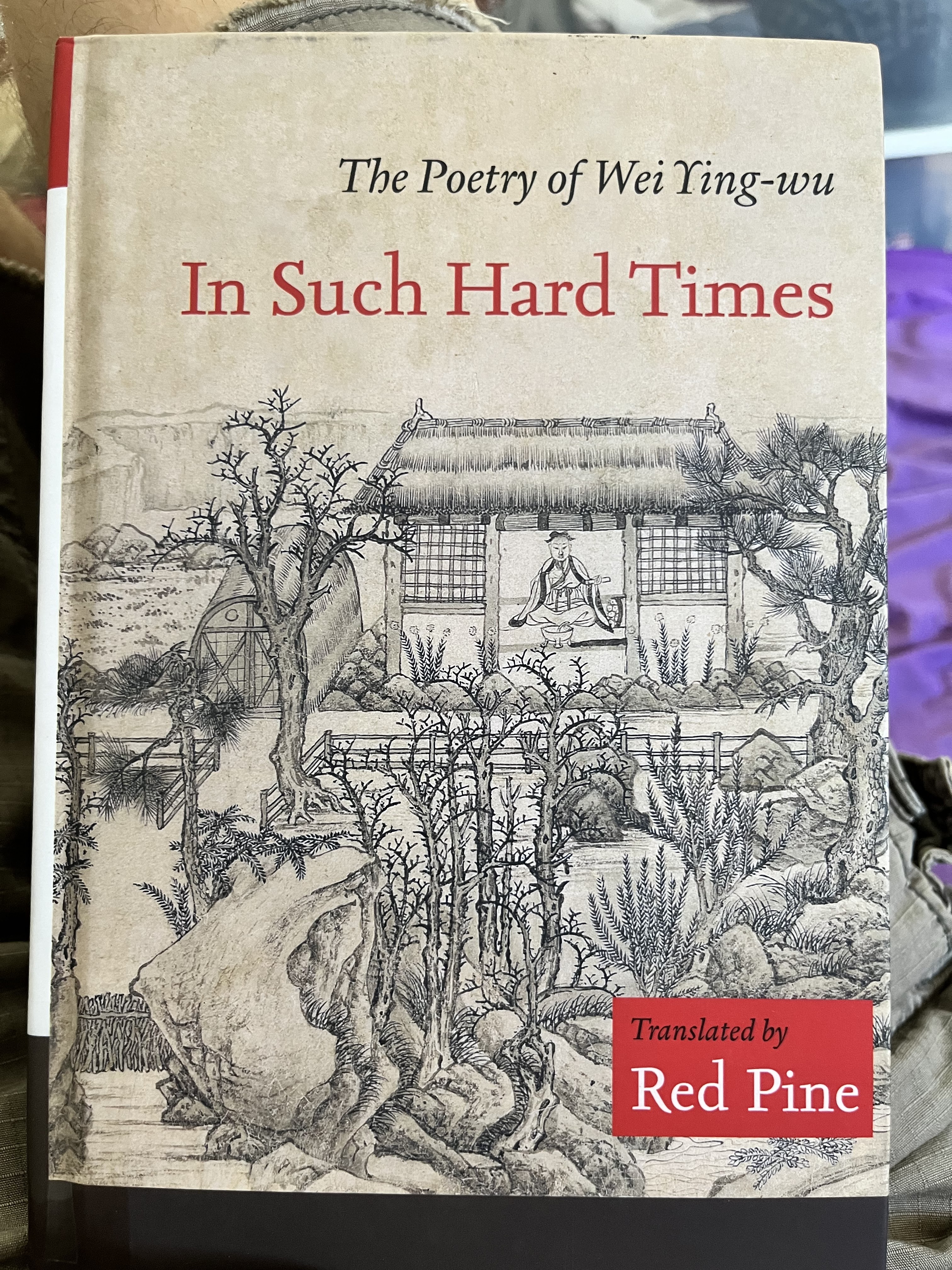
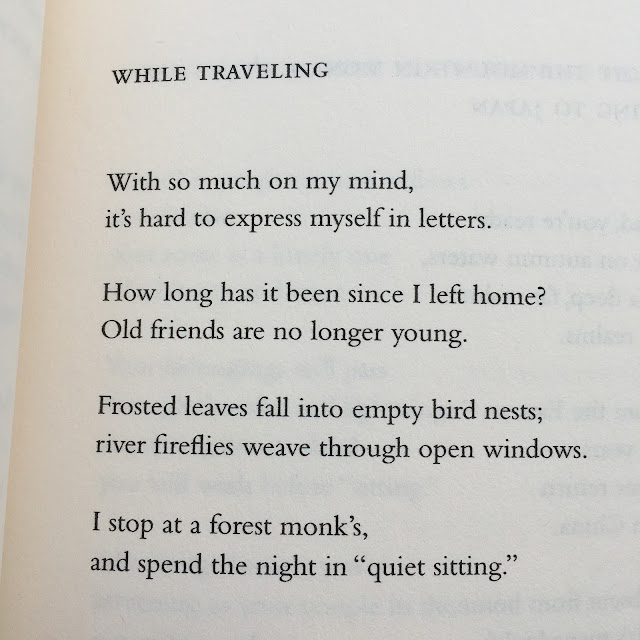
Wei Ying-wu

Wei Yingwu (737–792) wasn’t as Buddhist as Cold Mountain or Stonehouse, who were hermit poets who lived in the mountains. He was a civil servant. His wife had a Buddhist nickname and he lived in monasteries sometimes. Of the 600 poems that survive, this book has 175. He writes about friendship and loss. 


Tuesday, August 23, 2022

Bill Porter quote about syncretism

"Meanwhile, back on the veranda, Daniela [Campo] manifested another bag of fruit, more mangoes, and tangerines, too. We had a long discussion about Zen and Taoism. She was an advocate of the view current among most Western scholars—and some Eastern ones too—that Zen didn't come from India but resulted from the intersection of Chinese Taoism with Indian Buddhism. The proposition would be difficult, if not impossible, to prove either way, and would ultimately depend upon how one defined terms as much as the marshaling of so-called facts.

I've never liked the idea. Over the years, I've combed through the biographies of hundreds of early Zen monks. Among those who had an affiliation prior to becoming monks, most were Confucians. Taoists were rare. But I would suggest that Zen didn't derive in whole or in part from Taoism or Confucianism, or even from Buddhism as it existed in China at the time. Zen was something new. Who else besides Zen masters delivered wordless lectures or offered sermons in a cup of tea--no Taoist or Confucian I've ever heard of, and no Buddhist prior to Bodhidharma." (p. 308) Zen Baggage

Daniela Campo was doing her Ph.D on Empty Cloud (Xuyun (1840-1959) in 2006 when Porter was traveling in China and traveled with her for a time. There is a biography of Xu Yun by Ji Dyn Shakya.

I finished the book and I miss it already. What a great book. There was a sad bit when he started thinking about his friend who committed suicide because he couldn't find a job to support his family.

I got really excited about the idea of Buddhist Hall of Fame when he mentions visiting one. Then I thought about the Triratna Buddhist refuge tree of inspiration. Then I thought about how I'm writing a book about the great Buddhas, and that's already an idea I'm into.


Wednesday, August 03, 2022

Bill Porter visits Ch’an sites

Bill Porter (Red Pine) went to China in March 2006 to visit Chan sites, and the book came out in 2009. I count 23 books on his Wikipedia page, among other publications. I've read 6 of his books, this will be my 7th. Porter starts in Beijing. Lots of good Chinese Buddhism history in this book. I like that he’s authentic and not a poser. He prefers Zen to Ch'an, he likes the Z and feels all the words are pointing to the same Dharma. He interviewed abbots and China is really just beginning to recover from the cultural revolution. The smart monks head to the mountains during the Cultural Revolution. Porter has a book about that: Road to Heaven. This book is about the recovery of Buddhism in China in 2006 after the Cultural Revolution from 1966-76.

If you only read one of Porter's travel books, I'd read this one. There are tons of great stories and interesting characters, great historical summaries, and stories about Zen and poetry. I've been picking up a little about Porter through reading all his works, and I really like him. I know some people are jerks in real life when you meet them, but I can imagine sitting on a porch with Miles Davis in the background sipping tea with him. 

My favorite story is that just before Tiananmen Square Protests and Massacre, he was in Wuhan after seeking out the hermits, and people asked him for money for some pro-democracy protests. Porter thought he was giving 10 yuan, but accidentally gave 100 yuan. They were so excited the got him to speak in front of everyone. Back in Taiwan later, he was talking to someone in the CIA and they'd heard about it, the Chinese leaders were saying the protests were led by a foreigner. His reluctant words after accidentally giving too much were cast as him being a ringleader. I'm surprised they let him travel in the country after that, except that it wasn't true. Yikes. It's nice to read stories about Wuhan, when we have the negative association now as somehow the birthplace for Covid. Supposedly Porter's book about the Hermits was translated into Chinese and is a great source of national pride, so maybe he's seen more as a hero than a ringleader for democracy.


Quotes:

“No one knows when the Buddha's followers began making images of their teacher. According to an account attributed to the early Buddhist sect known as the Mahasanghikas, when Shakyamuni left this earthly realm for a few months to teach his mother in the heavens atop Mount Sumeru, two kings from neighboring regions had their artisans fashion statues of the Buddha so that his followers wouldn't be distressed by his sudden disappearance. One of the statues was carved from sandalwood, and the other was made of burnished gold, and both were said to be life-size. (Cf. Ekottara-agama-sutra: 28)

This account was compiled within two or three hundred years of the Buddha's Nirvana, which occurred in 383 BC, and it may or may not be true, but it suggests how important the Buddha's image was to his followers. According to the archaeological evidence currently available, the earliest representations of the Buddha were not statues but shadow images suggesting his presence: the fig tree beneath which he sat at Bodhgaya, the lion seat from which he delivered his sermons, the eight-spoked wheel that represented his teaching of the Noble Eightfold Path, a stupa that held his remains, or his footprints, which showed he had left the dust of delusion and its karmic wake behind. It wasn't until the first century BC and the first century AD that artisans in Gandhara (Pakistan) and Bactria (Afghanistan) - and slightly later in Mathura (Uttar Pradesh) - worked their way up from footprints to a human figure.” (P35)

“He didn't think much of Thich Nhat Hanh's Buddhism. By the time we left, he made it clear he didn't think much of my understanding of the Dharma either. But I had met so many accommodating Zen masters, it was somehow refreshing to meet a jerk. And a jerk who served such fine tea was worth enduring.” (P222, and what follows is a fun narrative about the jerk monk).

“When I asked her how she gauged the level of understanding among the students, she said, "There's no one way of determining how much someone understands. But we can usually tell when we give them a task they've never done before. Someone whose practice is good isn't easily upset when things go wrong. Someone who doesn't practice or who doesn't practice correctly is constantly upset. Just because you sit in the meditation hall doesn't mean you're making progress. This is why we watch and listen to the nuns who study and practice here to decide how best to help them. Some of them understand right away. Others seem to take forever. In any case, we tell them to be patient. Zen isn't for people in a hurry.” (P237)


Fascinating sites he visits (incomplete):
Yunju Temple contains the world's largest collection of stone Buddhist sutra steles in the world.
Yungang Grottoes are ancient Chinese Buddhist temple grottoes near the city of Datong in the province of Shanxi. They are excellent examples of rock-cut architecture and one of the three most famous ancient Buddhist sculptural sites of China. The others are Longmen and Mogao.
Huayan Temple (Datong): After the founding of the Communist State, the government provided great protection for the temple.
Nine Dragon Wall: At least 7 versions of this, but this one was near Datong, which Porter calls Tatung. He has a different system than the one used on Wikipedia so it's hard to look up his stuff.
White Horse Temple: Considered the first temple in China.
Daxingshan Temple: The temple had reached unprecedented heyday in the Tang dynasty (618–907), when Śubhakarasiṃha, Vajrabodhi and Amoghavajra taught Chinese Esoteric Buddhism in the temple. Daxingshan Temple was completely damaged in the Great Anti-Buddhist Persecution, after the fall of the Tang dynasty in 907, most parts of the temple were ruined in wars and natural disasters, and gradually it became unknown to public. Most of the present structures in the temple were repaired or built in the Ming Dynasty (1368–1644) and modern China. (Not sure if this is the same temple, when Porter visits it's because it's the only women's monastery for Zen in China. There are a few others but they are Pure Land. The entry doesn't mention that, so I think I've got the wrong temple, but I thought it was interesting anyway. The jerk monk thought it was inherently false that it was the one zen women's monastery. I have to think Porter is correct, and either this is the wrong temple and I was redirected there by mistake, or it's just not widely known in English language. The language barrier makes Porter's travels that much more interesting.)
There was nothing on google for “tsangfoken hidden buddha gully”


Some past Porter and Red Pine book and movies links on Going For Refuge:
Thoughts on the inspiration of hermit monks.

Thursday, July 28, 2022

Red Pine travel to south China

I’ve met people from Nanchang and Yantai in the park recently. Their children play with my daughter. That's not in south China, which is where this travel book explores. This area isn’t even that much studied by the Chinese, let alone in the English language. In south China there are over 50 ethnic groups.

I’m reading Red Pine’s book about South China travel that came out in 2015. But it’s based on his audio recording from his trip in 1992. 

It’s not really Dharma but I also enjoy culture and you can pick up bits when a Buddhist writes. He visits temples. I feel like the more I know about different cultures, the better. The better to understand people around me, and the better to understand the Dharma styles those areas, in the south of China. I also got this book with his traveling to the spots of the Zen Patriarchs. Thought I would read this book first because it's shorter. An I learned about the Tai ethnic group in China that follow Theravada Buddhism.

If I wasn't vegan I'd want to travel to the frog festival of Pingan. The mythology of locations is interesting. There are two tribes that descend from tree stumps, and all manner of dragon coupling. It feels like conditions create different cultures. Mythological thinking is so fascinating. I like the god of literature. Mythology is messy. Abraham is important in Christianity, Judaism and Islam. The Four Guardians are in Hinduism, Jainism and Buddhism. 

I’ve read too many fantasy novels, where the author’s experiences seem fantastic. Black rice and river moss. Women who play music tea leaves. History lost and found about great explorers with huge boats that sail the seasonal winds east and west. I want a new novel from Shelly Parker-Chan. Accidentally giving cultural signals for love, Porter has a woman coming to his room. He must politely decline an offer of love, after accidentally giving the signals. The Ani women don't hide their breasts and genitals. Two tribes descend from stumps and two tribes descend from union between humans and dogs, after a dog tricks the king into giving his daughter in marriage. The myths are so good other tribes co-opt them. Back through the mist of time they didn't worry about appropriation. These fantastical myths and stories are fun, some local color in Bill Porter's travels.

I read the book in the park and talk about it in with the Chinese whose English isn't so good. It's better than my Mandarin.

Quotes

 “My friend Gary Snyder once told me that two most important questions friends of the earth should ask are, Where does my water come from? Where does my garbage go?” (P. 159)

“It was Hsishuangbanna's most famous pagoda, and it was known far and wide as the White Pagoda. It was first built in 1204, and it had been rebuilt many times since then. It looked like the last time hadn't been very long ago. As with the Black Pagoda, the main ingredients were cement and white paint, with yellow and red trim. There was also a shrine hall, but pilgrims did their bowing outside at the base of the pagoda. On closer inspection, I discovered why. The pagoda was built on a huge boulder, and when I walked over to the southwest corner of the boulder, I noticed a small niche at the base. The niche was covered with glass, and there was a slot for people to insert donations. I looked inside and saw the reason for their veneration. It was the Buddha's foot-prints. Yes, the Buddha's footprints. By some mysterious power the Buddha had traveled here from India and left his footprints on the surface of the boulder. Buddhist pilgrims came here from all over China, as well as from Burma and Laos and Thailand, to pay homage to the footprints, which, according to the sign, the Buddha left when he visited that part of the world at the age of 62.

According to historical records, the pagoda itself wasn't erected until 1,700 years after the Buddha's visit. It wasn't surprising, though, to see footprints at a Theravadin Buddhist shrine. When Buddhism first developed as an organized religion, there were no statues of the Buddha, because it was felt that the human form somehow misrepresented the Buddha's message of liberation from all form. Instead, his disciples used his footprints to represent his transcendence from this world of dust. A pair of footprints was the only thing in the way of symbolism that early Buddhist shrines contained. I joined half a dozen other pilgrims in paying my respects before the niche, while a hundred flags flapped their prayers above us.” (P168-9)

“ Kashyapa was one of the Buddha's greatest disciples, and he reportedly came to Chickenfoot Mountain 2,400 years ago. To understand Kashyapa's importance, it's necessary to go back to when Brahma, the Lord of Creation, offered the Buddha a flower and asked him to preach the Dharma. The Buddha took the flower and held it up. His devotees and disciples were puzzled-all except Kashyapa, who smiled. This marked the beginning of Zen: the direct transmission of understanding with a flower and a smile. Kashyapa thus became the First Patriarch of Zen in India. Though there are no records attesting to it, Kashyapa was said to have come to Chickenfoot Mountain following the Buddha's Nirvana. And he took up residence in a cave below Huashoumen.” (P204)

Links:

Kirkus review "As satisfying as any trip by Paul Theroux but with a much less prickly and much more forgiving narrator."

Moon Hill

Frog Festival

Huating Temple

Stone Forest

Cheng Ho which Wikipedia says is spelled Zheng He. Fascinating fellow who was castrated and became a great diplomat and sea explorer, seven journeys to India. In a weird way the history of his life wasn't really taken up, China is weird in some ways in that at times they seem indifferent to their history. He seems like an interesting fellow but this is the first time I've ever heard about him. He was muslim and went to Mecca. 

Chickenfoot Mountain

Monday, May 30, 2022

Fanshan doesn't raise above society's sexism.

 In poem 173 of Red Pine's translation (2000), Fanshan doesn't raise above the sexism of China. He talks about women as though they are a burden, as though they are to be belittled and tolerated. They are compared to donkeys.


I'm not canceling Hanshan because I haven't met someone deeply who I didn't find some things I didn't like. If I'm canceling anything it's the NRA and Abbott. The republican congress that allowed the assault rifle ban to lapse. People who accept the sacrifice of children on the altar of false freedoms. My position on gun control.

The prevalence of people who think uttering gender conformity or ranking on the other gender is high. Honestly I took a break with this book after reading that. I got back to the book eventually. I really like Thomas Pynchon's novel Inherent Vice, but there are not any strong or virtuous women in the movie. I think in a way the book calls for superficial sexpots, but that doesn't mean you can't have one women character who has some depth or something interesting besides their body's ability to excite a man. 

I know it's a modern sensibility that honestly not a lot of men seem to have, but Franzen talks about it some. "Read a book from 50 years ago by John Updike, Norman Mailer, Thomas Pynchon, Kurt Vonnegut and, even though I love him, Joseph Heller, and you see they weren’t thinking about women in the right way. Those are pretty sexist books… I wish people would be spontaneously sensitive, but if they can’t, then a little bit of enforcement doesn’t seem to me a bad thing.”

Tuesday, March 22, 2022

Enfeoffed


 Enfeoffed means to get land, to be given land in exchanged for a pledge of service.

Thursday, March 03, 2022

Cold Mountain


Zen Buddhism for anybody Vol. 1:

Halos by day; horns by night

There’s a long boring argument among scholars, over the enlightenment or non-enlightenment of some legendary Zen poets.

Their arguments cover a large, varied and curious field of nonsense, but most agree on accusing the work of poets like Cold Mountain, Ikkyu and Ryokan of quite regularly expressing feelings of sadness and desire, which, according to these funny scholars, are not compatible with the Buddhist ideal of detachment.

That is: “They wrote poetry about feeling sad, or hungry, or lonely... Enlightenment is supposed to transcend these feelings; thus, they were not enlightened!”

One might immediately notice here how these poor dummies are beating their heads against the very same barrier that blocked our friend Ming in the previous koan. They are wrongly interpreting Buddhism as an escapist idealization of some “fantastical rainbow world” with no blockages, no sadness, no desires... This is the kind of mistake which could get a fool reborn as a fox five hundred times...

Attached to the fantasy that “it would be far better never to get yourself dragged by the net to begin with”, we block ourselves from understanding the freedom of the golden scaled koi fish as it jumps out of the net.

Of course that Ryokan and Cold Mountain and Shakyamuni and Bodhidharma and me and you – each and every person was and is exposed to the countless nets in the sea. We’re all affected by pain and hunger; by frustration and misfortune...

You can’t “meditate yourself” to some inhuman world that is absolutely free from difficulties and from suffering.

It should be stressed that Zen’s ideal (or, at least, Zen’s ideal as described by some of its most renowned masters) rejects none of our natural human conditions. It actually employs, in this non-rejection, the same stubbornness that it dedicates towards its non-attachment to them.

In a good mood,
The enlightened person becomes a Buddha;
In a bad mood;
Fur and horns grow on the body.

“Detachment” does not mean “rejection”.

Should we really reject part of what we are, so that we maybe correspond to some imaginary ideal; or should we just be exactly who we are?

To hope for a river where no nets are falling from the sky, or to develop the art of jumping out of the net? One of them is the essence of Zen; the other one is a prejudice from people who know nothing about the essence of Zen.

In a nutshell, the idea of Buddhist detachment and enlightenment as “beds of roses”, different from our daily experience – different from the natural world, and independent from it – corresponds to the “kitsch” interpretation of Zen Buddhism.

The kitsch is like covering the ears and screaming LA LA LA at the same time, trying to block the problems of the world by isolating oneself in a cozy and frail fantasy-bubble where feces don’t exist.

Zen Buddhism, in the opposite direction, is a school notoriously known for its contempt towards fussiness and sanctimony; a school from which some of the most prominent masters were making poetry about feces.

An old Chinese saying preached:

"Never fix your sandals when crossing a field of melons, and never straighten your hat when you’re under a peach tree. People will think that you are stealing fruit."

Well, it was precisely a Zen Buddhist monk who replied to this saying with a poem, like this:

Brothels and bars!
No tree and no fruit
Should ever prevent a Buddhist
From straightening their hat!

Tuesday, February 08, 2022

Hanshan, Fenggan and Shide

Another Red Pine documentary, this one about Cold Mountain, also known as Hanshan. With Burton Watson, Gary Snyder, who's poetic name is Listen To The Wind. Watson says the Japanese took up Hanshan more than the Chinese did. This 29 minute short is fun.

Cold Mountain had 2 friends, sidekicks, his entourage, one called Big Stick (Fenggan) or and the other called Pickup (Shide) or Foundling. The friends were both monks, but Cold Mountain wasn't. He was an eccentric poet. Pickup has a story about how he got his name: "Fenggan was travelling between Guoqing Temple and the village of Tiantai, when at the redstone rock ridge called 'Red Wall' (赤城) he heard some crying. He investigated, and found a ten-year-old boy who had been abandoned by his parents; and picked him up and took him back to the temple, where the monks subsequently raised him." The boy was Pickup, and he was found by Big Stick, who was tall.


Hanshan and Shide (Foundling)

They lived in the Tang dynasty, which is 7th and 8th century. They don't know where he came from, but there's a Hanshan temple in China today. They were also around Guoqing Temple in legend. In the film they eat a meal at the cave where Hanshan lived, called Cold Cliff, a days travel from Guoqing Temple (Source). Tiantai mountain is there.

Guoqing Temple is spelled Kuoching by Red Pine, and it's supposedly where the Tientai sect of Buddhism was founded by Chih-yi in the 6th century, spelled Zhiyi on Wikipedia or maybe that's a different person because they said he was the 4th patriarch, and a great systematizer, founded an indigenous version of Buddhism. He wrote a commentary on the Lotus Sutra. Another book to read. "According to David W. Chappell, Zhiyi "has been ranked with Thomas Aquinas and al-Ghazali as one of the great systematizers of religious thought and practice in world history.""

I really like these Chinese hermit poets. I'm reading the Red Pine 2000 translation of his poems that includes Big Stick and Foundling's poems too.

Tuesday, January 25, 2022

Chinese Buddhist Poetry


I'm reading The Clouds Should Know Me By Now (1998) first which is a collection from 6 poets. Edited by Red Pine and Mike O'Connor

Chia Tao is Jia Dao (779–843) on Wikipedia. His ordination name was Wupen, and later Wandering Immortal (Lang-hsien). Han Yu (768 – 824) was his poetry mentor. Su Shi didn't think much of his poems. An interesting story is the one where Chia Tao met Han Yu. He was riding a donkey into the market and kept trying out "push" and "knock at" a gate, and bumped into him. The story coined the phrase of poets trying to pick words as "push-knock". At 31 he abandoned Ch'an monasticism in Chang'an for the lay life of poetry and working in civil service. Meng Chiao (751–814), Chang Chi (712 - 779) and Han Yu and Chia Tao formed a group of poets. (I'm taking Red Pine's spelling over Wikipedia.) In China Buddhism, Taoism and Confucianism are intermixed. He quested for poetic mastery and people who appreciated his poetry (chih-yin). He is compared to Wang Wei (701-761). He often wrote in the form of Tu Fu (712–770). I have now referenced 6 other poets in describing him. He wrote 404 poems. Pine translates 20 poems, neither of the short ones below.

The Swordsman
A decade long I honed a single sword,
Its steel-cold blade still yet to test its song.
Today I hold it out to you, my lord,
and ask: "Who seeks deliverance from a wrong?"

Gone is the guest from the Chamber of Rank,
And petals, confused in my little garden,
Zigzagging down my crooked path,
Escort like dancers the setting sun.
Oh, how can I bear to sweep them away?
To a sad-eyed watcher they never return.
Heart's fragrance is spent with the ending of spring
And nothing left but a tear-stained robe.


I say 6 poets but one chapter says 9 monks and a guy, so it's not 6 different poets, there are 15 in total.

The next poet Ch'i Chi is similar, and it as the end of the T'ang period. He sees a leaf fall into a bird's nest too, like Chia Tao. I guess that's death entering the house, maybe not. Sometimes a leaf is just a leaf. 

Anyway, I really like this book. I'm putting it on my reread list after I read it, because I don't think I've gotten everything from it.


Saturday, January 01, 2022

Final stories and thoughts on Road To Heaven.

Imagine a time where going into the mountains was a way to seek promotion. Porter reports that in Stephen Owen's book about 8th Century China, if you went into retreat, and then got a promotion, they called that the "Changnan shortcut". 

I spent my summers near Hayesville North Carolina and these mountains were known for being a hotbed of survivalists and right wing wackos. I saw a bumper sticker, "Heston is my president" meaning the head of the NRA was their real president. The grocery stores say, "American Owned" like there is some great foreign grocery conspiracy.

My friend who likes the wilderness drives onto remote public lands and camps out of his car. He has a special tent attached to the end of his car.

Porter ends going through the 8 Immortals.

I certainly think this is a monument book in terms of Chinese culture. I'm not sure if it has any great insights, though Porter said he hoped it would inspire people to practice more intensely and a not just lead comfortable lives. Something like that. Anyway, quite a wonderful book to read on many levels.

Wednesday, December 29, 2021

Chinese Monks

Bill Porter who became Red Pine is older in this one, so this is an update. There's a real respect and devotion that I really like.

Bird sounds, dogs barking, insects, beautiful panoramas. As the effects of the Cultural Revolution wear off more people come there. One guy says Porter's book Road To Heaven opening things up a little bit, re-educated the Chinese about their cultural heritage. 

A young fellow recognizes him. Porter leaves some money under his bowl of water. The fellow lets bugs bite him. He bows very deeply. 

A woman carved out a cave. It took 3 people 2 months to chisel out a cave. Red Pine talks about translating poets. He was just doing it, and somehow someone got interested in publishing them. I've ordered all the red pine books from my library. I have a copy of his book on the Heart Sutra, maybe I'll give it a reread. He had a Taiwanese wife, and he wasn't allowed to go to China until 1989. He wanted to inspire Americans to a more austere practice, they are too comfortable. He didn't know his book would be a hit in China, but it was.

She gets up at 430am and meditates first thing. She goes for a walk around 6, and by 8 after refreshing herself she makes breakfast. She farms, chants and copies texts, and reads them till 11. Her favorite text is Tao Te Ching. She eats rice porridge and vegetables. If she's not hungry, she doesn't eat. Lay people bring her rice and noodles. She eats potatoes, yams and cabbage in the winter. She eats ginger to cope with the dampness. She has a bush that tastes like mint to Porter, but she thinks it smells like patchouli and it's "heat clearing" in the summer.

He first came in 1989, and he says he's 71 which is 7 years ago, so around 2014-15 the footage was shot. He reports he's lived in Seattle for 21 years, so that's 1993 onward. He talks about his first translation of a Pure Land sutra about the 16 contemplations, it starts out about the sun setting.

The monks seem more like hipsters as he goes along, they have fruit from somewhere else, they they say all the right Buddhist things. He speaks to the camera.

Another monk says tourism isn't bad if the monks are closed off and can practice in part of the monastery and the tourists come and light incense in another part.

The sun sets. One monk thinks words don't really help people, teaching them to meditate, chant and study gets more done. He doesn't like to talk much. He didn't feel like the Dharma healed people's problems. Just giving a hint of the Dharma life possibilities is better. You can see the lights of a city encroaching on the remote mountain monastery. It took Pine 5 hours to hike to it.

A female monks points out that she doesn't have to go to the village any more, presumably people bring food now. They used dynamite to blow up and get rocks for construction. She feels like that Tao is receding. The loss of hardship weakens the practice. Those with weak will quit. She chants the Shurangama Sutra (Some of the main themes of the Śūraṅgama Sūtra are the worthlessness of the Dharma when unaccompanied by samādhi power, and the importance of moral precepts as a foundation for the Buddhist practice. Also stressed is the theme of how one effectively combats delusions that may arise during meditation.). She makes him some bread, garden vegetables and soup, while he stares off into the distance. They show her lips move while she reads a sutra.

He takes a walk with an acupuncturist. He meets a fellow who wants to go over Taoist lineage. He gives him a poem to stick in his pocket. Another guy practices Tai Chi and martial arts. It ends with footage of a guy carrying huge bags up the mountain. 

Chinese Monks. This one has commercials, feel really violent next to the peaceful setting. I'll only watch it once, I'll watch the other one over and over probably.

Among The White Clouds

With the documentary in the background while I read, I can hear the birds on the mountains. I can hear the different way people talk in Chinese. When he talks in English, I take a break from reading and listen. It's usually about his attempts to find someone. Sometimes I take a break and read the text translations of what people are saying. They talk about Buddha nature, the nature of the mind, the struggle for existence. Some of the hermits can't read. They meditate. You can see them gathering stuff to eat. Getting water. Taking down laundry. Making tea. Cooking a meal. Eating. Chanting to Buddha statues. There are some young monks with an older monk. A woman alone. All sorts of scenarios. Endlessly varied, unique.

Among The White Clouds. I can't believe this is free on YouTube, but it is. Quite amazing.

I have a fantasy of living by mountains filled with Buddhist hermits, but I can understand their language, and I bring them food and whatever they need. The Chinese tradition of mountain hermits is as old as time, but unique.

One of the things you notice is their humility. They're just simple people carrying on. America has such a hype culture that it's hard to imagine Americans talking that way, but I bet some would. What you feel is great devotion.

Thursday, December 23, 2021

Road to heaven


I guess Porter, or Red Pine, translates poetry, so he's open to the poetry of life. 

I'm getting more interested in Tao. Last night I listened to a podcast with Benjamin Hoff. The emphasis on nature and natural, in harmony with Buddhism, is interesting. 

It's sad the hermits retreat further into the mountains to get away from the tourists, who get superficial teachings.

Chapter 6 starts out talking about Buddhism coming to China and there's been a recent discovery where they think some statues are from 2,200 years ago. 2,300 years ago in Pakistan

My theory is that Buddhism swept the globe but died out because it's such a hard and subtle path, but there was a crazy awakening during the Buddha's life, and for 100's of years following it. What an amazing thing. 

Chapter 6 has some good discussion about the differences and integration of Buddhism into Taoism. 


Tuesday, December 14, 2021

Road To Heaven by Bill Porter

Bill Porter had an interesting childhood. His father was a farmer, then bank robber. He got pardoned because his sisters were waitresses where the governor used to dine, and they talked him into a pardon. Then he became a hotel millionaire. The money was frozen in a divorce, and Porter went into the military and then used the GI Bill to educate himself, but he lost interest, somehow ended up in Taiwan as a monk for 3 years, and then did his travels to write this book.

He is also known as Red Pine, that's his art name, or pen name. 

You can watch the movie if that's your speed, link below. I like the book myself, but I'll graze the movie some more. I've watched it some in the past. 

So it's an adventurous book. He's going out looking for Chinese hermits. In China there is a tradition of respecting hermits. I don't think we have that tradition in the USA, to my knowledge. Anyway, he goes from place to place asking about hermits, until he finds some, presumably. Don't want to give anything away, the book builds the tension about finding some of these guys. 

The hermit tradition goes way back, and some early dynastic choices involved hermits, so the culture historically respects hermits. Hermits were sometimes shamans. Hermits were sometimes Taoist. I took a class on Taoism in college, and I read their basic texts. I didn't know that it originally about the waning and the waxing of the moon. I'm tempted to dig out my classic texts. I feel the idea of proportion, yin and yang, effortlessness, and being natural are very appealing to me. That's not all that Taoism is about but that's a big part of it.  

Visiting Taoist temples, Porter said they were organized like Buddhist temples. Supposedly there is Chʻüan-chen Taoism and Cheng Yi Taoism, which is more a lay practice. I learned about Taoism and Chinese culture, how the monasteries fared through the cultural revolution and changes in politics of China.

One of the things I don't like about reading the 1993 book is that it seems like all the terms have changed. Maybe he just simplifies Chʻüan-chen to Chuan Chen.


Links:

Eight Immortals of Taoism.

He Xiangu, the one female in 8 Immortals


Interview of Porter (YouTube)

Post Magazine profile:

video Amongst The White Clouds

video Chinese Monks (seems to be a different documentary)

book review quote: Porter describes a farmer grinding green rind off of walnuts, the steep and slippery green rocky ascents to hermit hideaways, misadventures with suspicious police. We share a meal of corn gruel and potatoes here or a bowl of noodles and a pot of tea there. One old hermit tells Porter about his few planted vegetables, of gathering wild plants, of coming down once every couple of years. Why do you live there? asks the author. "For the quiet," comes the answer. "Zen monks like quiet."

There's information in Tricycle "Porter, moreover, seems too enamored of his hermits to challenge them with the kind of difficult question that can elicit unusually penetrative responses. One wishes that he’d asked them whether, by entering a hermitage, they hadn’t lost as well as gained-for instance, the friction as well as the fellowship occasioned by others and seemingly so essential to self-knowledge."

And Lion's Roar

Ancient Ginkgo tree like Lao Tzu's?

Lao Tzu is spelled Laozi now.


Wednesday, March 27, 2013

Lankavatara Sutra

The Queens Public Library in New York City is awesome. They have a copy of The Lankavatara Sutra: Translation and Commentarywhich is one of my favorite sutras. The only downside is that because of how it's classified, I can't renew it on line, and have only 2 weeks at a time with it.

(Guess I'll have to concentrate on it. I like to read where my whims lead me.)

Pine writes in the introduction, "Just as the Diamond Sutra teaches detachment from dharmas, and the Heart Sutra teaches the emptiness of dharmas, the Lankavatara teaches the non-projection of dharmas, that there  would be no dharmas to be empty or to be detached from if we did not project them as existing or not existing the first place." (p.4)

Pine also writes, "the Lankais not a text that welcomes the casual reader."

I found the Suzuki translation very interesting. Suzuki translated from the Sanskrit. Pine translates from the Chinese, which is from the Sanskrit edition.