Saturday, September 23, 2023

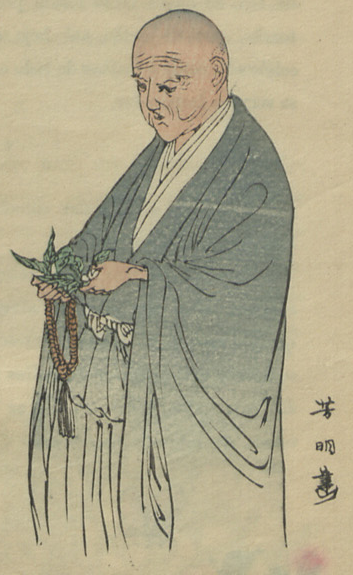
Kukai

"...how can a man remain bad always? When favorable conditions are provided, even a fool aspires to the great Way." (p. 69 Yoshito Hakeda Kukai (1972))


Reading about the 10 stages of development in the 68 page essay in English, Precious keys to the secret treasury by Kukai has an interesting sense of development in 8/9 century Japan.

Kukai  (774-835) was a revolutionary and legendary figure in Japan. Perhaps 1257 years after the Buddha. We’re at 2,503 in 2023. That is almost a midpoint (770) between now and the Buddha parinirvana. 

Kukai seems to have anticipated many connections we see today, including the connection to the body.


Poem (p. 71-2)

The sea of Mind is forever tranquil
Without even a single ripple;
Stirred by the storm of discriminations,
Billows rage to and fro.

Men in the street are deluded;
They are fascinated by phantomlike men and women.
Heretics are crazed;
They adhere to the grand tower of mirage.

They do not know
That heaven and hell are fabricated by their own minds.
Do they come to realize
That "mind-only" will free them from their tragedies?

Be that as it may,
By practicing the Six Paramitas for three aeons,
By practicing the fifty-two stages of enlightenment,
They will uncover One Mind.

When they become purehearted,
Cutting off their emotional and mental obstacles,
They will find their own Treasury-
Enlightenment, or Nirvana.

Wednesday, September 20, 2023

Why Has Bodhi Dharma Left for the East (1989)


I like lists of Buddhist movies. 

I don't think Groundhog Day is Buddhist because every religion claims it as about their spiritual ideals. 

I couldn't find Zen (2009), but I did find Why Has Bodhi Dharma Left for the East (1989) on YouTube.

The Wikipedia entry about the film says it was written and produced by Bae Yong-kyun, a professor, painter and filmmaker. The film follows a child, young adult and elderly monk. The title is a koan.

It's actually shorter than Into Great Silence (2007), which is a Christian non-narrative documentary which shows footage of Christian monks throughout their day. I mean there's a narrative, but it's not a drama, it's just seeing these three guys, the young guy playing, the old guy doing stuff, and the middle aged guy working to get wood and whatnot.

Tuesday, September 19, 2023

meditation apps


I have an iPhone so this relates to that.

I renounce Insight Timer because for the second time they've broken it, in an attempt to get me to rebuy something I've already bought. 

I like it that I can hear a friend chant a mantra, and there's a lot of good teaching on the app, but breaking it once, I can forgive, breaking it a second time in an attempt to squeeze more money out of me, no thank you. I've got a streak of meditation going there, that is gone now. It already deleted my data once, and I kept using it, so that's on me. I liked seeing other people meditating, but honestly, it's not a real connection. I'm not going to delete the app. I'm just not going to use it any more to time my meditations. My experience is they broke it twice in an attempt to get more money, and lost my data once. 

I tried Meditation Time 2.0 today. On my home screen it says Meditation. I was pleasantly surprised to find my stats. We'll see how that evolves. The only downside is that it doesn't connect to health app.

Simple Meditation Timer was another one I tried. On my home screen it says Simple Timer. It's simple, goes by minutes, not interval bells. I guess it's better than the free one on my phone because that one has seconds that fly past fast and that's distracting. This one connects to the health app.


Kukai

I'm always complicating things, I want to know the depth, breadth and width. But there's some virtue to the stripped down and smooth narrative. It seems I'm unable to do that, so this is just another narrative of Kukai's life, which might be easier to read that my previous posts. Maybe the first 4 posts were rough drafts, source material. I decided to write it all over again. For some reason I go into detail about different things I've just learned.


Kukai was born into an aristocratic family in Zentsuji. Zentsūji is located in northwestern Kagawa Prefecture. It is the only city in Kagawa Prefecture that does not face the sea. It's a small town in the middle of nowhere, but he has an uncle in Nara who begins to teach him at 15 and he goes to college. He begins to try and chant a mantra a million times as suggested in a sutra he reads. Whether he really becomes disillusioned with worldly life at that time, well, he says he does. 

The uncle's influence is on the wane because the family is accused an assassination, they are out of favor. In college Kukai realizes he's not going to get a job as a bureaucrat and/or he finds Buddhism. He chants mantra of Kokuzo, associated with the space element, and meditates. At some point he begins to wander as a mendicant. At 24 he writes a small tract that begins his literary output called Indications of the goal of the three teachings.

“Now I have a nephew who is depraved and indulges in hunting, wine, and women, and whose usual way of life consists of gambling and dissipation. It is obvious that an unfavorable environment has caused him to lead this kind of life. What has induced me to write this story are the opposition of my relatives to my becoming a Buddhist and the behavior of this nephew.” (p. 103 Hakeda)

"I am writing just to express my own unsuppressable feelings and not in forder to be read by others." (op cit).

From 24-31 he wanders around Japan, meditating and chanting his mantra. It's hard to get ordained in Japan, because it implies state support, and the state didn't want to support monks, so some emperors, to cut costs, would just destroy Buddhism, which was only in Japan for roughly 250 years prior to Kukai's existence. 

Kukai decides he wants to go to China because he likes a sutra, and he thinks he can be initiated into the tantra of a sutra there by teachers who are empowered. He wants to go to Chang'an, which is now called Xi'an. In Kukai's day it was a center of civilization and the start of the silk road. Somehow he gets onto a boat going there, and with his good Chinese talks his way to the city, and finds Huiguo. Huiguo is glad to see him and teaches him everything he can before he dies. He's passed on the lineage to one fellow who will carry on the lineage in Chang'an, but Kukai is to spread the lineage to Japan, in what will become the Shingon sect of Vajrayana Buddhism in Japan.

Kukai has a rival, Saicho. Saicho became a monk at 13 under Gyōhyō in the Flower Garland (Kegon) sect of Japanese Buddhism. Saicho is on the second boat to China, which takes longer to get to China in perilous journey, where the 4th boat loses everyone but one survivor. Saicho goes to a mountain to get his teachings that is closer to the coast. He comes back before Kukai, and charms the emperor, who grants him some recognition and resources, and his career is set, except the emperor dies, and the next one will favor Kukai. And Saicho will eventually ask Kukai for initiations, which shows he was the superior monk. Even so, this is not the end of Shingon and Tientai Buddhist rivalry. On Reddit someone asks why Tientai is more popular than Shingon in America, as if the rivalry is part of the legacy.

Kukai waits 3 years at the port he landed to be invited to approach the emperor. Seems like a really long time.

The fight for state support creates rivalries, but the surviving correspondence between the two seems cordial and collegial. Saicho would die in 822, and Kukai would ascend even more, though he would eventually get old and retreat from service to the emperor, but not after initiating some universal education in Kyoto, where students and teachers would get breakfast and lunch. I'm reading that Massachusetts just re-instituted this policy. 

Kukai would trade poems with the emperor, advise him, and supervise the building of temples, which was a great honor in those days. He died in 835, which is 1,188 years ago in 2023. That's a long time. 

I'm grateful for the stories, artwork, and temples that come down to us using him as inspiration. I'm grateful for Yoshito Hakeda's book on Kukai, a Columbia professor who died in 1983, 40 years ago.

Today you can visit temples that have been replaced since Kukai's day, but still represent the Shingon sect and the spirit of Kukai's teachings. If I were to plan a trip to Japan to honor Kukai I would do the 88 temples on Shikoku, and visit Kongobuji Temple, Looking at pictures of the temples and reading about pilgrimage is enough for me. You could probably spend a lot of time tracking down all the tourist sites associated with Kukai. 

I'm impressed with the wandering years between 24 and 31, the trip to China, and then building a sect of Buddhism that comes down to us today. There are many quaint legends, and you can go sit on a rock that he sat on. There's a shrine where they put food out for Kukai every day. They gave him the honorary name of Kōbō Daishi upon his death which means The Grand Master who Propagated the Dharma. 

Kobo Daishi is on the Triratna refuge tree of inspiration. I've never been initiated into anything in Shingon Buddhism. Vajrayana is the whispered lineage which, in opposition to open source Buddhism, whispers things from the guru to teach you.


Links:


Monday, September 18, 2023

Kukai part 3

This is my final post on the life of Kukai based on Hakeda and Wikipedia.

Part 1

Part 2


This is a continuation of a summary of the life of Kukai derived from Hakeda. This is the end part of his life, the last 11 years.

In 824 Kukai was granted a big temple near the emperor's quarters with 50 monks, and they were all to be trained in the Shingon tradition Kukai created. It's now the head of Kegon or Huayan Buddhism, based on the Flower Garland Sutra. Of the 21 carvings present today, there are 14 from Kukai's time when he chose what the carvings were going to be. 3,500 workers were mobilized to bring wood to the temple. It still wasn't completed in Kukai's lifetime. 

Esoteric means likely to only be understood by a few. Exoteric means understood by many. To call Shingon esoteric means it won't likely be understood by many. 

Saicho died in 822. 

I wonder what it was like to oversee the construction of temples and not see them completed. He got more and more busy, being promoted to junior director to senior director. He declined the positions but the court insisted. He opened a school of arts and sciences. It was the beginning of universal education in Japan. Universal education means everyone can be educated, not just the rich. Providing free meals was a means for including the poor. Teachers and students ate for free. (Here in America there is a weird kind of retreat from that ideal in 2023.) They think Kukai created a children's dictionary during this time. 

He continued to articulate his doctrines in writing, in 830 he wrote Treatise on The Ten Stages of the Development of Mind

He would go back to Mount Koya in 832 in failing health. He was given 3 monks support for his Koya monastery. He refused food at the end of his life. He was suffering from a carbuncle. He was buried on the Eastern Peak, age 62. The legends imagine he did not really die, and there's shrines to him where they continue to feed him. He died in 835.


Last edited 9/19/2023.


Kukai's Letter to a Nobleman in Kyoto

You ask me why I entered the mountain deep and cold,
Awesome, surrounded by steep peaks and grotesque rocks,
A place that is painful to climb and difficult to descend,
Wherein reside the gods of the mountain and the spirits of trees.

Have you not seen, O have you not seen,
The peach and plum blossoms in the royal garden?
They must be in full bloom, pink and fragrant,
Now opening in the April showers, now falling in the spring gales;
Flying high and low, all over the garden the petals scatter.
Some sprigs may be plucked by the strolling spring maidens,
And the flying petals picked by the flittering spring orioles.

Have you not seen, O have you not seen,
The water gushing up in the divine spring of the garden?
No sooner does it arise than it flows away forever:
Thousands of shining lines flow as they come forth,
Flowing, flowing, flowing into an unfathomable abyss;
Turning, whirling again, they flow on forever,
And no one knows where they will stop.

Have you not seen, O have you not seen,
That billions have lived in China, in Japan,
None have been immortal, from time immemorial:
Ancient sage kings or tyrants, good subjects or bad,
Fair ladies and homely – who could enjoy eternal youth?
Noble men and lowly alike, without exception, die away;
They all have died, reduced to dust and ashes;
The singing halls and dancing stages have become the abodes of foxes.
Transient as dreams, bubbles or lightening, all are perpetual travelers.

Have you not seen, O have you not seen,
This has been man’s fate, how can you alone live forever?
Thinking of this, my heart always feels torn;
You, too, are like the sun going down behind the western mountains,
Or a living corpse whose span of life is nearly over.
Futile would be my stay in the capital;
Away, away, I must go, I must not stay there.
Release me, for I shall be master of the great void;
A child of Shingon must not stay there.


I have never tired of watching the pine trees and the rocks at Mount Koya;

The limpid stream of the mountain is the source of my inexhaustible joy.

Discard pride in earthly gains;

Do not be scorched in the burning house, the triple world!

Discipline in the woods alone lets us soon enter the eternal Realm.

Kukai part 2

This is a continuation of part 1 on Kukai.

The state exerted control over religious matters, to be ordained and live in a temple was decided by the state. Kukai's list of documents he brought from Japan would make the case he should be included. The court wanted to be assure he was the highest teacher of esoteric Buddhism. It took them 3 years to decide, Kukai was in China for less than 3 years. Kukai stayed in Kyushu waiting,  a subtropical island at the bottom of Japan.

I'm seeing now why Japanese Buddhism is perhaps the way it is, you really have to fight to get a wedge in with the government to get permission and support. Kukai's arrival back home is preceded by Saicho, and Saicho was with the emperor. 

Saicho is profiled in Hakedo. 


He was from Lake Biwa. He studied with Gyohyo (722–797) starting at age 12. He was ordained at 14. He was further ordained at a big temple at 19. He built a grass hut and meditated on Mount Hiei. That is also where the marathon monks run as written about by John Stevens in the book The Marathon Monks of Mount Hiei, (called Kaihōgyō)

Enryaku-ji is the temple founded in 788 by Saicho. He had 100 disciplines in 807, where his monks lived in seclusion for twelve years of study and meditation.

Saichō's Prayer (Ganmon):

1. So long as I have not attained the stage where my six faculties are pure, I will not venture out into the world.
2. So long as I have not realized the absolute, I will not acquire any special skills or arts [e.g. medicine, divination, calligraphy, etc.].
3. So long as I have not kept all the precepts purely, I will not participate in any lay donor's Buddhist meetings.
4. So long as I have not attained wisdom (lit. hannya 般若), I will not participate in worldly affairs unless it be to benefit others.
5. May any merit from my practice in the past, present and future be given not to me, but to all sentient beings so that they may attain supreme enlightenment.

There is a lamp called Fumetsu no Hōtō that Saicho lit that supposedly has never extinguished.

Sachio was asked to give lectures, and they were successful, he was recognized as a good teacher by the emperor. He was sent to China. His discipline Gishin spoke Chinese, and accompanied him. After a difficult journey he eventually met seventh Patriarch of Tiantai, Daosui. Saichō remained under this instruction for approximately 135 days. 

Then "Saichō spent the next several months copying various Buddhist works with the intention of bringing them back to Japan with him. While some works existed in Japan already, Saichō felt that they suffered from copyist errors or other defects, and so he made fresh copies." Then, "Saichō went to Yuezhou and sought out texts and information on Vajrayana (Esoteric) Buddhism." He got some unspecified transmissions. It's towards the middle of 805 when he goes back to Japan, being in China for 8 months. 

Back in court Saichō's Tendai Lotus school won official recognition. One course would study the Mahayana texts, and one course would study Chih-I's teachings. Paul Swanson says that Chih-I "has been ranked with Thomas Aquinas and al-Ghazali as one of the great systematizers of religious thought and practice in world history."

"Before Saichō, all monastic ordinations took place at Tōdai-ji temple under the ancient Vinaya code, but Saichō intended to found his school as a strictly Mahayana institution and ordain monks using the Bodhisattva Precepts only. Despite intense opposition from the traditional Buddhist schools in Nara, his request was granted by Emperor Saga in 822, several days after his death. This was the fruit of years of effort and a formal debate."

Saicho got back before Emperor Kammu died. With his foot in the door first, he became the transmitter of Esoteric Buddhism, Vajrayana Buddhism, into Japan, with it's reliance on the guru. They had quotas on how many monks could be ordained. Saicho's Tendai was allotted 2 ordinations a year. It would only be the year Kukai died in 835 that Shingon was allowed 2 ordinations a year.

Eventually Kukai was allowed to lecture and proceed to the new Emperor. Jingoji temple in Kyoto was his home temple in Kyoto from 809-823. It has a statue of Bhaisajyaguru, the medicine Buddha.

Emperor Heizei would retire because of health and Emperor Saga favored Kukai. In 823 Kukai would be granted Tō-ji Temple, founded in 796, The Temple for the Defense of the Nation by Means of the King of Doctrines, one of three inside the capitol. The poet emperor Saga favored Kukai, and ruled from 809-823. Kukai exchanged poems with the emperor and was summoned and visited the emperor many times. In 810-813 Kukai was the head of Tōdai-ji temple in Nara, though he lived in Takaosanji on Mount Takao.

There is palace intrigue and shenanigans. Kukai writes letters for the emperor and counsels him in crisis. 


Letters survive between Saicho and Kukai. Saicho asked to borrow some texts. Did they meet before they sailed to China? They sailed from different ports, on different ships. Did they meet the first time back in Japan later? 

Kukai writes, "the essence of Esoteric Buddhism is not to be obtained from written words but to be transmitted from mind to mind; the written words are mere lees and dregs; they are bricks and pebbles." (p.43-44 Hakeda). Saicho and Kukai started to spend time together. Kukai performed an abhisheka for Saicho. "The abhiṣeka ritual in Shingon Buddhism is the initiation rite used to confirm that a student of esoteric Buddhism has now graduated to a higher level of practice." And, "The student, who is blindfolded, then throws a flower upon the Mandala that is constructed, and where it lands (i.e. which deity) helps dictate where the student should focus his devotion on the esoteric path. From there, the student's blindfold is removed and a vajra is placed in hand." Wikipedia quotes the very page I'm reading in Hakeda. Hakeda points out that this sort of proves Kukai's superiority over Saicho in Esoteric Buddhism. Saicho wanted the higher ritual, and Kukai pointed out that it involved 3 years of study. Saicho had performed the ritual in the past too. By everyone seeing Kukai leading the initiation of Saicho, Takaosanji became the center of Esoteric Buddhism in Japan. Kukai was already favored and popular. 

Kukai was writing and teaching quite a lot. He wanted to move further away from Kyoto. He asked Emperor Sega to grant him Mount Koya, what would come to be Kongobuji Temple, Diamond Peak Temple, the head monastery for the Shingon Sect. The one standing there now was built in 1593.

The legend has it that when Kukai was about to land in port coming back from China, when he stood on land for the first time, he threw a vajra, and that it landed on flat land near Mount Koya. When he went to look for the vajra, a hunter showed it to him, it was in a tree that has 3 pronged needles. Usually they are 2 pronged needle pines in Japan. A kami, or Japanese deity, appeared and declared Kukai lord of the mountain. The highest peak of Mount Koya is 3,230 feet above sea level, and there are 8 different peaks along the chain. There is a plateau. In 818 Kukai climbed the mountain. He wanted the summit view to help him understand where to build the temple and other buildings. Kukai didn't like it that he had to leave after the ground breaking, to return to Kyoto to advise the secretary of state. He had to ask his supporters for oil and rice, and nails. Kukai saw the 8 peaks as the petals on a lotus. Kukai died before the grand pagoda, the lecture hall and monks quarters could be completed.


Kobo Daishi means "Great Master Who Spread the Dharma". It was the name Kukai was given upon death, and how he's often referred to (source). The comments on an article on Reddit has a lot of interesting information. Gūmonjihō is a method for increasing memory, and is referred to in the Indications. "Temple monks were a kind of a magical bureaucrat."

"what we know about Kūkai's sexuality:

As a young man, he was familiar with an infamous, popular work of erotic fiction.

The self-insert monk character in Indications is said to have become infatuated with a girl at some point and contemplated returning to the world, but a nun's admonishment put him back on track.

He was definitely celibate at least starting from his official ordination, which he got before leaving for China." (op cit)

(I'm cobbling this together from Hakeda, Wikipedia and a Reddit post as my three sources.)


Links:

I watched this video of myths and places of Kukai. He's a wonderful legendary figure in Japan. There's one shrine where they give food to Kukai who they imagine is still meditating. Kukai wrote about the 3 kaya doctrine, and of course you can always consider everyone alive in the Dharmakaya. So to feed him at a shrine is to honor that doctrine that he articulated.

I watched a video on a monk talking about Kukai: Major Works by Hakeda. 


Read and looked at photos: "Uncovering Kukai's Influence Across Japan" Japan Travel

"88 Temples, 750 Miles, Untold Gifts: Japan’s Shikoku Pilgrimage" NY Times
You get your nokyocho or book stamped at each temple.
Osettai: the act of giving gifts to the pilgrims.

Travel advice for the pilgrimage. "never stand in the center passage in front of the main gate as this path is meant for the gods." And, "When leaving, always exit on the left side and bow once facing the gate."

"While it's most common to start the pilgrimage at the first temple in Ryōzenji in Tokushima prefecture, many also start in reverse order for good luck. The last temple, number eighty-eight, is Ōkuboji in Kagawa prefecture."


"Shikoku is known for its forested mountains and slow pace of life" The Week


Journal of someone who did it.


Kukai's Letter to a Nobleman in Kyoto (also on pp. 51-2 Hakeda.


Thoughts:

First off, Shingon is Vajrayana, so to really practice it, you need to get a Shingon guru. So it's going to be superficial study. But there is a lot of Kukai that is interesting in terms of historical development of Buddhism in Japan and history of Japan. To really understand Kukai, I would think time wandering, meditating and studying, and then finding a Shingon guru and doing initiations. He says, "the essence of Esoteric Buddhism is not to be obtained from written words but to be transmitted from mind to mind; the written words are mere lees and dregs; they are bricks and pebbles." You're not going to get it reading the book. I do value what he did and some of his ways of being. I am not initiated into the Shingon tantra.

I've always felt a weird competitiveness in Japanese Buddhism, and I understand now, with the limiting of ordinations and state controlled religion. I guess I prefer the mountain hermits not coming down off the mountains to play in the halls of power. 

It's long enough ago that there are some fun legends and mythologies. I not a fan of the religion as a way get things in the world approach that seems to sneak in. Another version of spiritual materialism. I'm more into authentic spirituality than the performance of piety and the enforcement of respect. 


Last updated  6:30 AM 9/19/2023.


Kukai


I just read in the introduction to Kukai's (774-835) work that he wrote in Chinese because at the time he wrote, Japanese wasn't advanced enough at that time, to carry the abstract concepts. 

This volume, Kukai: Major Works by Toshito S. Hakeda (1924 -1983), the Columbia professor who passed away in 1983, includes a biography section. All page cites are from this book.

An outline of his life

His birth name was Tōtomono. He started studying with his uncle at 15 and got into college, which was reserved for the children of nobles. They studied Confucius. He went off to meditate a lot in the mountains and had some visions, like the sword of Manjushri and Venus entered his mouth. It was an austere existence in the mountains and he became a monk eventually. It's not clear if he quit college right away to become a monk or how long he was in college. 

The document he created called "Indications of the Goals of the Three Teachings", which is the first text in the book. It's unknown if the publication date was much later than the original composition of the document. With things so far into the past, and through translation this minor point seems like a weird hill to die on but it illustrates the difficulties and issues with studying Kukai. As with many texts, there are layers of edits throughout a lifetime, and various parts of the text seems to have been written in various parts of his life. In 794 the capital of Japan was moved to Kyoto from Nagaoka, 500 km to the south, when Kukai was 20. We have 2 different introductions in his first text, one when he was young, and one when he was much older. Comparing the differences shows his maturity, and change.

Japan had only been a unified island for 200 years. There were homeless people including the shidoso, who were not ordained Buddhist monks. People were trying to avoid conscription, forced labor and taxation. Emperor Kammu ruled from 781-806. Buddhist temples owned a lot of land, and it's suggested that the move to Kyoto was an effort to start anew in a city that wasn't owned by the Buddhist temples. One of the nobles sent ahead to Kyoto to prepare for the emperor, was murdered. People who opposed the move mysteriously died. The empress died too, his son died too. The mortality rate was pretty high with murder and diseases. People could attribute all sorts of mythologies to these events. 

Kukai had no high placed relatives to give him access to the halls of power, the clan falling out of favor being blamed for an assassination, though he did go to college, so he had to have had something in his favor. Grasping at solutions he read that if he chanted a mantra 1 million times, he would be able to understand the Buddhist scriptures, such as they existed at that time. He climbed mountains and meditated. "I despised fame and wealth and longed for life in the midst of nature." (p. 20). His sense of transience led him to this renunciation. He was a wandering monk for a time.

His renunciation came from the beginning of the Heian period and the end of the Nara period, when the government focused on building Buddhist temples. Buddhism had been introduced to Japan 250 years earlier through Korea in 552. Two Buddhist temples were to built in every province, 20 monks to be maintained in one, 10 nuns in the other. Building temples was ordered in 741. Todai-ji temple was constructed in 752 where a great bronze statue of Vairocana, in Nara, nearby Kyoto. 

The school at that times was called the Natural Wisdom School and they focused on meditation and reciting the mantra to Ākāśagarbha which is associated with the element of space, and is mentioned in the Kṣitigarbha Bodhisattva Pūrvapraṇidhāna Sūtra (Wayback Machine has a copy). Kukai practiced this form of Buddhism to begin with.

"As he chanted the mantra, he experienced a vision whereby Ākāśagarbha told him to go to Tang China to seek understanding of the Mahāvairocana Abhisaṃbodhi Sūtra. Later he would go to China to learn Tangmi from Huiguo, and then go on to found the Shingon sect of esoteric Buddhism in Heian Japan." (Wikipedia). The cite is from The Weaving of Mantra: Kūkai and the Construction of Esoteric Buddhist Discourse by Ryūichi Abe (1999).


Like all political power, they were co-opting the moral authority of Buddhism to enhance their reputation and power. They had magical beliefs of warding off bad luck and fortune, grief and mourning. As Buddhism gained more power, it became corrupt. It wasn't open source Buddhism, access was granted for favors. Monks would have varying degrees of corruption and sincere devotion. There were many unordained monks called shidoso. Even so, they were trying to reduce the amount of ordained monks draining the coffers of the state.

They don't know where he wandered that provided the space to study and write. It was probably Nara. He alternated retreat and engagement with society throughout his whole life. Mount Koya isn't far from Nara, 70km or 43 miles. Now there is Kongobu-ji temple built in 1593 on Mount Koya, the center of the sect of Shingon which Kukai founded. Indications references 90 books and sutras so he couldn't have just wandered and meditated. 

"...a man is capable of improving himself, no matter how wicked and biased he may be..." (p.26).

From 24-31 there is again little information about Kukai, like his first 16 years. At 31 he goes to China. The stated reason is to study with masters who could explain the Mahavairocana Sutra (320 pages). How did he get the state to pay for his trip to China to do this? Hakeda has various speculation. 

In some ways we know so much about the surrounding context of his life, and he has evocative tidbits in his life, and we have the texts that have survived to this time. In some ways we know quit little through the mist of time. He goes to China in 804 to Ch'ang-an (Eternal Peace) or Xi'An, where China's first emperor, held his imperial court and constructed his massive mausoleum guarded by the Terracotta Army. 

"During its heyday, Chang'an was one of the largest and most populous cities in the world. Around AD 750, Chang'an was called a "million man city" in Chinese records, with modern estimates putting it at around 800,000–1,000,000 within city walls." The Giant Wild Goose Pagoda was built in 649 and would have been there when Kukai went and is still there. The Bell tower marks the beginning of the silk road (source).

Saicho was on another ship, there were 4 ships who went. Saicho (767-822) is often a parallel figure to Kukai, he is credited with founding the Tendai school. He was 7 years older than Kukai and at age 19 lived in a hut on the side of a mountain. He was going to Tiantai Mountain in China.

In 804 ship one took a month, ship two took 2 months, ship 3 turned back and tried again next year, and ship 4 only had one survivor. Kukai's ship was told to go to another port, and when they didn't their ship was impounded. They spent 2 months imprisoned in a swamp. Kukai wrote a letter to the governor and the govenor was impressed and let them go. It took them a month and 20 days to get from Fujian province to Chang-an, 6 months after leaving Japan.

Hakeda says there were 64 Buddhist temples for monks and 27 for nuns in Chang'an, 10 Taoist temples for men and 6 for women, and 3 foreign temples (Nestorian Christian, Zoroastrian and an unknown one). He stayed for about 2 years at the pleasure of the T'ang court. He moved to the Hsi-ming temple, built in 658, and one of 4 temples to survive the destruction of Buddhist temples by Emperor Wu-tsung: "destroying 4,600 Buddhist temples and 40,000 shrines, and removing 260,500 monks and nuns from the monasteries." in 845. 

That's a bit after Kukai was there. Wu-tsung ruled from 840-846, so that's of side interest to Kukai's story, but is a precedent for the cultural revolution.

Kukai was about 200 years to late to meet Xuanzang, a famous Chinese traveling Buddhist monk who journey to India in 629–645 CE and brought over 657 Indian texts to China: "At age 27, he began his seventeen-year overland journey to India. He defied his nation's ban on travel abroad, making his way through central Asian cities such as Khotan to India. He visited, among other places, the famed Nalanda monastery in modern day Bihar, India where he studied with the monk, Śīlabhadra. He departed from India with numerous Sanskrit texts on a caravan of twenty packhorses. His return was welcomed by Emperor Taizong in China, who encouraged him to write a travelogue."

While Kukai was there, Kukai studied under Hui-kuo (746–805). 

Upon seeing Kukai he said, "As soon as he saw me, the abbot [Huiguo] smiled, and said with delight, "Since learning of your arrival, I have waited anxiously. How excellent, how excellent that we have met today at last! My life is ending soon, and yet I have no more disciples to whom to transmit the Dharma. Prepare without delay the offerings of incense and flowers for your entry into the abhiseka mandalas [Womb Realm and Diamond Realm]."

Hui-kuo was a disciple of Amoghavajra (705–774) who was born in Samarkand to a Hindu merchant and a mother of Sogdia origin, the area where the Bukharian Jewish people who live in Queens New York, are from. 

Hakeda says Hui-kuo was a discipline of Pu-k'ung

"In 765, Amoghavajra used his new rendition of the Humane King Sutra in an elaborate ritual to counter the advance of a 200,000-strong army of Tibetan and Uyghurs which was poised to invade Chang'an. Its leader, Pugu Huai'en, dropped dead in camp and his forces dispersed."

Amoghavajra was a disciple of Vajrabodhi (671–741) who studied at Nalanda. He traveled to Sri Lanka and Sumatra. He went to Chang'an.

Dharmakirti was one of Vajrabodhi's teachers at Nalanda. Tibetans think Dharmakirti was trained by Dharmapala, who is a mythical being.

Back to Kukai. His teachings from Hui-kuo made him the 8th patriarch of Esoteric Buddhism. Hui-kio discipline I-ming would teach in China, who isn't even mentioned in the Wikipedia article, and doesn't have any information on the internet that I can find. Kukai was expected to spread the teachings in Japan, where he would found a school of Buddhism that would live on to today, and has an outlets in the USA.

Kukai left Chang-an and it took him 4 months to get to the coast. They don't know exactly when he got back to Japan, but he writes a list of all the documents he brought for the emperor. He was in China for 30 months, and he's back in Japan at the age of 33. Hakeda says he must have impressed the court. The emperor got back to him 3 years later. He waited in Kyushu that whole time for permission to approach. The emperor who sent him was no longer alive. His successor wasn't as interested in Buddhism, and when he was, he favored Saicho.

Part 2 post on Kukai


Below is a painting by Hokusai (1760 –1849) of Kukai warding off a demon with tantra.


One legend from Wikipedia:

A mendicant visited the house of Emon Saburō, richest man in Shikoku, seeking alms. Emon refused, broke the pilgrim's begging bowl, and chased him away. After his eight sons fell ill and died, Emon realized that Kūkai was the affronted pilgrim and set out to seek his forgiveness. Having travelled round the island twenty times clockwise in vain, he undertook the route in reverse. Finally he collapsed exhausted and on his deathbed Kūkai appeared to grant absolution. Emon requested that he be reborn into a wealthy family in Matsuyama so that he might restore a neglected temple. Dying, he clasped a stone. Shortly afterwards a baby was born with his hand grasped tightly around a stone inscribed "Emon Saburō is reborn." When the baby grew up, he used his wealth to restore the Ishite-ji (石手寺) or "stone-hand temple", in which there is an inscription of 1567 recounting the tale.


Previous post on Kukai

Shelter In Place


Last updated 9/19/23

Wednesday, September 13, 2023

Unetanah Tokef

Friday at Sundown Rosh Hashanah begins. Here is a poem that is recited.


We shall ascribe holiness to this day.

For it is awesome and terrible.

Your kingship is exalted upon it.

Your throne is established in mercy.

You are enthroned upon it in truth.

In truth You are the judge,

The exhorter, the all‑knowing, the witness,

He who inscribes and seals,

Remembering all that is forgotten.

You open the book of remembrance

Which proclaims itself,

And the seal of each person is there.

The great shofar is sounded,

A still small voice is heard.

The angels are dismayed,

They are seized by fear and trembling

As they proclaim: Behold the Day of Judgment!

For all the hosts of heaven are brought for judgment.

They shall not be guiltless in Your eyes

And all creatures shall parade before You as a troop.

As a shepherd herds his flock,

Causing his sheep to pass beneath his staff,

So do You cause to pass, count, and record,

Visiting the souls of all living,

Decreeing the length of their days,

Inscribing their judgment.

On Rosh Hashanah it is inscribed,

And on Yom Kippur it is sealed.

How many shall pass away and how many shall be born,

Who shall live and who shall die,

Who shall reach the end of his days and who shall not,

Who shall perish by water and who by fire,

Who by sword and who by wild beast,

Who by famine and who by thirst,

Who by earthquake and who by plague,

Who by strangulation and who by stoning,

Who shall have rest and who shall wander,

Who shall be at peace and who shall be pursued,

Who shall be at rest and who shall be tormented,

Who shall be exalted and who shall be brought low,

Who shall become rich and who shall be impoverished.

But repentance, prayer and righteousness avert the severe decree.

For Your praise is in accordance with Your name. You are difficult to anger and easy to appease. For You do not desire the death of the condemned, but that he turn from his path and live. Until the day of his death You wait for him. Should he turn, You will receive him at once. In truth You are their Creator and You understand their inclination, for they are but flesh and blood. The origin of man is dust, his end is dust. He earns his bread by exertion and is like a broken shard, like dry grass, a withered flower, like a passing shadow and a vanishing cloud, like a breeze that blows away and dust that scatters, like a dream that flies away. But You are King, God who lives for all eternity! There is no limit to Your years, no end to the length of Your days, no measure to the hosts of Your glory, no understanding the meaning of Your Name. Your Name is fitting unto You and You are fitting unto it, and our name has been called by Your Name. Act for the sake of Your Name and sanctify Your Name through those who sanctity Your Name.


There are 10 days until Yom Kippur.

NY Times has a good article on Rosh Hashanah. Reflecting on the shortness of life can lead to some clarity. There are similar contemplation in Buddhism.

Sunday, September 10, 2023

Interesting vein of articles about spirituality

While not directly Buddhist, I feel the "spiritual" grounds are supportive to Buddhist practice. It's almost like there's a non-sectarian aspect without reference to a specific spirituality that is adjacent enough to mean something. 


Enlighten Me with Rachel Martin is also 

The search for a church that isn't a church (NPR) Rachel Martin with Perry Bacon. 

It's about refugees from churches of intolerance. From trying 30 churches and deciding that the farmer's market was more in line with what he wanted from community on the weekend.

There's a great list of past articles and interviews from the past, where like someone sees Jane Eyre as a sacred text. You can also listen.

Spirituality as mental health supportive.

Grief as a spiritual practice.


I also really like On Being Podcast with Mary Oliver. I've been writing a lot about the transcendentalists on Hiking In Nature.

Tuesday, September 05, 2023

Psyching myself up

To meditate deeply, there's a kind of persistence, which also overcomes boredom and knee pain, and to fighting to find a teacher, through all the thicket of obstacles. To meditate deeply is to see in a way all the things that hold you back. That's why I see the use of Tara as important, to see your own obstacles. The whole Tibetan mythology, the 5 Buddhas, the whole panoply, they are another support on the path. Stepping beyond the psychological idealism into a real perception. 


(Quote from Buddha Nature by Sallie King)


One thing I learned in AA, my fortunate fall wasn't all bad, is that you create your own recovery philosophy, psychology, program by owning what is around you. A good sangha has the rudimentary tools to cobble together a personal program, and the support and encouragement to do it. You can adopt it from those around you, being with others helps you to see what planks you can reuse to build your own meditation hut, the way Thoreau built his hut on Walden from used planks from Irish railroad workers. Teachings that don't make sense you can leave aside. Every day I create the inspiring teachings that propel me forward.

It was almost good that nobody else was a Buddhist at my AA meetings, when I spoke about Buddhism being utilized by myself to overcome addiction, it didn't matter that nobody applauded me, they could see maybe what I was doing and it didn't matter if they didn't understand the tradition. To be around other Buddhist who care about the tradition feels really sacred to me. It's a very lucky thing. Every second of past experience and memory is cherished. You can lose the ability to be around the sangha, you will lose it because it's impermanent.

Psychological obstacles are to be worked with, they're in a way a joy, just like realizing you haven't been following the breath, that is the joy of coming to, awakening. The negative undertow of my negative thinking can twist things up, and not see the silver linings. The "at least.." reframing really helps me. There exists a culture and a lineage that carries the teachings forth, and they are shared out of joy, the way you would share good food at a party.

The asceticism can evolve naturally, as you see how obstacles are preventing yourself going deeper. I have learned the hard way that it's easy to justify anything, but if you're really honest, the ethics support the meditation. Seeing the harm done to others is hard for me, I fight seeing it, assimilating it. It's hard not to veganize your whole life trying to avoid harm.

Striving and energy support. It can all cohere into a path with real movement. Even being stuck is a joy. And any false summit you reach can have a great view of where else you can strive for. Wanting a guide is natural and there's enough feedback from yourself on the path to be a teacher. It's natural to share the bounty you have enjoyed. Others share so generously:

“…the instruction on seclusion could additionally be employed as a reminder to let go of our worries, concerns, responsibilities, and tasks when approaching the location which we have chosen for engaging in mindfulness of breathing. The idea is to tell ourselves that all such issues can be set aside for the time being, to be taken up again once the meditation period is over.“ (Mindfulness of Breathing Bhikkhu Analayo)


Links to read:

The Value of Being Uncomfortable

Amazing Reddit list of sutras.

Thursday, August 31, 2023

Lashon hara

Learned this concept by reading the Wikipedia entry: Lashon hara "is the halakhic term for speech about a person or persons that is negative or harmful to them, even though it is true.  It is speech that damages the person(s) that are talked about either emotionally or financially, or lowers them in the estimation of others."

Helpful speech isn't that complex, isn't just confined to one spiritual tradition or sect. Still, for me it's cool to find specific terms in other cultures that express this idea as a special idea. 

I read the term as someone was trying to shut down conversation about the neighborhood on Facebook, which might be controlling, and preachy, but it is an interesting concept in terms of right speech.

The fellow on FB saw social media in a way as unskillful. I don't see that as true. 


Tuesday, August 29, 2023

Rapture


I feel rapture in my meditation in a way I've never been aware of it before. It's like my life force and energy are surging forward. In some ways it's uncomfortable, and a distraction. It makes me want to get up and blog about it, instead of sitting with it in meditation, and allowing it to settle a little bit more into serenity. Folding it into a focused effort is part of the journey. 

I don't know my breath. I imagine I can feel oxygen going into my body but is that a story I'm telling myself about a faint feeling. I'm trying to put my finger on it, but honestly all I really know is that I feel my chest expanding. I can imagine my diaphram going down to open things up, but do I really feel that? I don't think I'm being overly doubtful, but perhaps it's these subtle edges that focusing on the breath is all about. What is actually going on? I think of Stephen Batchelor's break with the Tibetans and going to Korea and just sitting in meditation and asking, what is this? I think of Mun just saying Buddha over and over again in his language. 

I wonder if information is my new addiction. I don't hide it that I've struggled with addiction, and one hallmark of that just transfering the addiction to something more acceptable, like workaholic, or shopaholic. Informationaholic is where I'm at. I cruize Twitter for the latest, trying to figure out if and why Maxime Chanot left NYCFC. Reddit's karma is nothing in this world, and yet I was so excited to blast past 30K to 31k with a popular comment. Do I express myself too much on Twitter, Reddit and Blogger? Sometimes I think of something and have to rush to express it before I forget it. It's all so ephemeral. The navel gazing of a mindfulness practitioner. It's a good thing the Mahayana ideals were introduced to counteract, and articulate more altruistic internal forces.

The best headway I've made is on Facebook, which reconnected me with my high school class. In some ways I think of the 4 years of high school in weird ways, that include the musical Grease, to the Ramones Rock and Roll High School. It was a phantasmagoric party enhanced by The Breakfast Club, Ferris Bueller's Day Off, Heathers, Pretty In Pink, Valley Girl, Porky's. Movies are intoxicating, and I've left those behind as much as I've left Facebook behind. 

In high school, I bought into the self development program they were selling, and there was automatic friendships through shared suffering and efforts. I'm still thinking about Thoreau and Conrad, 1984 and Animal Farm. I got my first taste of Asian ideas in my Junior year Russia/China class, when they talked about Confucianism, Taoism and Buddhism. The next year I took an ancient history class, and learned about ancient Greek philosophers, in very small high school ways. I was yearning for ideas, philosophy seemed to hold a power to organize experience I'd hitherto been deprived of in my education. I read on my own too. 

I've yet to put a limit on my apps on my phone, to cap the amount of energy I dissipate. What do I want to channel my energy towards? What do I want to deliberately do? Being on the path towards enlightenment is an endless journey, and the support of sangha, mindfulness, study, devotion and ethics is great, but what do monks do all day besides meditate and pay attention? The struggle for existence: Eating is such a big project, and complicated when you strive for veganism. 

I recently read 1% of Americans are vegan and 4% are vegetarian. I thought there were more vegetarians. It's so hard to be a purist for me any more, I've lost my desire to be a cutting edge vegan, the art of the possible means I fall short of my ideals, and I'm not going to lambast myself, I want to be encouraging. You can do it, even if I fall short. Some people say that if you fall short of spiritual ideals, what's the point? 

The point is that reaching for something is better than just not seeing the lotus in the muck. There is beauty, and spiritual beauty is very important. Supposedly Kukai was a proponent of that, but I've yet to crack the tome of his teachings next to my bed. To be an expert is so much harder than a reality star. I was interested to see that in the documentary Harmontown (2014), he sought to evolve and not just celebrate his shortcomings, making it more documentary than reality TV. 

Which is to say I don't really know how to channel my energy towards the good. Inspired heroes like the Buddha, Thoreau, Mary Oliver give me hints, but I'm embedded in my own life of various exposures, and responsibilities. What is my vision, where do I want to go? How do I want to use this energy? I guess you live the questions. But the joy of meditation is quite a joy, and all the hyperbole about it is I guess warranted when you finally start touching it. The glimpses and tastes of the fruits of practice are quite sweet. Rapture is a geyser you want to harness, and that reminds you that you own your own energy and it's your responsibility to channel it. 

Sunday, August 27, 2023

Mental formations

A mental formation I can get upset about is the idea that you can be murdered for displaying a flag that signals tolerance for others sexuality.

On August 18th 2023 Laura Ann Carleton, a mother of 9 children, was gunned down for displaying a flag that signaled tolerance and acceptance at her clothing store in Lake Arrowhead California (source). A special flag was created to commemorate her.


Expressing outrage perhaps closes down the space that stochastic terrorism creates. 

To be upset by violence is normal, to be upset by specific hatred in normal. When you're doing the compassion meditation in the Brahma Viharas, a far enemy is horrified anxiety. If you open yourself up to the suffering of others you're going to feel that feeling all the time, and the meditation practice is in a way practice for something you have felt over and over throughout your life.

Of course working for tolerance and whatnot is important, but the larger meditation goal is be able to let go of these fixations when you need to, to function, or go deeper in meditation. Not in a hide your head in the sand way, and not suggesting you don't work towards social justice in your world. 

All the harm done in the world is from a place of confusion and bewilderment, and even eating only plants you're killing bugs in the field, and bugs with the transportation. Modern agriculture is the least harm we can do, as individuals, we have to eat. People who say ha, plants have feelings, don't really care about plant feelings, because if they did, they would connect the dot that animals eat more plants, eating animals is eating more plants, but they're trying to poke logic holes into something they don't want to do. The best argument for carnism is "I want to and I can." It's not illegal yet. My hope for society is that we trend in the more ethical direction for our own sake, moving towards ethical gladdening. 

Meditating, it helps to drop these mental formations, and focus on the object of concentration, in my case the breath, ala anapanasati. Insight into mental formations could be part of a solution for violence. We work best on ourselves. 

We're all bewildered and confused. It's not easy to reduce my bewilderment. 

Saturday, August 26, 2023

Buddha-Nature

Before I go into studying this book, I'm going to express my reservation. Having Buddha nature in us still doesn't absolve us from practice to get there, the hard spade work, and it's not a foregone conclusion even if you postulate Buddha nature. 

My second qualm is to wonder if it's imported Hinduism. Everyone is god, everything is god, yadda yadda. We're all Buddhas. 

Even so, Buddhism evolves, and develops ideas. We need to use our brains for something and it's fun to study Buddhism. There's an extensive literature on Buddha nature (Wikipedia). Why not look at it?


I haven't seen a more clear articulation of Buddha nature than this video of Kamalashila's 30 minute introduction to a retreat in 2020 on YouTube. He says he's said the story before, he just intimates how thinking about Buddha nature really opened things up for him. He didn't examine it from a philosophical point of view, nor a literary point of view, he asked himself if it would help his practice of Buddhism. And it did. Wonderful. Sympathetic joy to him. I feel like I need to begin to ask if it could help my practice.


Sallie King has a book called Buddha Nature (1991), that came out in 1991. I have to read it now.

Here's a review of the book on jstor. It's not long and mostly a summary. 

This is a complicated book:


I see things in terms of ideas that set the continuum. To counter the excessive individualism of going for enlightenment, the Bodhisattva ideal pushes the altruistic element. 

On the one hand mappo posits that there's been such a degradation of society that nobody can get enlightened any more. The Buddha's life is too remote, his influence has waned, and nobody can get enlightened anymore. 

Countering mappo is Buddha-nature says you're already enlighten and you're trying to realize it. Everyone has Buddha-nature. Icchantika is the idea of a person who can't become enlightened. 


Links:

Buddha Nature Wikipedia

Tathāgatagarbha sūtras


Thursday, August 24, 2023

Becky Chambers quote


I don’t feel as though I have to confine myself to the subset of thoughts in the Pali Cannon or prescribed thoughts. Maybe there's nothing Dharmic about it, but this passage struck today, from A Prayer For The Crown-Shy by Becky Chambers (p. 141);

"You don't have to have a reason to be tired. You don't have to earn rest or comfort. You're allowed to just be."

The story is about a monk who travels around a provides tea. She is joined by a robot who has come out of hiding. The robots hid from society in the wilderness, but this one has become curious about humans again. The monk and robot strike up a friendship and share experiences, and reflect together.

The monk is struggling in that she somehow struggles not to accept the above quote, she internally resists that, she feels obligation to her raising and to others. She feels like a leetch if she is alright with just existing.

There will be a harsh punishment for letting go of the protestant work ethic. The struggle is internal, too.

As a side note, this "lack of ambition" also leads to being single often, maybe not all cases.

Another struggle for me in the spiritual life, a terrible concepts makes me feel so precious, is the mating mind. Being single also lets go of the mating mind.


Just as the Calendar Began to Say Summer

I went out of the schoolhouse fast
and through the gardens and to the woods,
and spent all summer forgetting what I'd been taught-

two times two, and diligence, and so forth,

how to be modest and useful, and how to succeed and so forth, 
machines and oil and plastic and money and so forth.

By fall I had healed somewhat, but was summoned back
to the chalky rooms and the desks, to sit and remember

the way the river kept rolling its pebbles,
the way the wild wrens sang though they hadn't a penny in the bank,
the way the flowers were dressed in nothing but light.


(By Mary Oliver, p35 Long Life)


Tuesday, August 22, 2023

Tan Dun’s Buddha Passion


Read an article about Tan Dun’s Buddha Passion in the Guardian. Listened to it on Spotify.

"Buddha Passion was inspired by murals dating from the 4th-14th centuries in the Mogao caves in China’s Gansu province. The Chinese-American composer’s work sets an assortment of Buddhist texts in a mixture of Chinese, Sanskrit and English for four main vocal soloists, two Indigenous singers, two choruses and symphony orchestra. Comprising a prologue and six acts, it presents a series of tableaux symbolising the importance of love and compassion, and depicts the path towards enlightenment."

Tan Dun is a Chinese born American, it was his birthday August 18th, he's 66 years old. He lives in New York. 

Sunday, August 20, 2023

Shelter in place

I heard a talk once about a pilgrimage around an island Shikoku in Japan, where you dress in white robes, and you hike around the island and stop in 88 temples and stay the night in whichever ones you want. It sounded so wonderful. Supposedly it was based on Kukai (774-835) who founded a Japanese sect of Vajrayana Buddhism. It sounded lovely. 

Reading Kukai's Wikipedia page, I wonder what mountain is sacred in North America to Buddhists? In New York City? 

Kukai founded the sect Shingon Buddhism, that thrives to this day. 


This talk by Vadanya suggests that Kukai allowed Buddhism to use nature and art beauty in the spiritual life. 

Kukai was a dynamic fellow who did things in the world and held it lightly it seems. He also was into Vairocana. 

I'm beginning to see how modernism works over the ideas of Buddhism in the context of modern ideas. Kukai is a Vajrayana teacher where you need teachers to unlock texts, because it's not open source, it's the whispered lineage. To open up Kukai is in a certain sense not what is meant by it. But there are a lot of interesting aspects to this talk. 

He says Buddhism is not about a total philosophy of everything and it doesn't put forth a metaphysic that explains everything. They're just saying, this ways of being can lead to enlightenment. You can improve your relationship to reality, and it's not for philosophical quibbling and it's not really committed to taking over everything in thinking. I really believe that about Buddhism, but I don't know if any ancient Buddhists actually ever think that, that's a modern interpretation of the teachings. You can advance the teachings in our times, but wow you need to be really careful doing that. 

He goes off on nature, and seeing an alive universe, and seeing the larger mysteries. He really develops that, and that's also a modernist idea, not so much a part of Buddhism's original teachings.

It reminds me of Mary Oliver who sees rocks as alive, etc. There's also the Triratna idea that it's OK to celebrate Christmas and Easter as pagan festivals. There's a real openness to the whole of culture that I guess traditional Buddhists would say, "that's not Buddhism."

I was trying to fall asleep, I'm exhausted, and this talk woke me up, I had to listen to it, and then go to sleep. 

I see now how Kukai fits into Triratna, possibly, and that's perhaps a narrow interpretation, and a modernist interpretation that is expansive. 


I got out my copy of Teachers of Enlightenment, Kulananda's book on the Triratna refuge tree of inspiration to read about Kukai, since I stumbled upon him, and started wondering about him.

This is a quote from Kukai’s Major Works:

“The blue sky was the ceiling of his hut and the clouds hanging over the mountains were his curtains; he did not need to worry about where he lived or where he slept. In summer he opened his neck band in a relaxed mood and delighted in the gentle breezes as though he were a great king, but in winter he watched the fire with his neck drawn into his shoulders. If he had enough horse chestnuts and bitter vegetables to last ten days, he was lucky. His bare shoulders showed through his paper robe and clothes padded with grass cloth.... Though his appearance was laughable, his deep-rooted will could not be taken away from him."

Kukai believed in Universal Education. 


He is associated with the Vairocanabhisambodhi Sutra and the Vajrasekhara Sutra.


In a way Triratna has done something extraordinary revolutionary. Lineage doesn't matter, and you can draw from every school of Buddhism. Honestly that's crazy, I can see why they get so much hate, that I see online. The idea that you can read Kukai and get what the Shingon sect imagines as their wisdom, it's almost like stealing. They might think those insights belong to their sect, and it's a kind of imperialism to come in and steal this rich resource. But is knowledge something you can steal? Is Triratna a literature based sect, inclusive, expansive?

What is the proper relationship to sects in Buddhism, how open source is Buddhism? I guess you live the questions.


I read part of a book by Robert Thurman about a pilgrimage around a sacred mountain in Tibet.

When you're neither monastic nor lay, you go forth still in society. 

I want to go on a 5 day pilgrimage into meditation, reading, prostrations, puja, and reflection. We'll see how much of my ambition I can pull off.

Days of Brahma Viharas, anapanasati, pure awareness meditation. Reading the Heart Sutra, Diamond Sutra, Bodhisattvacaryāvatāra, and the Lotus Sutra. Maybe Vessantara's Meeting The Buddhas

Maybe a visit to the Met: Tree and Serpent: Early Buddhist Art in India, 200 BCE–400 CE. Maybe a trip to the Rubin Friday night if it's still free then. 

Nature walks to the pond, around the neighborhood to look at flowers, look for wildflowers for my shrine.

I started off tonight with a short sit and puja. I'll do worldly things too, got a lot of errands and cleaning to do. And I'll end by cooking a meal for my daughter and ex, when they get back.

Sunday, August 13, 2023

Recent Buddhism information, found things


Review of Met show in Washington Post.


"You can see that with this deep divide now in the United States based on ignorance. Delusion is a cause of suffering. If you could get rid of that, that will alleviate suffering in many forms." Matthieu Ricard in New York Times.


The White Temple - Chiang Rai, Thailand (Reddit)