Monday, August 23, 2021

Devotion

I think some personality types benefit from devotion and supplication. Maybe all. It's seen as important in substance abuse recovery. It might be part of a complete psychological makeup trying to be whole and integrated. 

Sports is a distraction and a diversion. It feels important to me in my relationship to one of my sons. NYCFC started some time after my son got into soccer, and we bonded over going to games. 

One of the players is Maxime Chanot. He was born in France, but he plays internationally for Luxembourg. He's played in England, France and Belgium, before he came to NYC. He's played for NYCFC for 5 years, only missing the first year of their existence. No other player from the 2016 roster is still on the team.

Maxime has a devotional routine you see him do. He touches his head, belly, and two shoulders, holds his hands up, looks upward, how bows down twice I think. He prays in the laundry room in Yankee Stadium. There is a caplin who comes midweek, and pregame. 

Fascinating video

Friday, August 20, 2021

Urgency


Practice like everything is on fire.

Posted this and then saw this

Wednesday, August 11, 2021

Uruvela Kassapa in the Vinaya Mahāvagga

Reading about Uruvela Kassapa in the Mahavagga. This kassapa keeps saying, "But he is not an arhat like me." In a way it's a doubter of the Buddha, but proving him wrong by miracles is the wrong way to go to my modern sentiments. The Buddha confronts him and he just snaps out of it. I'd like more information. Just like I'd like more information about the gradual teachings that converts Yasa, his father, mother, and his father's ex-wife (nice detail there). In a way what comes down to us is pretty sketchy. It can fill up a bookshelf, but it's so ancient, it's hard to get through to it. I'm trying though. Someone asked on Reddit if as a Buddhist you really had to read the Pali Canon. I'd say you don't have to, the only have to is uttering the refuges and precepts, but as others pointed out, couldn't hurt.

Monday, August 09, 2021

Stuck

 P. 28 The Life of the Buddha:

"...seeking the unborn, unageing, unailing, deathless, sorrowless, undefiled, supreme surcease of bondage, Nibbana."


PS, I read about the 5 dreams and thought about posting and then remembered a past post.

Friday, August 06, 2021

Interesting Characters And Details Reading the Life of the Buddha Edited By Bhikkhu Nanamoli

Ñāṇamoli Bhikkhu died in 1960. He led an interesting life, he was an intelligence officer during WW2. He and his friend Ñāṇavīra Thera went to Sri Lanka and ordained as a monk. My heart warms so much when a friend is mentioned in a Wikipedia entry about a person's life. 

He was taught by Nyanatiloka, German born, who was among the earliest western monks in Sri Lanka. Nyanatiloka went off to Sri Lanka in 1903 at the age of 25, and went on to Burma. You can read about him in a biography that is online. 

Nyanatiloka met U Dhammaloka, Irish born, who ordained in 1900.

Nanamoli left us an amazing modern edited book from the Pali Sources about the life of the Buddha. 

How it is that I can read these awesome texts in English today is amazing to me.


People Gotama met before enlightenment and his family

Ananda remembers the discourses, what the Buddha said. It is his great memory that comes down to us. He was a first cousin to the Buddha.

Upali remembered the monastic rules. "He was ordained before the princes, putting humility before caste." He was a low caste barber. 

There is Asita, an ascetic who laments he will not live enough to see the Buddha. "Among the bipedal race he is unique."

King Bimbisara offers the Buddha a lot of money to be a general in his army.

Alara Kalama was a teacher who taught Gotama everything he knew on his spiritual quest, but he kept going.

Uddaka Rāmaputta was his second teacher. The teachings do not lead to dispassion, fading of lust, cessation, enlightenment. 

Tapussa and Bhalluka: Two merchants who came upon the Buddha while he was freshly consolidating the insights of his enlightenment under the Mucalinda Tree. They gave him some food. The Buddha wasn't really into eating but the Four Devine Kings persuaded him with food from the 4 corners of the world, rice cake and honey. His first meal after enlightenment. Tapussa and Bhalluka took refuge in the Buddha and the Dharma, but there was no Sangha yet to get the three jewels. They were the first disciples of the Buddha. 


Details:

Gautama talks about the need to go forth from home life: crowded and dusty. 

I would add crumbs. My daughter eats pretzels in bed before she goes to sleep, and there are crumbs.

Gautama went off and was in nice parks where deer came up to him and peacocks were around. I can hear their cries. He talks about hair standing on end, what an amazing detail, fear and dread arose, which he subdued. I kind of like these details of the struggle. 


The Buddha's family includes his father Suddhodana and mother Maya and his foster mother Mahapajapati Gotami.

There are bits where they say he went forth young, and don't mention a wife. It is possible that that whole story line cropped up later, but in the legend his wife has a name, Yashodhara.

What does it add to the myth that he went for not as a late teen but as a father at 29? Does that add more gravity, more drama? Does that make it more relatable?


Thursday, August 05, 2021

The vanity of death entirely left me


Has anyone felt the vanity of life entirely leave them? That's pretty intense. I feel like looking at death isn't easy. I'm not sure what to make of something like that, it seems experience far. I suppose that just proves once again I'm not close. This happened to the Buddha before he was enlightened, before he went off on his 6 year quest. What do you make of it? Is it something one can get to through reflection? Meditation? 

There is a part of me that wishes to survive, a survival instinct, that rebels against not existing. I can intellectually understand that the cycle of life means I will eventually die. I have read a lot of books on the subject of death and dying to try and understand. Maybe I understand that I will not live forever. I'm not sure if the vanity of life has left me. 

Among the bipedal race he is unique


Five strands

 "There are five strands of sense desire. What are these five? Forms cognizable by the eye that are wished for, desirable, agreeable and endearing, bound up with sensual desire and tempting to lust. Sounds cognizable by the ear... odors cognizable by the nose... flavors cognizable by the tongue... tangibles cognizable by the body, that are wished for, desirable, agreeable and endearing, bound up with sense desire, and tempting to lust.


(Source)

Monday, August 02, 2021

Quotes: Thomas Pynchon tells a Buddhist parable

 Bleeding Edge by Thomas Pynchon:

"Shawn tells her the Buddhist Parable of the Burning Coal. “Dude is holding this burning-hot coal in his hand, obviously suffering a lot of pain. Somebody comes by—‘ Whoa, excuse me, isn’t that a burning-hot coal in your hand, there?’ “‘ Ooh, ooh, ow, man, yes and like, like it really hurts, you know?’ “‘ I can see that. But if it’s making you suffer, why do you keep holding on to it?’ “‘ Well, duh-uhh? ’cause I need to, don’t I—aahhrrgghh!’ “‘ You’re . . . into pain? you’re a nutcase? what is it? Why not just let it go?’ “‘ OK, check it out—can’t you see how beautiful it is? lookit, the way it glows? like, the different colors? and aahhrrhh, shit . . .’ “‘ But carrying it around in your hand like this, it’s giving you third-degree burns, man, couldn’t you like set it down someplace and just look at it?’ “‘ Somebody might take it.’ “So forth.” “So,” Maxine asks, “what happens? He lets go of it?” Shawn gives her a nice long stare and with Buddhist precision, shrugs. “He lets go of it, and he doesn’t let go of it.”"


There are some other fun quotes:

"And who, really, is so fancy-schmancy they can’t appreciate “Volare,” arguably among the greatest pop tunes ever written? Young man dreams he’s flying in the sky, above it all, defying gravity and time, like having midlife early, in the second verse he wakes up, back on earth, first thing he sees is the big blue eyes of the woman he loves. And that will turn out to be sky enough for him. All men should grow up so gracefully."

and

"...sounds of jollification and a music track including Motor City psychobilly Elvis Hitler, at the moment singing the Green Acres theme to the tune of “Purple Haze” and providing Maxine an unmeasured moment of nostalgia so unlikely that she begins to feel targeted personally."

Friday, July 30, 2021

Jack Kornfield

A redditor went pretty hard at Jack Kornfield. His talk on an Oprah interview wasn't orthodox Buddhism. Here is my response (since expanded upon here as I thought more and more about this):

Feels like an Oprah interview is setting him up to be a more than Buddhist teacher and being open to a more Abrahamic background, to widen his audience beyond the 0.7% Buddhist in America. He has been ordained by the marketplace, his books have sold. I've read most of them and his first book is about the various meditation practices he encountered in Thailand, published in 1977, feels like good information. 

Kornfield, strikes me as a good writer. Good writers don't necessarily start movements or make a lot of hay in Buddhism, but I also like Stephen Batchelor. There's a synthesis going on with Buddhism as certain western ideas are being integrated into Buddhism. It feels like some of the negative aspects of Christianity can avoided, and there's a hope in a religion that is going to be more suited for our current times.

There is a syncretism going on in America, and it's hard to imagine the Buddhism that is going to emerge. The lay Theravada tradition, with the lay going for it instead of just trying to make merit, along with their worldly lives, is another example of Americans trying to have it all. 

New movements have always gotten pushback from traditionalists. Time will tell if the American lay tradition of Theravada is going to be a thing (IMS).

I'm not ready to cast Kornfield out for a populist and honest interview with Oprah, but it's good to get information and to see how far a perspective can go. Every country reconstructs Buddhism, and that is OK. I feel like Buddhism is strong enough to be tested by being adopted to a new country in the modern world. Spirituality has always been adapted and adjusted to a culture it enters. Look at the spread of Buddhism in China. Maybe you can't snuff out what Buddhism has to offer, maybe we want something beyond a secular humanism, which can be a glorious spirituality too. If we're allowed to explore and make sense of things, not just swallow doctrines whole, maybe we can sift out an essential Buddhism, or an American Buddhism that works. As the many sects of Buddhism show, there are lots of possibilities. Americans don't take to being told how to be. That is both our strength and downfall. 

The quote "Buddhism is not just whatever some white guy makes up after visiting Thailand and learning meditation" is a bit provocative, but it makes the point that perhaps syncretism needs to have some limits. It's true that if you want a good brand of Buddhism perhaps don't experiment with a new one, but I myself am more flexible and think that new movements don't need to be snuffed out. Of course rigid fundamentalism trying to snuff out other traditions, is also a American tradition as well. I'll be interested to see this dance play out with the remainder of my life.

We need traditionalists who make us aware of our choices. We need innovation and creativity as we adapt to new circumstances, too, that is the essence of mindfulness to me.

My feeling is that the creativity and innovation of Chogyam Trungpa was too wild, not disciplined enough. On the other hand, I don't want to be a monk who can't touch a woman, when it's an elderly relative who could use some support with some stairs. The real question is what really works and are we just adopting something without really changing. The change of moving towards enlightenment can be quite challenging and it's hard to sort out what growing pains and dark nights are necessary, and which ones are not. The push/pull of a lay Theravada movement is utterly fascinating to me.

A vibrant dynamic movement, and intense devotion will look cult like, will be suspect. The sexual misconduct in American Buddhism has been pretty damaging. Mistakes have huge ripples throughout time that are not easy to see. Trying to do things will always invite criticism. We want a solid foundation but nothing is perfect. 

If Buddhism came to America in the 1840's with Chinese immigrants we've had it on this land for 180 years. I think one time I came up with 250 years. Both estimates are minuscule over the history of Buddhism. Buddhism came to China around 67 CE, maybe 150 CE. They've had Buddhism a little longer, though communism has tried to snuff it out. My point is that the newness to a continent and the newness to a culture churning and changing is going to produce some interesting results. Maybe traditionalism is what is needed amongst this churn, but some periods are more open to change. I appreciate the redditor drawing the traditionalist line, but I feel like Kornfield's journey is his own, and his early books provided good information to a culture starving for Buddhist information. There are some Buddhist teachers that adopt some Christian language, I imagine in the hopes that it will help spread Buddhist ideas in a Christian America. I'm turned off by that. And maybe the criticism that adopting a foreign religion doesn't get around the various tricks and boondoggles of religion, but it feels like there's a minimalist essential Buddhism combined with mythological awareness and sophistication, and fear of literalism, can really make a religion for the times we live in, here in America. If it can draw this athiest in, I think anything is possible.

I would also add that I can't buy into lineage ideas being paramount. I respect people who feel that is important, but sorry, too much time has gone by and it's great if you got it, but I don't think that means you can't make a new movement without a lineage. The Buddha created a new movement that wasn't there before. Not that these new people are on his level, but it's possible.

Sunday, July 25, 2021

Beginning of rainy season retreat

The Buddha had the monks not wander during the rainy season. (Link)

Here is a photo of the monks in Wheaton MD.


Installed at Aurangabad Buddhist Caves, in Aurangabad, Maharashtra, India. "the statue was placed offset to challenge the Buddhist locals sense of inner piece against their OCD and basic maths"

Saturday, July 17, 2021

Not a panacea

“I began meditating in search for a decrease in stress and anxiety. I got that, and then somehow became swept away in a new-age super religion without even knowing it. There are parts of this essay that embarrass me. But, when you’re vulnerable and looking for answers, you take what is available. For me, that was the enlightenment pill, and I almost choked on it.“

Fascinating article by Dan Lawton about his negative experiences meditating, a few researchers who listen to negative experiences, and how many teachers deny there can be negative experiences in meditation. Courageous article.

I have panic attacks sometimes on retreat, when I feel trapped, can't move, in meditation. But then I cry and it seems to release a lot of things. I wouldn't describe that as a negative experience, but I suppose it's a challenging experience.

Friday, July 16, 2021

Rahula does not mean fetter, that is a later insertion by a self congratulating monk

Someone went onto r/buddhism and asked if they should have children, or that would lead to attachment. I see a little red when "attachment" is used, because it's a useful and powerful concept in modern psychology. 

But they mean clinging to sense pleasure, not the healthy child need. OK. I propose Buddhists stop using the word "attachment" because the other sense of the word is primary, stronger, more important and interesting. (I'm pretty sure I picked that up from the culture of Triratna, but I guess I'm owning it now. I honestly don't think I'm original, but I googled "Rahula doesn't mean fetter" and I just got all the articles that spout that terrible idea, thus I have to add it to the dialectic of the internet.)

Nobody was giving the opposite view, so I stepped in and tried to articulate why having children isn't a death sentence to the move towards enlightenment. 

The spouting of doctrine and cant was pretty difficult to bear. One person actually purported to be the voice of the Buddha. 

First off, a human isn't a fetter. They are a subject with feeling, not an object in your way. Maybe attitudes are fetters, and maybe some people can't see the long term affect certain ideas.

And yes, there is a dance between engagement and retreat, and retreat is vital to the spiritual life. But I also feel it's important to think for yourself and not just spout doctrine without processing it through the human who says it and the humans who hear it.

There's plenty of stuff in the canon that needs to be interpreted, updated, modernized. In a good way.

A human is not a fetter, I think that Rahula should not be seen as a word for fetter. If it really was at that time, and I'm not convinced that is true, then maybe it's a mistake in our times when humans have a certain dignity and everything isn't about finding your hierarchical place in the universe. That was the caste system and the Buddha rejected it.

Spiritual individualism is to be avoided when it harms others. There are so many instances where the Buddha brings in the family to make sure things are right, that he's not out of disharmony with the larger society. He didn't want a family to stop giving money to a rival sect, he thought that would create disharmony. He thought about the welfare of others, not just putting his methods forward. There is a time and a place.

The "great I am" is not the spiritual endpoint, and when you steamroll a human being to get your imagined spiritual ends, that's a sign things have gone off the road, lost their way.

I'm very much into the spirit of the dialectic, every thesis has an antithesis, and the veracity of a statement is about the vector it takes in relation to other ideas, and the opposite idea also has some truth in it, often. Discussion is the life blood of the spiritual life. 

Fusty doctrine defense feels hollow, unliving. Breathe some life into the teachings. Whenever I heard a statement that feels changing, I am more interested to investigate and discuss. I like books that have the title like Why I am Not a Buddhist or What the Buddha Didn't Teach, I'll be interested when I get a chance to read those books. I think there is a place for challenging provocative statements. 

Wednesday, July 14, 2021

1987 classic I've never gotten around to until I found it today

 "in craving we also have a distorted view of the world, and in having a distorted view of the world we also crave."

from The Buddhist Path To Awakening by Rupert Gethin

A Handful of Leaves has an amazing library available on PDFs. With Sutta Central, there's no real need to buy a book, but I do like something I can put in my hand that doesn't require recharging.


Monday, July 12, 2021

Epistemic priority

"While, generally speaking, all human beings have similar minds and mental states, at the more subtle level we are all quite unique mental configurations. We are the only ones who can truly know our own mind, so we are the only ones who can truly know how to work with it."

Working With The Five Hindrances by Ajahn Thiradhammo


I saw this and liked it:


Thursday, July 08, 2021

SN 24 5


 5. There’s No Meaning in Giving

At Sāvatthī.

“Mendicants, when what exists, because of grasping what and insisting on what, does the view arise: ‘There’s no meaning in giving, sacrifice, or offerings. There’s no fruit or result of good and bad deeds. There’s no afterlife. There are no duties to mother and father. No beings are reborn spontaneously. And there’s no ascetic or brahmin who is well attained and practiced, and who describes the afterlife after realizing it with their own insight. This person is made up of the four primary elements. When they die, the earth in their body merges and coalesces with the main mass of earth. The water in their body merges and coalesces with the main mass of water. The fire in their body merges and coalesces with the main mass of fire. The air in their body merges and coalesces with the main mass of air. The faculties are transferred to space. Four men with a bier carry away the corpse. Their footprints show the way to the cemetery. The bones become bleached. Offerings dedicated to the gods end in ashes. Giving is a doctrine of morons. When anyone affirms a positive teaching it’s just baseless, false nonsense. Both the foolish and the astute are annihilated and destroyed when their body breaks up, and don’t exist after death’?”

“Our teachings are rooted in the Buddha. …”

“When form exists, because of grasping form and insisting on form, the view arises: ‘There’s no meaning in giving, sacrifice, or offerings. … Both the foolish and the astute are annihilated and destroyed when their body breaks up, and don’t exist after death.’ When feeling … perception … choices … consciousness exists, because of grasping consciousness and insisting on consciousness, the view arises: ‘There’s no meaning in giving, sacrifice, or offerings. … Both the foolish and the astute are annihilated and destroyed when their body breaks up, and don’t exist after death.’

What do you think, mendicants? Is form permanent or impermanent?”

“Impermanent, sir.” …

“Is feeling … perception … choices … consciousness permanent or impermanent?”

“Impermanent, sir.” …

“That which is seen, heard, thought, known, sought, and explored by the mind: is that permanent or impermanent?”

“Impermanent, sir.” …

“But by not grasping what’s impermanent, suffering, and perishable, would such a view arise?”

“No, sir.”

“When a noble disciple has given up doubt in these six cases, and has given up doubt in suffering, its origin, its cessation, and the practice that leads to its cessation, they’re called a noble disciple who is a stream-enterer, not liable to be reborn in the underworld, bound for awakening.”

(source)


Friday, July 02, 2021

Beware of Darkness

Beware of darkness by George Harrison has always held me since I heard a Concrete Blond version of it, and I traced it back to it's source. My stepfather might have had the George Harrison album but I didn't hear the original first. I'm open to different versions. I saw a Sheryl Crow and Brandi Carlile version this morning and the song continues to hold insights for me.

Maya in Buddhism is "pretense" or "deceit" that is identified as one of the twenty subsidiary unwholesome mental factors within the Mahayana Abhidharma teachings. Harrison was influenced by Hindu gurus but Buddhism is the universal religion that springs off of the ethnic religion of Hinduism. 

An ethnic religion is something you're born into: Hinduism and Judaism. A universal religion is something you can convert to: Buddhism and Christianity. Now the distinction isn't always clear cut. There's a Korean Christian church, and many vedanta teachers see it as universal. There are Jews for Jesus, combine Judaism and Christianity. Joyce can reject Christianity as an atheist, and write a book they teach in Catholic schools, because his whole mind couldn't just reject it. Religion is confusing and sneaky. The Abrahamic religions make you think god is at the center, but there are not theistic religions such as Buddhism and Taoism. There are even christian non-theistic versions. 

"Beware of greedy leaders. They take you where you should not go." I also think Trump is a "soft shoe shuffler" of sorts.

But my revelation today made me think about why I love this song. Fans of Ted Lasso will say a kind of relentless self help and optimism is essential to success, but I would argue that a dialectical approach is what is needed. Too much optimism misses out, is wasteful, but gets more done. Pessimism isn't sustainable either, doesn't get much done. What needs to get done?

We are facing a time when optimism and being positive can't erase insurrections and cult like behaviors. The Marjorie Taylor Greens continue even after suggesting Jews shoot lasers from outer space, and harass AOC. Maybe partisanship is over for the near future, and the ruthless victories of what used to be an essential conservatism, have become toxic. 

News viewership has gone down, Biden hasn't attracted our attention with lurid actions designed to distract. He is just quietly leading as best he can. Seventy three million people voted for Donald Trump, after all we know or should know if we have good epistemic character. Eighty million people didn't vote, essentially letting other's voices count more.

It's becoming more popular to be aware of the effects of robber barons manipulation of the system.

When do you stop dialectical thinking and when do you double down on one side?

I think conservatism is essential to America, even though I am progressive. I bet if the progressives took over for a while, like Reagan and his minions have since 1980, I might be conservative. There are a lot of conservatives that were born of the progressivism from Roosevelt to Lyndon Johnson, they felt things had swung too far left. Conservatism is too successful, they are grasping for too much, and the leaning on populism is the lasp gasp. Things are shifting. Younger people see the dark side of capitalism.

Capitalism and communism are two poles. In America the roads are owned by everyone. Garbage is taken away for the collective good. Police and fire services are seen as essential services. That is as communist as it gets. 

In China and Russia they realized they needed the dynamism of capitalism, even if a few people got disgustingly rich. 

The growth of the federal government is huge. My grandparents saw the creation of a federal income tax that they promised to do away with, but didn't after WW2.

It's obvious now that universal health care would save lives. Utilitarianism is the idea that you preserve the most good for the most people. 

There are often unintended consequences to government control, like the criminality of prohibition. Infact, we are moving away from criminalizing drugs, and that is decreasing crime and the costs of crime. I saw an article today about a for profit prison complaining about not having enough prisoners. Certain institutions should just not be for profit: schools, infrastructure, prisons. The Margaret Thatcher experiment failed. Injecting business into institutions of the public trust just doesn't work. Look at what's going on in Texas with power. It's just wrong.


The 5 precepts guide us to avoid easy extremes of negative unhelpful harmful behaviors. It's pretty broad actually. 

Dialectics are the idea Hegel has developed. It's why one teaching for one person can be right for them and another teaching for another can seem contradictory.


Lyrics:

Watch out now

Take care, beware of falling swingers

Dropping all around you

The pain that often mingles

In your fingertips

Beware of darkness

Watch out now

Take care, beware the thoughts that linger

Winding up inside your head

The hopelessness around you

In the dead of night

Beware of sadness

It can hit you

It can hurt you

Make you sore and what is more

That is not what you are here for

Watch out now

Take care, beware of soft shoe shufflers

Dancing down the sidewalks

As each unconscious sufferer

Wanders aimlessly

Beware of Maya

Watch out now

Take care, beware of greedy leaders

They'll take you where you should not go

While weeping Atlas Cedars

They just want to grow, grow and grow

Beware of darkness (beware of darkness)

Monday, June 28, 2021

So many rich teachings, you can get indigestion. Don't get gout from your spiritual consumption.

"Don't' quit before the miracle." Now I don't buy into the the whole Christian scheme of things, but I do like it as a metaphor. A miracle is something that happens that we don't quite understand how, but we really like it. That's a crucial aspect to a miracle. We don't understand quite a lot of things, but when something really good happens we want to understand how, so we can make it happen again.

NYCFC had an amazing come from behind, end of game winning goal. For the long suffering fan--I say that sarcastically because the team is only in it's 6th season--but for someone who has watched live or on TV the 159 MLS regular season games, plus 10 so far this year, plus playoff (mostly losses) and US Open cup and CCL games. Materialistic Yankee fans are used to 27 championships, but I'm a Mets fan with 2 championships. Yankees fans call up WFAN and ask for a trade for Mike Trout when they lose a few games. An original 6, the Rangers only have 4 Stanley Cups. The Islanders got 4 in a row in the 80's. 

Atlanta United has a MLS Cup, but NYCFC doesn't. The hopes of a fan are bound to be dashed. You can't always win. I was watching NYCFC play. They have great passes, they link up, build up an attack, but often flounder and can't get a goal. That is soccer, not just NYCFC. Real Madrid, the greatest soccer team, has that happen all the time. My team Barcelona even more. Batting in baseball is a great example. If you hit 2 out of 10, you're almost out of the league, but if you hit 3 out of 10 you're a great player. In between those two results is all of baseball. Well, Ty Cobb hit .366 lifetime, so he hit better than 7 out of 20, but he played last in 1928. Shoeless Joe Jackson is the only other player to hit over .350 lifetime. But I digress. Sports is about coping with failure more than it is about triumph.

I think the suffering also creates the joy of an amazing comeback win. NYCFC has had some hard losses to DC and NE. But they beat DC yesterday in an amazing comeback win

Plastic fans tuned out, quit watching at 80 minutes. Plastic fans wrote on Reddit, "should I watch the game?" And my feeling is "Don't quit before the miracle." 

Sports are a distraction, but it's a parallel that I respond to regarding practicing Buddhism.


"With great power comes great responsibility" Meditation and psychotherapy can integrate you, help you learn to process your emotions, give you confidence. But you can use those things to be more ruthless, or follow the Sith path. This is why I think ethics is the first teaching in Buddhism, the heart of Buddhism. And not because I'm some perfect moralist--I'm actually giving advice to myself here. Ethics is the groundwork of everything. I love the positive precepts because it's about what to do, not what not to do: With deeds of loving-kindness I purify my body.


Worldly winds and Scott Stringer: Trump can argue with Epstein about who raped the 16 year old girl tied up in the bedroom first, Biden can stick his finger inside a woman without her consent, and they're president. Scott Stringer grabbed his girlfriend, and 20 years later she felt the need to tell everyone during his campaign for mayor, and his lifetime dreams are dashed. There's an article about it in the NY Times. Life is about coping with the worldly winds. Lets see what he does from here. How do you handle setbacks and adversity. It's quite possible the person who wins will be miserable. de Blasio has been crucified while Mayor of NYC. One of the central teachings of Christianity is to not be taken up by superficiality, you will be crucified in this life in a million different ways. You have to look past superficialities. When people use superficial Christianity to manipulate the masses it drives people crazy, but it works. Public opinion should not lead us, that is a paradox of democracy. We need integrity in our leaders, not poll followers, but if you don't at least look at the polls you're going to instantly be to unpopular to succeed in politics. It's all contradictory dialectics. People take a teaching intended for a certain kind of personality at a certain point in the path and they say, "oh, that's not true, that's too weird, therefore the whole of the teachings are not true." It's not always easy to take things the right way. So many rich teachings, you can get indigestion. Don't get gout from your spiritual consumption.


"First of all, I'm taller." AOC points out reality to MTG's comment that she's a "little communist". The facts are pretty inconvenient to the Trump led Republican party, they undermine the sales pitch, the scam. You can raise to the highest office in this country even if you're a business failure, you cheat charities to steal money from the needy, and rape your way through life. Everyone else is an object of your gratification, not subjects with feelings of their own. I hate Trump because he has the traits in myself that I hate. He's represents my shadow, America's shadow.

Being reality oriented seems to be a dying art these days. I got injured, but not at work, but everyone told me to get workers comp, though I was a chump for being honest. It takes more energy to enforce compliance with the laws, our society relies on people following the rules. Driving on the right side of the road (in the USA) is a rule we follow easily because it just doesn't profit to break the rule, but you bet when you can profit from breaking the rules, that's what people do in a greedy materialist society. Is the phone you're reading this on built on the child slave labor of children in poor countries? You say you love animals, do you eat them too?

Yes, you can joke about going to hell because you drank almond milk, make fun of the "woke culture". Go ahead, stay selfish and fend off all those worrying qualms. I think that is why Trump can suggest to men to grab women by the pussy, even if they are married, and he's still been a one term president of the USA. Nobody cares, nobody is paying attention. 

The idea of power is more attractive than the idea of integral sustainable growth, lovingkindness. What a nightmare when things I have done, were done to me, and they seem wrong now that I'm on the other side. We're just waking up to the gap in empathy with others and how important it is. Tissa can criticize others, but can't take criticism about himself. You wake up one day to find yourself a cockroach. Pema Chodron made a living out of beating the drum: Start where you are. Where you really are, shedding the narcissistic story you need to get out of bed. When you read the lofty statements from evolved beings, you can mouth the same insights, and nothing happens. You need to feel the words in your body, you have to do the work to even understand it in your body. Real compassion is an ongoing struggle. You can hide away in a monastery, you can indulge in spiritual individualism, but the harder path, the path the Buddha took, is to move out into the world with your insights. 

That's why a lot of people quit psychotherapy or meditation. They take a look and don't like what they see. So just stop looking. 

The teaching that it's better to stick your dick into a snake's mouth, doesn't get much press. Chastity is probably the least taught aspect of Buddhism. John Wellwood isn't going to make it rich teaching about spiritual bypassism, people want more sexy teachings, to reinforce your lifestyle. What I appreciate about reading Sangharakshita is that it's quite challenging--not intellectually, though there is that too but to actually do. Deep teachings that hurt, are the opposite of superficiality, quitting before the miracle, the worldly winds, pragmatic lying.


Tissa

The Buddha's cousin is sitting there, "...miserable, sorrowful, with tears streaming down..." The other monk's sharp words towards him have hurt him. The Buddha points out that he can admonist others, but can't take it back. He supposedly utters the following poem:

“Why are you angry? Don’t be angry!

It’s better to not be angry, Tissa.

For this spiritual life is lived

in order to remove anger, conceit, and denigration.” (SN 21 9)


Tissa is fragile, brittle, can't take criticism, but he likes to criticize others. 

Tissa is the Buddha's cousin. In another episode (SN 22 84 (Sujato)


, Thanissaro Bhikkhu) he feels drugged with sloth and torpor. The Buddha teaches him about the lust for the aggregates, the 5 skandhas, a basic foundational teaching. The Buddha compared the untutored person with one who practices the Dharma. The Buddha is there to guide Tissa. "Rejoice, Tissa, rejoice! I’m here to advise you, to support you, and to teach you.” And I guess Tissa is inspired, and goes back to his dedicated practice.


It's a glimpse of the Buddha pushing people to keep going. The Buddha can guide us too, with the preserved words and stories. We can support each other on this difficult journey. That is the hope for sangha, and why I take refuge in the sangha jewel. It's the opportunity to give to others, focus them, inspire them, reinforce them. Sometimes you need help from others.


Sunday, June 27, 2021

Do you agree with this quote from the Dalai Lama?

 "...all religions are in general agreement. They all teach love, compassion, forgiveness, nonharm, contentment, self-discipline and generosity." From Approaching The Buddhist Path by The Dalai Lama and Thubten Chodron.

I don't really agree with that. I think a lot of so-called Christians don't believe in nonharm, and have practiced the opposite. Prime examples are the Crusades, to voting for Trump who did nothing to stop the spread of Covid that has killed 600K so far. People quibble about what percentage of those deaths are responsible for the inaction of a leader, but to me his holding the Bible up represents the death cult aspect.

I think there are many pagan religions that are willing to do harm. 

Before monotheism you prayed to a god in hopes that they would favor you, give you more power, and hurt your enemies. Whoever have the more powerful god won the war. Mostly though you hoped to not get trampled in the doings of the gods, like an ant. 

I think love was a later addition to the Bible. 

I'm not sure if the sectarian elements, the proselytizing elements are about contentment.

I wish all religions thought that way. I wish there were not so many counter examples. 

You could say that priests raping the young isn't a religious act, it's a worldly act, and doesn't touch spirituality, but they do use the word religion, and not spirituality, so I think religion has to bear the weight of actions done by it's representatives. That the church shielded, avoided justice, has meant it is now dealing with financial crushing, and the loss of real estate and influence.

The sexual scandals in Buddhism has crushed it's authority in America, and makes it seem like a sex cult. 

To say "True Religion" is to add an ad hoc wiggle. Either religion is what the people do in the name of it, or I don't even know what it is. It's not what you say, it's what you do. Are people imperfect and sinners? That's a version of Christianity. OK, so we're all sinners. Do the Christian sinners behave any better than others of other religions or atheists or non-religious people? Not sure how you would measure that. Do religions bind communities, provide support--quite often. There are many good aspects to religion, I'm not saying they're all horrible. I'm just not sure I agree with that quote.

Embracing the devil, or Mara in Buddhism, is about owning your shadow, not pretending that the dark side is isn't present. Padmasambhava pinned the local demons down, to get Buddhism into Tibet. You look at them in the full light of day, accept them, and work with them to act in your own best interest, in the interest of your community.

Now I am not giving the full quote. Here is the full quote, it makes more sense:

There are two aspects to each religion: one is transformation of the mind or heart, and the other is the philosophy that supports that transformation. I believe that in terms of transforming human beings’ minds and hearts, all religions are in general agreement. They all teach love, compassion, forgiveness, nonharm, contentment, self-­discipline, and generosity. No matter the religion, a person who practices it sincerely will develop these qualities. In every religion, we see many examples of ethical and warm-­hearted people who benefit others.The difference among religions occurs mainly in the area of philosophy.


What does it mean to be a man?

There are those that go deeper into the mystery of transitioning from female into male. They have information for us. Thomas Page McBee writes about his experiences in the NY Times, and it's an interesting read. Here are some quotes I liked (with commentary):

"I was a man and I was born trans, and I could hold both of those realities without an explanation that could be written on the back of a napkin."

Trans experience invites us to challenge conventional and easy narratives.

"Lost jobs and a slow recovery from the Great Recession created a shake-up of gender roles in homes and workplaces across the country, leading to what some experts termed a “masculinity crisis” — a widening educational achievement gap between boys and girls, the high rate of male suicides and other “deaths of despair,” and single women dropping out of the marriage market rather than partnering with low-earning men. It all led to much gender anxiety and hand-wringing. What, I wondered, might it mean to ask a new question: What makes a man, at all?"

Buyer beware.

"...if we found ourselves at all, it was often in others’ bad translations..."

Who wants that? Seems reasonable. We all want to be happy, minimize suffering. That's a basic connection.

"We are, all of us, in a constant stage of negotiation with the political and cultural forces attempting to shape us into simple, translatable packages."

Yes, yes, yes.

"What might it mean for all parents if “mother” and “father” were not such distinct categories in child-rearing?"

Yes, yes, yes.

"Despite the growing interest in our lives over the past decade, being the trans flag bearers of the “future of gender” usually made us the subjects, not the authors, of our narratives."

We write our own narratives.

About media coverage: "“Don’t look at them as a monster,” suggested the wife of a trans woman in a network TV news story."

Yesh, the media coverage proves how uptight our thinking is.

"Today, only three in 10 Americans say they know a trans person, and experts and advocates twin the continuing epidemic of violence against trans people (especially Black trans women and other trans women of color) with those dehumanizing portrayals of our lives." 

Comment: Remember when Ross Perot said he didn't know anyone who was gay--that is much more prevalent. Gender critical feminists don't accept transwomen in their space because their experience is that they are too pushy and insistent, like a man, and they want women only spaces. I had a similar experience when I was working with male to female trans who insisted I wanted them--I was seeking to work with them as a psychotherapist and whether or not I was attracted to them (I was not) would not be acted on anyway. I was tempted to work with this population, but the accusations and insistence wasn't pleasant. I know intellectually that when oppressed populations try to get out of the victim position, they often fall into a victimizer position. And I did have one patient who seemed present and open to the process. And I felt very strongly for one patient who struggle to live outside jail, away from the privileged position she had in jail as the girlfriend of the top dog. 

Every year they read out the names of all the trans people who died that year in NYC at City Hall. It's quite harrowing, the violence, they don't often die of "natural causes", violence is often present, and the violence of poor medical treatment, and the self violence of suicide. Not a lot of media coverage about that--many people's underlying feeling is probably--"good". We need to confront that aspect of the death cult.

"...violence against trans people continues to hit record highs, with 2020 being the deadliest on record"

Not sure why that isn't the lead in every trans story.

"“Am I sexist?” As a newcomer to this fraught landscape, I reckoned with my own masculinity in a very public experiment: I learned how to box, spending months grappling with other men in a Manhattan boxing gym, learning the rituals of the men’s locker room and asking sociologists and biologists and psychologists every “beginner’s mind” question I had about masculinity along the way. I became the first trans man to fight in Madison Square Garden."

Women box too, but is pugilism an aspect of masculinity? I have not boxed.

“...toxic masculinity” had become part of our national lexicon, and trans and nonbinary artists, advocates and activists were leading powerful conversations about gender diversity, intersectionality and the limitations of the gender binary."

"Dangerous gender-reveal parties sought to reaffirm genitalia as the de facto definition of gender, no matter how many people got hurt or killed in the process"

Yea, that's pretty crazy, right?! As someone who isn't super gender conforming, to witness that is pretty disturbing.

"Trans people who either don’t want or can’t get medical interventions remain vulnerable to both the existential threat of erasure and the often-physical violence of gender policing."

Gender policing is a thing, isn't it. I'm horrified.

"Visibility, of course, is not the same as belonging. Language creates nuance, but not necessarily legislation. Stories save lives and also, paradoxically, endanger them. Seeing ourselves reflected in the broader culture may have given us more models of how to navigate the crushing weight of transphobia, but increased awareness of our existence also inflamed gender fundamentalists, who initiated a moral panic about trans kids duped into gender variance by predatory trans adults. Their rhetoric reminded me of the same sort of anxiety straight people had about gay kids like me in the late ’90s."

Gender fundamentalists is a thing. I'm horrified.

"...supposed “competitive advantage” of trans athletes..."

I kind of believe this one, male to female trans. 

"When I left my doctor’s office that June day in 2011, trans visibility was still a nascent strategy in the struggle for our civil rights. The prevailing advice to trans men on hormone replacement therapy was to focus on “passing” as cisgender men — even if that meant leaving your past behind. According to this myopic logic, being trans was not its own identity so much as a swift journey between two gender poles."

Powerful expression.


[end of quotes]


I read an article that cognitive flexibility isn't measured very well currently by psychology intellectual tests. To me the test in listening to transgender experience is a lesson in cognitive flexibility. I am confronted with something that doesn't slot into my mind easily. Born in the wrong body gender? Is that conception offensive? Why is it offensive, it's not said in the article. What could that even be like? What does that mean? I want to get away from the gender expectations, not rush towards the other one. 

As a man I want to be free to be emotional, dependent, caring, accepting. I don't want to have to assertively thrust myself into leadership and domination. I don't want to be a woman, I just want to be free from the gender police.

I'm OK with people with different experience, and all I want is to hear about other people's experience, not make their experience conform to my expectations. I value different experience, because it tests my cognitive flexibility, proves my empathy. I don't want to be limited to what I can imagine, I want to flow, naturally, unimpeded.

Thank you Thomas Page McBee for sharing your experience and insights!


Saturday, June 26, 2021

The dude abides

"This is called, bhikkhus, a noble disciple who neither builds up nor dismantles, but who abides having dismantled; who neither abandons nor clings, but who abides having abandoned; who neither scatters nor amasses, but who abides having scattered; who neither extinguishes nor kindles, but who abides having extinguished." SN 22 79


What is Buddhist Fiction?

I've been following an excellent blog, Buddhist Fiction for quite some time now. I love fiction and I read as many of the books that I can.

Recently r/Buddhism had a post about buddhist fiction. I can't find it now, so maybe it was another subreddit. Anyway, someone recommended The Possibility of an Island, and I read it. I felt like the idea of Buddhism was discussed, and there were interesting questions about cloning and reincarnation, but in the end, I didn't feel like it was a Buddhist book. There were some interesting parallels and I'm glad I read the book, but I don't feel like it was Buddhist Fiction.

Contrast that with Zorba The Greek, where the ideas of Buddhism were seriously considered by the narrator, I felt like that was Buddhist fiction, even though the narrator didn't meditate. 

I honestly don't think the ideas of Buddhism are that interesting. More important, you meditate to expand your mindfulness and all that comes from that, realizing in your body that we're one with everything. Understanding ethics is important for meditation. Understand kindness is easier when we feel interbeing. All the talk and writing is just inspiration to be in a Buddhist zone, to inspire me to meditate, study and commune with my brethren. 

But I still feel like Zorba was buddhist fiction somehow.

Buddha Da is Buddhist fiction because it's a modern person engaging with the ideas of Buddhism. For me that will always form the central example of Buddhist fiction.

Looking at the list on the blog, I've not read that many Buddhist fiction. I'm going to have to try and read more of them.


Thursday, June 24, 2021

Impermanence, Impermanence, Impermanence


I don't automatically think impermanence makes pleasure somehow not important. I easily accept that impermanence is true, but that you can't aim for pleasure, I guess you go the middle way, and don't desperately go for pleasure. A hedonist will know all too well how impermanent pleasure is. 

It's OK to enjoy the pleasures of meditation. I can never really be part of a Buddhism that bans music and other enjoyments because somehow seeking pleasure is bad. I do know that when you move towards the middle from asceticism it's a different experience than moving to the middle from hedonism. Kiss the joys as they pass by, is the oft quoted Blake sentiment.

The Triratna culture isn't to talk a lot about impermanence, and some people can become obsessed by it in weird ways. The phrase grabbing the firebrand by the wrong end is used a lot in the TBC when I was hanging around and listening to it. Who knows what has happened in the past 10 years. Even the TBC is impermanent. I read someone on Reddit who didn't even think the cult was Buddhism, but I'm pretty sure it's Buddhist, and while intense movements will have cultish aspects, when some grab the firebrand by the wrong end, I think it's a valid new movement. NKT is also branded for it's newness, as though being a new movement is a bad thing. Time will tell. With Buddhism being more than 2500 years old, there's bound to be some need to update, and there will be flash in the pan sects. In the end, there is a lot of latitude for the insights of Buddhism, the Dharma, to be integrated into different cultures, and to be developed along different lines. IMS is a fascinating movement, creating a lay movement among the Theravada is kind of interesting. The criticism is that it's not much of a sangha, it's more of a teaching vehicle doesn't mean you can't find or create sangha there.

Speaking of impermanence, Beck's Odelay is 25 and Joni Mitchell's Blue is 50. It's hard not to see the transience of pop culture, but I think both of these albums are great, and Blue and Odelay will hopefully live a long time. That later generations are appreciating Blue and Odelay is wonderful. I'm not comparing the two albums, Blue is I think transcendent, and Odelay is a really catchy album rooted in art. 

Anicca is one of the marks of existence. We are always disappointed when good times end (dukkha), and of course this also applies to the self (anatta), it's not impermanent. Giving up "soul" has been hard for me, it's a great metaphor for being deeper, beyond superficiality. 

Hereclitus is famous for saying you can't step into the same river twice. It is this reaction that gets Plato to create his impermanent forms, that reality takes part in.

My mother was lamenting that a friend had severe arthritis and she had to do all the cooking on a vacation she and my pop took with another couple. I think it's a gift when you let others take care of you, and we're only all temporary abled. I'm sure my mother has lost a lot of friends in her life, I know I've lost friends. 

I think every day about my friend Scott Hamilton. (His scholarship fund) My uncle Charles Thanhauser passed away this time of year, years ago now. My grandparents have been a huge loss to me because I used to spend my summers with them. I got to know them as an adult, but I still feel like I was a knucklehead. The difference in ages is a sort of time travel. 

Grief and loss are everywhere, find a house that isn't touched by loss. That's the mustard seed story

I think about relationships with people I never see any more, the relationship is dead. Maybe I'll see the person. When I studied special education, I volunteered in the hunter learning lab. One of the teachers downplayed goodbyes, but the professor leading it said not to do that. Denial of ending relationships doesn't give a person a chance to really mourn the loss with the person. We get uncomfortable. How many times have I chosen not to say goodbye?

And then a relationship ended a long time ago, yet I find the tendrils of clinging. I finished up the last of her hemp hearts. She's going camping with my daughter, and I feel something about them going without me? I have no right to invite myself on the trip. So what if camping was our thing. That is over now. And yet the tendrils of clinging teach me of another opportunity to let go. Letting go turns out to be quite a skill.

My health and beauty fade. My grandfather wouldn't stop talking about death, it was quite annoying. One of my grandmothers thought she would be an angel with wings, and I hope that is true, I hope she believed that enough to get comfort from the idea. My daughter graduated from preschool, and it signals that I'm that much closer to my end. Everything is a signal of our own end. Death isn't talked a lot about in our society, as though pretending it's not there helps us to reconcile with the impermanence of our very own life. The Denial of Death is a root text for me. It won the Pulitzer Prize in 1973. While it's not a Dharma book, it's more about the psychology of Otto Rank, it opens up into the modern culture about impermanence of life, in the fairly current social context. 

You really don't need to read books to be a Buddhist, but I think in America at least, it opens a rich vein of thought that is being well mined. I like to read, and they joke about how you can just incorporate Buddhism into your language and not really even change. I think that's true of all spiritual traditions. The bit of really trying to become more, is too much really. And it also needs to be alongside acceptance, in the dialectic of personal development. 

Doing it instead of talking about it, might be a critique of this blog. I don't care, I use the blog as a kind of public journal about my journey, it's quite easy just to not read it if you don't like it. People who complain about certain books or websites or TV shows--I don't get commenting on it, just ignore it. Not for you. Some day this blog will be taken down. The internet thrives on a lot of illusion hype, like that it's permanent or true or democratic or free. It's not free.

So practice while you can. I'm going to go meditate. May you all be happy, may you all be well.

Saturday, June 19, 2021

Juneteenth


Slavery still exists, but the ending of legal slavery in the USA is significant. 

Thursday, June 17, 2021

Buddhism quizzes and how I did

This Britannica quiz I got 5/6, I missed the question of who brought Buddhism to Korea. I won't give away the answer.

I got 86% right on this How Stuff Works website, the average is 70%. Not sure how I got so many wrong.

I got 94% on this one. It doesn't say which ones you got wrong. I didn't like the question about the two main Buddhism, I think there are 3.

100% on this one.

Didn't like the interface of this one: https://quizizz.com/admin. It wouldn't let me guess the answer and keep my score, and if I toggled see the answer, when I clicked to the next one, it would show the answer. Maybe some good quizzes. Plus you have to sign up for this bad interface.

Monday, June 14, 2021

David Loy Links

There are no reviews of Nonduality because it's a monstrous book, and to be qualified to comment on it, in the review format wouldn't be easy. So here are some links brushing around it.

Patheos James Ford

"The Work of David Loy" Tasshin's Blog

Insight Journal "The Many Faces of Nonduality"


Saturday, June 12, 2021

Kensho

If Kensho is the experience of oneness with everything, the unseparateness, the nonduality of reality, then there are gradations of that experience.

Is my first memory of feeling gravity pulling the tricycle on the pedals an experience of the universe, understanding that I was not separate from all?

Is the swing, rowing together in a 4 on lake Mendota, an experience of ultimate harmony?

Is those experiences where you lose yourself in exercise, dance, a movie, art, whatever?

Is flow at work, where you forget yourself, because you're focused on a task, a glimpse at the ultimate nature?

At the time I thought it was a delusion, and because of the culture of Buddhism, I didn't even talk about, but I felt I was the wind in the tree, I was the tree, I was the roots in the soil, the soil, the water, the earth, the space--on a walk on a deep intensive meditation retreat.

David Loy in Nonduality writes about how Neruda, TS Eliot and Simone Weil describe kensho type experiences. He speculates that it might be fairly normal human experience.

I want to learn more about how this relates to enlightenment and what the Pali Canon says about it.


New Book


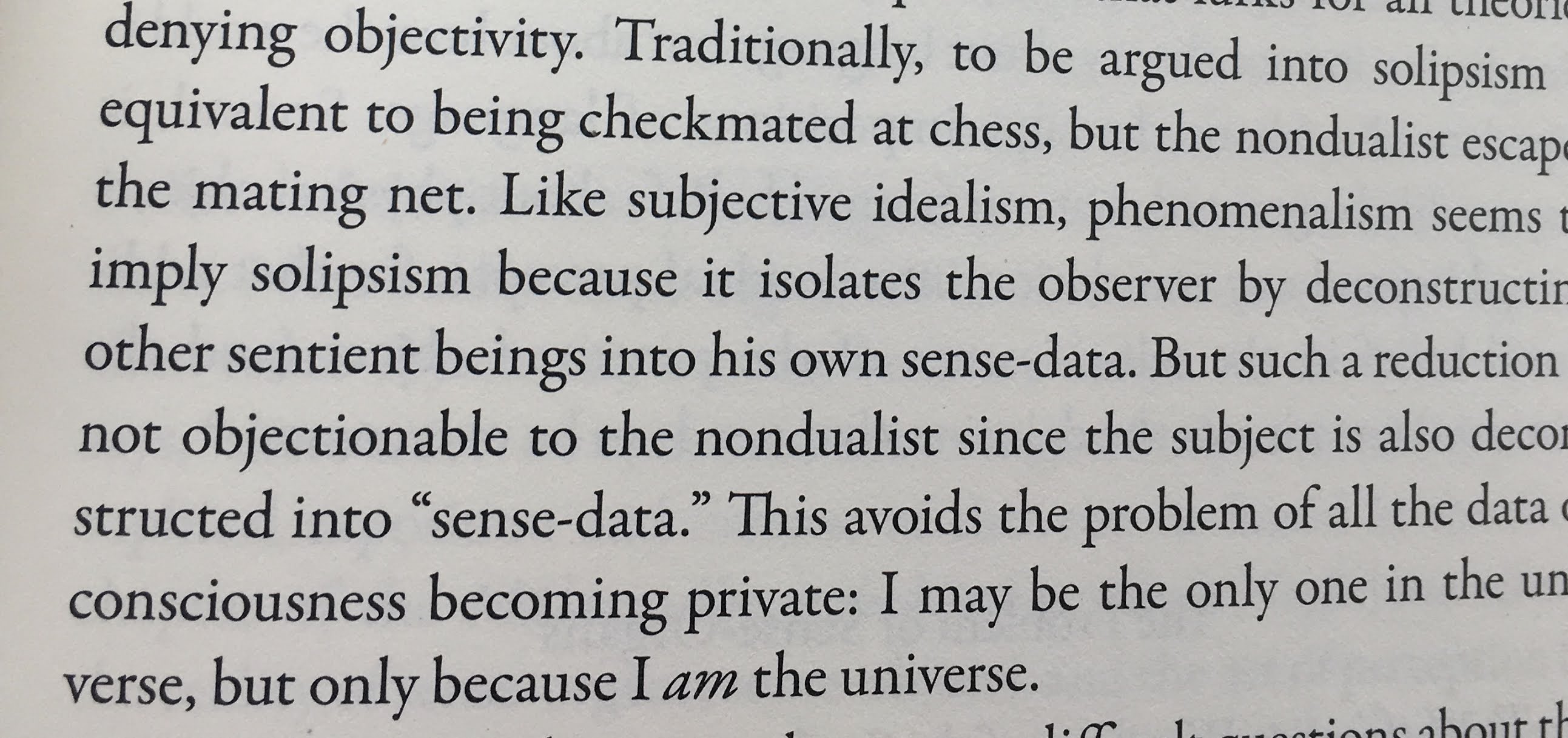
Look at the cool new book!
Friday, June 11, 2021

KWL: Nonduality

 P. 40: “…sense perception has really always been nondual.”

It's what we add to perception that both expresses our commitments and desire, and separates us from the universal consciousness.

Bahiya got enlightened with the idea "...in the seen only the seen..." from the Buddha. 


Which brings me to the idea of universal consciousness, something I've become interested in reading this book. This article in Popular Mechanics says, "Kleiner and Tull are following Penrose’s example, in both his 1989 book and a 2014 paper where he detailed his belief that our brains’ microprocesses can be used to model things about the whole universe. The resulting theory is called integrated information theory (IIT), and it’s an abstract, “highly mathematical” form of the philosophy we’ve been reviewing."

"In IIT, consciousness is everywhere, but it accumulates in places where it’s needed to help glue together different related systems. This means the human body is jam-packed with a ton of systems that must interrelate, so there’s a lot of consciousness (or phi, as the quantity is known in IIT) that can be calculated. Think about all the parts of the brain that work together to, for example, form a picture and sense memory of an apple in your mind’s eye."


Unrelated but maybe related is the idea of dogecoin. Could you accumulate wealth and then pay for the meme kindness to flood the memeosphere, and would that actually change anything in the world (besides wherever dogecoin resides).


P83


Thursday, June 10, 2021

KWL: Nonduality

So what do you do when you don't completely understand a book. You can linger, reread, and really struggle. Or you can just cut your losses, and move onto something else that is more meaningful. 

I like to struggle to acquire meaning. But I also like to drop a difficult book because I have about 30 minutes for struggle, and then I like something smooth, easy to digest. Too many rich foods give you gout, indigestion. 

Loy seems to be asking a question, or I'm getting a question reading the book: Do you need to avoid sense perception or can you just try not to seek or attach to it? There seem to be shifting answers in various parts of the tradition.

I think it's impossible not to be human and humans seek out what they don't have. It's why we go to the Moon and Mars, it's why we hate the rich, and why even though being alone is better, we seek out partners. The desire for justice might be a sisyphean journey. The desire for a sane stable government might be a fight between two personality type projections vision of that government. The X in the sentence "I would just be happy if x were present," is an ever shifting target just beyond our reach. 

I don't like the asceticism of the Theravadan tradition banning music, dancing and general merriment. I like ecstatic dance. I like to listen to music. I like to taste rich foods. Their idea is to act enlightened, you might move towards it. But I think appreciation for the beautiful is what attracts us to the spiritual life, so that we can't ban the arts. I would be constantly writing poems, and creating sculptures, and wanting to read scripture, if I were meditating in the forest. To ban books and writing on a solitary retreat might be torture for me. You can restrict yourself in so many ways: sleep, food, socializing, art, entertainment, comfort, modern amenities, and on and on, but even if you're just trying to live your life, there's always a feeling of deprivation, because we always want what is just beyond our reach, and we like to work towards putting things within our reach.

The path is simple. The path is hard and subtle. Both statements are true.